Lombok Notebook: What NTB’s Solar Conversion Plan Signals for Investors
NTB’s plan to convert six small coal plants to solar facilities offers a useful signal on Lombok’s sustainability direction, while key delivery questions remain open.
Quick answer: NTB’s proposed conversion of six small coal-fired plants into solar facilities is an early strategic signal for Lombok investors: the province is aligning energy policy with a greener tourism and investment proposition, but technical assessments, land access, investor participation and an implementation timetable all remain unresolved.
The most useful way to read a provincial energy announcement is neither as a completed infrastructure project nor as a footnote. It is a statement of direction, carrying implications for the kinds of capital a place hopes to attract and the practical constraints it must still overcome.
The Context
West Nusa Tenggara, known as NTB, plans to convert six small coal-fired power plants into solar facilities, according to the provincial government. The proposal spans Lombok and Sumbawa, placing it within a wider provincial transition rather than presenting it as a Lombok-only initiative.
Samsudin, head of NTB’s Energy and Mineral Resources Office, said state utility PLN presented the conversion plan in a meeting with Governor Lalu Muhamad Iqbal. The named facilities include Paokmotong, Ampenan, Baok Botok, Bima and Dompu. The initiative is directed at small-scale plants and explicitly excludes larger facilities, including the Jeranjang power plant in West Lombok.
That distinction matters. A plan focused on smaller generation assets should not be mistaken for a wholesale replacement of NTB’s existing power system. Nor has the government announced a timetable. Every conversion plan remains under technical assessment, Samsudin said.
For investors, this is therefore best understood as a policy and project-development signal. It suggests a willingness to move individual assets away from coal where the technical case can be made, while preserving a more cautious stance on the broader generation base. The gap between intent and delivery will be defined by engineering, land, financing and coordination, not simply by a stated preference for renewables.
“All conversion plans are currently undergoing technical assessments,” Samsudin said, with no implementation timetable yet set.
The announcement also sits beside PLN’s identification of 1.73 gigawatts of renewable-energy potential in NTB, mainly from solar and wind. Samsudin said that estimate could rise as work to replace coal-fired generation with solar progresses, based on PLN’s assessment. It is potential, not commissioned capacity, and investors should preserve that distinction.
From Green Positioning to Project Reality
NTB’s stated rationale extends beyond electricity generation. Samsudin framed cleaner energy as important to strengthening the province’s position as a sustainable, green tourism destination. That makes commercial sense as a positioning ambition: tourism, hospitality, real estate and infrastructure increasingly share an interest in how a destination describes its resource base and future development model.
Yet a credible sustainability proposition is built through operating realities rather than branding alone. The source identifies land availability as the principal challenge to renewable-energy development. This is the central practical constraint in the plan, and it deserves more attention than the headline appeal of solar conversion.
The province, PLN and district administrations intend to conduct field visits to map potential sites and assess available land. Officials will work with district heads to identify suitable parcels while preparing what Samsudin described as a fair acquisition mechanism, intended both to protect communities and facilitate investment.
That sequence is important. It implies that site selection and land arrangements are not administrative afterthoughts; they are core project risks still being worked through. A solar project requires more than a favourable renewable-energy narrative. It needs land that is suitable, available and acquired through an arrangement that can withstand scrutiny from communities, developers, financiers and public authorities.
The announced approach contains several linked stages:
- technical assessment of the proposed coal-to-solar conversions;
- field mapping of potential project sites;
- assessment of available land;
- engagement with district administrations and district heads; and
- development of a fair land-acquisition mechanism.
None of those stages guarantees construction. Together, however, they offer a more substantive framework than a purely aspirational target would. The province is acknowledging the work required to turn renewable potential into investable projects.
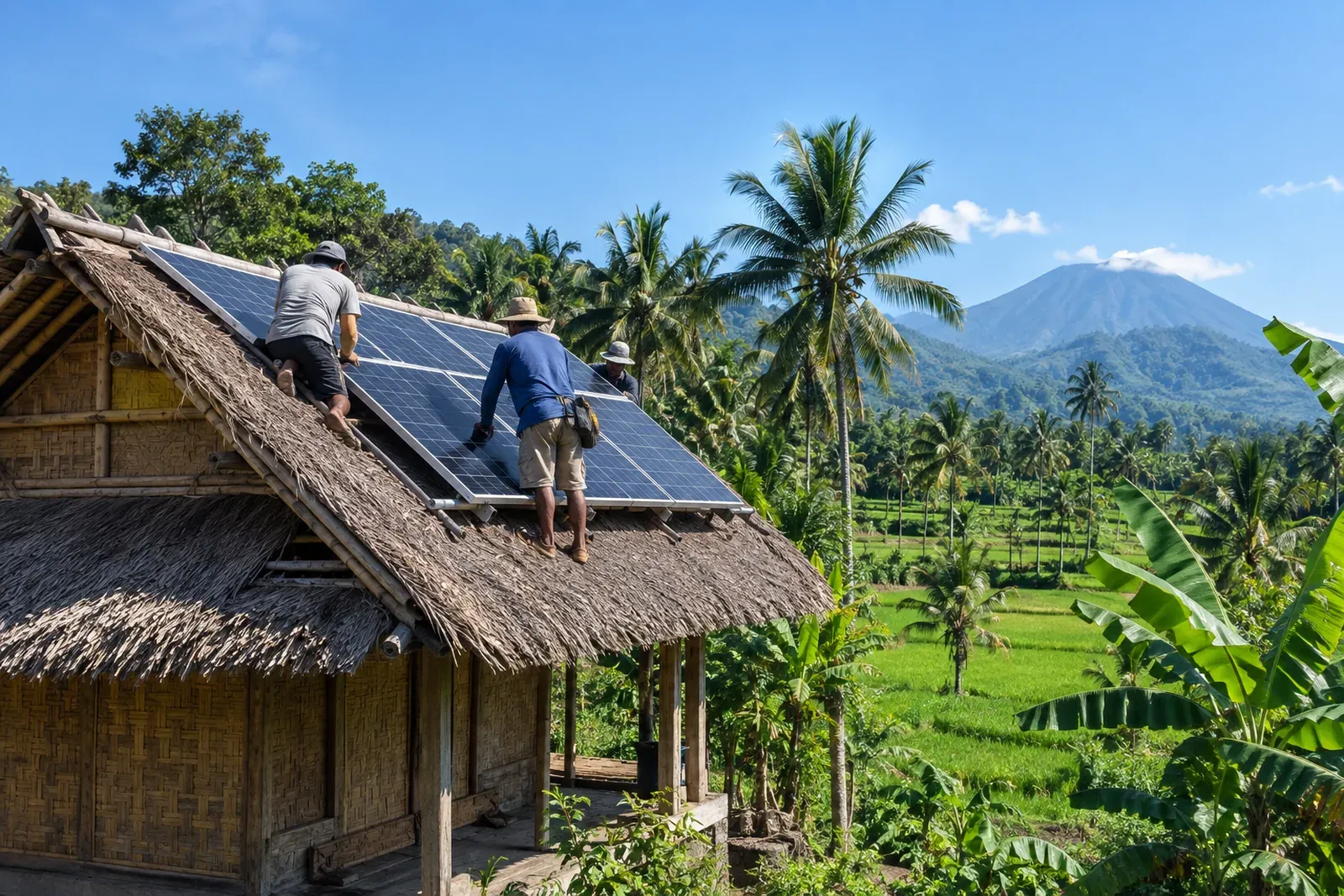
 Lombok Notebook · Illustration: HubLombok (AI-generated)
The Capital Question Behind the Plan
The transition will also depend on who finances and develops it. NTB is encouraging PLN and investors to pursue solar, wind and geothermal projects through the Independent Power Producer, or IPP, scheme. Samsudin said PLN will need to work with investors because the utility cannot carry out the projects alone.
This is perhaps the clearest investment message in the announcement. The provincial government is not depicting the energy shift as a public-sector exercise with private capital added at the margin. It is presenting private participation as necessary to advancing the project pipeline.
For prospective investors, that does not create a simple invitation to deploy capital. An IPP framework still leaves essential questions for project sponsors and their advisers: which sites ultimately emerge from mapping, which conversion projects pass assessment, how land access is structured, and when PLN’s plans translate into specific procurement or development opportunities. The source does not answer those questions, so they should not be filled with assumptions.
What it does establish is a hierarchy of present evidence. The conversion proposal has been presented to provincial leadership. Renewable potential has been identified. Officials plan field work and land mapping. Private investment is being sought through the IPP scheme. By contrast, a timetable has not been set, technical assessments are ongoing, and the project-level land position remains a challenge.
| What is established | What remains open | |---|---| | A plan to convert six small coal plants to solar facilities | The timetable for implementation | | 1.73 gigawatts of identified renewable-energy potential | Results of technical assessments | | Interest in solar, wind and geothermal IPP projects | Suitable land and acquisition arrangements | | Coordination between province, PLN and district administrations | Which projects progress to delivery |
For the wider Lombok investment conversation, this should encourage disciplined attention to infrastructure rather than premature conclusions. Energy policy can influence a destination’s long-term proposition, especially where tourism is part of the economic narrative. But the investable significance lies in execution: viable sites, clear land arrangements, capable counterparties and projects that move from assessment into delivery.
What This Means for Investors
The immediate takeaway is nuanced. Investors with exposure to Lombok’s visitor economy, property, services or infrastructure can treat the plan as evidence that NTB wants cleaner energy to support its green-tourism positioning. It may be relevant to diligence on how the province is thinking about future development. It is not, on the available information, evidence that a transformed power system is imminent.
A sensible investor reading should separate three questions.
First, what is the strategic direction? NTB is signalling a move from small coal-fired generation towards solar facilities and is encouraging renewable development across solar, wind and geothermal.
Second, what is technically and commercially actionable today? The source confirms ongoing assessments and an intended mapping process, but it does not identify a delivery timetable or finalised sites.
Third, where is the principal friction? Land availability is explicitly identified as the main challenge. The provincial response, field visits, district coordination and a fair acquisition mechanism, recognises that community protection and project facilitation must advance together.
For capital considering direct participation, the IPP route is the relevant framework named by the provincial government. For investors whose interest is indirect, the more useful exercise is to monitor whether the announced process produces concrete milestones: completed assessments, identified sites, transparent land arrangements and clearly structured opportunities with PLN and other relevant authorities.
This is the kind of development that rewards patience. NTB’s solar-conversion proposal is meaningful because it joins energy policy, private capital and destination positioning in one provincial agenda. Its value to investors will be determined not by the aspiration alone, but by whether the difficult middle of the process, technical work, land and implementation, turns that agenda into operating assets.
Stay informed, subscribe to the free Lombok Briefing for market intelligence like this, published twice a month.
What is NTB planning to do with its small coal-fired power plants?
NTB plans to convert six small coal-fired power plants into solar facilities across Lombok and Sumbawa. The provincial government says the proposals remain under technical assessment, and no timetable for implementation has been set.
What renewable-energy potential has PLN identified in NTB?
PLN has identified **1.73 gigawatts** of renewable-energy potential in NTB, mainly from solar and wind power, according to Samsudin of the provincial Energy and Mineral Resources Office. This is identified potential, not confirmed operating capacity.
What is the main obstacle to renewable-energy projects in NTB?
Land availability is the main challenge identified by NTB’s Energy and Mineral Resources Office. The province, PLN and district administrations plan field visits to map sites, assess available land and prepare a fair acquisition mechanism intended to protect communities and facilitate investment.

The Lombok Buyer's Field Guide
Legal structures ranked by risk, the honest ROI math line by line, all six zones ranked, and the 24-point due-diligence checklist. The whole book, free in your inbox.
See what's inside