Indonesia Pushes EAEU States to Ratify Trade Deal After Jakarta Approval
President Prabowo has urged EAEU members to complete ratification of the Indonesia-EAEU FTA, moving the agreement closer to use.
Quick answer: President Prabowo Subianto has urged Eurasian Economic Union members to complete ratification of their free-trade agreement with Indonesia. Jakarta has completed its own approval process, but the agreement cannot be used until notifications are exchanged, making this a live policy development for investors tracking Indonesia’s trade access, capital links and broader economic positioning.
Indonesia’s trade diplomacy has acquired a sharper operational edge. Speaking at the Eastern Economic Forum in Vladivostok, Russia, President Prabowo pressed the Eurasian Economic Union’s members to finish their internal procedures for the Indonesia-EAEU Free Trade Agreement signed in December 2025.
The request matters because the agreement is no longer merely an announced ambition. Indonesia has completed parliamentary approval and, according to the President, he signed the presidential regulation of ratification in July. The remaining hurdle is reciprocal completion and the exchange of notifications that would allow the arrangement to enter into force.
The Context
The EAEU side comprises Armenia, Belarus, Kazakhstan, Kyrgyzstan, Russia and the Eurasian Economic Commission. At the forum, Prabowo framed the proposed agreement as a south-south trade architecture: a route to five markets for Indonesian producers, while offering Eurasian producers access to Indonesia’s consumer market of more than 290 million people.
The commercial scope presented by the President is substantial. Indonesia and the EAEU have committed to eliminate or reduce duties on 11,882 tariff lines, representing more than 90% of goods traded between the two sides. That is a statement of intended coverage, rather than evidence that the benefits are already available to exporters, importers or investors.
“Indonesia wants the agreement in force and in use as soon as the exchange of notifications allows,” Prabowo said, according to Antara Business.
For investors, the distinction between signature, domestic ratification and entry into force is central. An agreement can signal policy direction well before it changes the conditions under which goods move. In this case, Indonesia says it has cleared its own parliamentary and presidential steps; the timing now depends on the EAEU members completing theirs.
This is therefore a development to monitor as a sequence, not as a finished outcome. The live question is whether the other parties translate political encouragement into completed domestic procedures, enabling the notification exchange sought by Jakarta.
From Diplomatic Statement to Commercial Use
Prabowo’s remarks suggested that some practical preparation has already begun. Indonesian business delegations in Vladivostok had, he said, concluded pilot shipments, identified buyers, secured logistics, and settled compliance and payment arrangements intended to make use of the FTA.
Those activities are important because trade agreements are implemented through commercial systems as much as through tariff schedules. Buyers, logistics providers, compliance processes and payment arrangements all sit between a diplomatic announcement and a transaction. Yet the source does not identify the products, businesses, shipment scale or timetable involved. Investors should avoid treating the pilot activity as proof of broad-based trade flows or immediate revenue.
The agreement’s potential logic is clearer than its near-term economic effect. A lower-duty framework across a large share of traded goods could widen the set of viable exchanges between Indonesia and the EAEU. But which sectors benefit, how quickly businesses use the provisions, and how costs or regulatory requirements evolve are not established by the announcement.
A disciplined reading separates the known milestones from the open questions:
| Known from the dispatch | Still dependent on implementation | |---|---| | Indonesia completed parliamentary approval | EAEU members’ internal ratification procedures | | The President signed Indonesia’s ratification regulation in July | Exchange of notifications | | The parties committed to duty action across 11,882 tariff lines | The agreement entering into force and being used | | Delegations reported pilot-shipment preparations | Scale and durability of commercial activity |
The policy signal is nonetheless notable. Indonesia is making the case for trade optionality while presenting itself as a market of scale. For international investors, including those who view Indonesia through tourism, property or consumer-demand lenses, trade policy can shape the broader investment environment without creating an immediate, localised investment case.
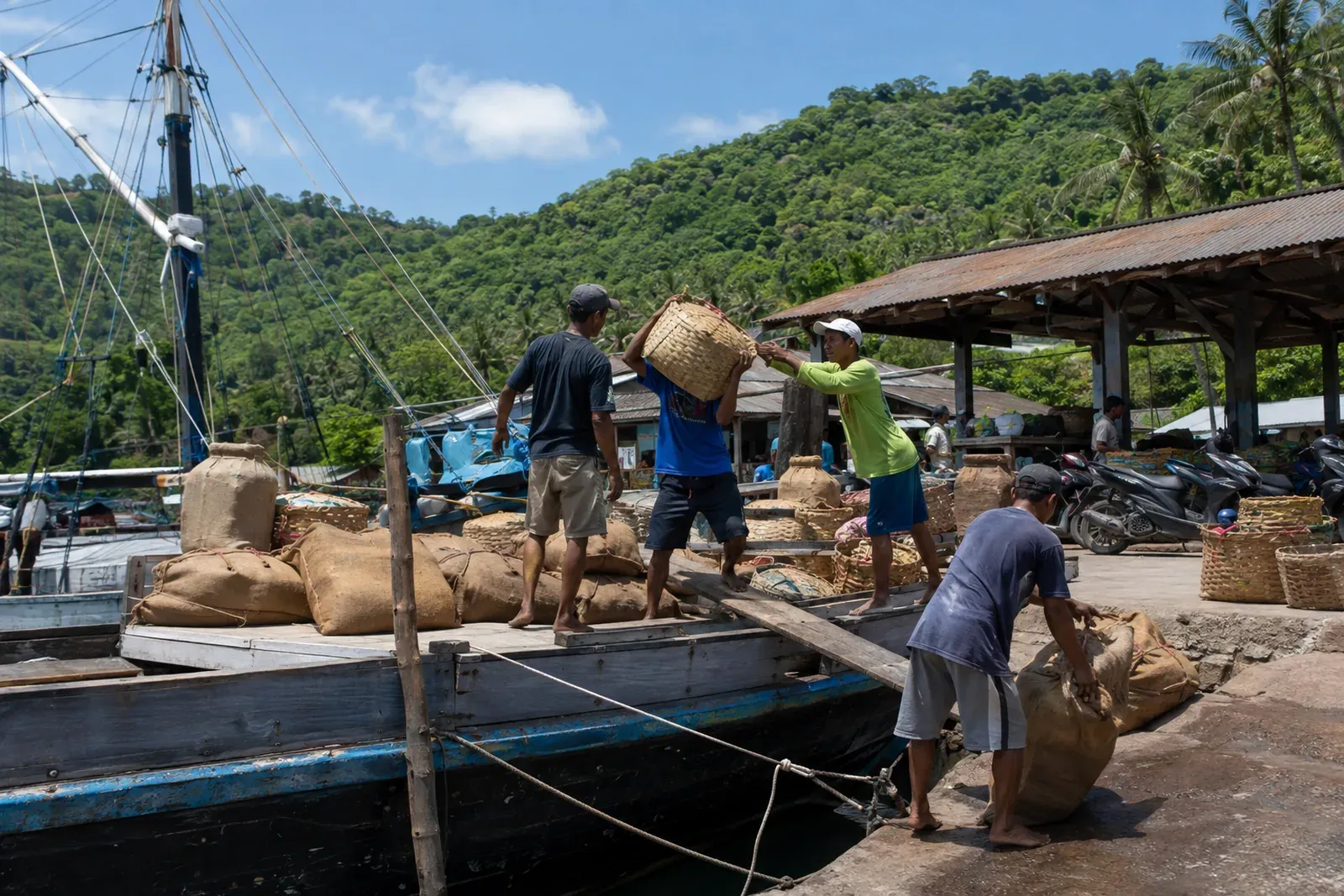
 Indonesia Pushes EAEU States to Ratify Trade Deal After Jakarta Approval · Illustration: HubLombok (AI-generated)
Capital-Market Conversation Runs Alongside Trade
At the same forum, Prabowo called for greater co-operation between Danantara Indonesia and the Russian Direct Investment Fund, known as RDIF. He described Danantara Indonesia as having US$1 trillion in assets under management and proposed that it could act as a bridge between Russian and Indonesian capital markets and strategic goals.
This part of the address broadens the dispatch beyond customs duties. It places trade access and capital-market links in the same diplomatic conversation. That does not mean a project, investment programme or transaction has been announced. The source records a call to optimise the partnership, not a disclosed commitment to fund a particular asset, sector or region.
That caution is especially relevant for investors tempted to draw a straight line from high-level diplomacy to individual opportunities. The available evidence supports a narrower conclusion: Indonesia is seeking to deepen economic engagement with EAEU-linked markets through a trade agreement and discussions between sovereign investment institutions.
The President’s approach also presents Indonesia as an active participant rather than a passive recipient of foreign demand or capital. He urged the other parties to proceed, emphasised domestic readiness, and pointed to business-level preparations. Such signals may matter for sentiment and strategic assessment, but they should not replace deal-specific due diligence.
For a Lombok-focused audience, the connection is macroeconomic rather than property-specific. Nothing in the source identifies Lombok, tourism infrastructure, land, hospitality assets or real-estate development as a direct beneficiary. The relevant implication is that investors assessing Indonesian exposure may need to watch how the country’s external trade and investment relationships develop alongside domestic market conditions.
What This Means for Investors
The immediate investment implication is one of watchfulness, not repricing. Indonesia has taken a meaningful domestic step towards implementing the FTA, but it has not said that the agreement is already in force. Investors should distinguish between a ratification announcement and an operational trade regime.
Three practical points follow.
-
Track the remaining ratifications. The President explicitly called on every EAEU member state to complete its internal procedures. Until that occurs and notifications are exchanged, the agreement’s promised treatment of tariff lines remains prospective.
-
Treat pilot shipments as preparation, not proof. The reported work on buyers, logistics, compliance and payments indicates commercial intent. The source does not provide enough detail to judge the value, frequency or sectoral reach of those shipments.
-
Keep the macro and asset-level cases separate. The speech may strengthen Indonesia’s narrative of economic engagement and market access. It does not, by itself, establish a valuation, yield outlook or investment recommendation for Lombok property or any other individual asset class.
The balance of evidence is constructive but incomplete. Indonesia’s own ratification is done, and the President has publicly pressed for the next steps. The scale of the proposed tariff coverage gives the agreement strategic weight; the absence of a confirmed entry-into-force notice keeps it in the implementation phase.
For European, Australian and American investors, that is the appropriate lens for this Daily Dispatch. Monitor the notification process, seek confirmation of operational commencement before modelling trade-related effects, and demand asset-level evidence before attaching a trade-policy narrative to a specific investment decision.
The urgent news is not that a new trade regime has already transformed Indonesia’s commercial landscape. It is that Jakarta says it is ready, has asked its counterparties to match that readiness, and is pairing the request with a wider conversation on capital-market connection. The next official confirmation, not the forum rhetoric alone, will determine when the agreement becomes usable.
Stay informed, subscribe to the free Lombok Briefing for market intelligence like this, published twice a month.
Has the Indonesia-EAEU free-trade agreement entered into force?
No confirmation of entry into force appears in the source. Indonesia has completed parliamentary approval and President Prabowo says he signed the ratification regulation in July, but EAEU members must complete internal procedures and notifications must be exchanged before the agreement can be used.
Which markets are involved in the Indonesia-EAEU FTA?
The EAEU members named in the source are Armenia, Belarus, Kazakhstan, Kyrgyzstan and Russia, alongside the Eurasian Economic Commission. President Prabowo described the agreement as opening five markets to Indonesian producers while giving Eurasian producers access to Indonesia’s consumer market.
What tariff coverage does the proposed FTA have?
According to President Prabowo’s remarks reported by Antara Business, Indonesia and the EAEU are committed to eliminate or reduce duties on 11,882 tariff lines. He said this represents more than 90% of goods traded between the two sides, subject to implementation.

The Lombok Buyer's Field Guide
Legal structures ranked by risk, the honest ROI math line by line, all six zones ranked, and the 24-point due-diligence checklist. The whole book, free in your inbox.
See what's inside