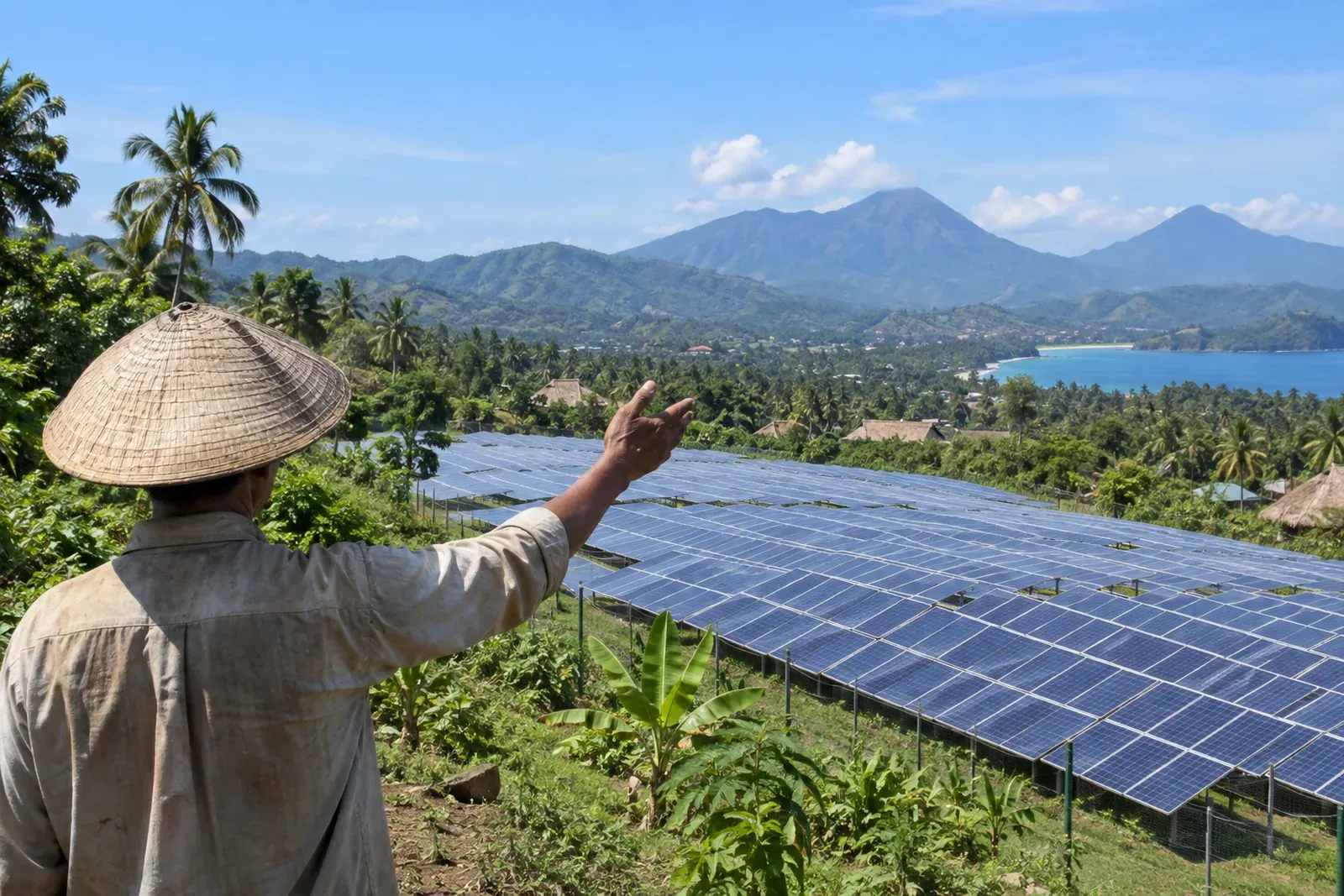
Indonesia Positions Green Investment at the Centre of Economic Strategy
Indonesia is advancing green investment policies, financing mechanisms and ESG frameworks to support growth and energy transition.
Indonesia is placing green investment more firmly at the heart of its economic strategy, linking environmental policy with international market access, industrial competitiveness and longer-term growth. For global investors assessing Indonesia, the direction of travel is increasingly clear: capital allocation and ESG considerations are becoming more closely connected.
At the BIG Strategic Forum 2026 in Jakarta, Dendy Apriandi, Director of Investment Deregulation at the Ministry of Investment and Downstream Industry/Indonesia Investment Coordinating Board (BKPM), said the country had begun pursuing an investment strategy focused on green industries. The stated aim is to support both economic growth and the energy transition.
Green credentials and export access
Apriandi said green-energy use is becoming an increasingly important consideration when Indonesian products seek access to overseas markets, particularly in Europe. That matters because the investment case for cleaner infrastructure and industrial processes is no longer presented solely as an environmental proposition; it is also being framed as a commercial requirement for companies serving international customers.
Green energy use is increasingly relevant to Indonesian products seeking overseas market access, particularly in Europe, according to BKPM.
For European investors in particular, this positioning is notable. ESG expectations are now part of the practical conversation around supply chains, financing and investment selection. Indonesia’s policy response, as described by BKPM, is intended to strengthen the country’s place in the global green economy while supporting domestic economic expansion.
The emphasis is broad rather than limited to one sector. Apriandi said Indonesia needs an ecosystem for green investment that includes:
- faster energy transition;
- a circular economy;
- green transportation; and
- adoption of green technologies.
The significance lies in the attempt to treat these areas as connected. Energy, transport, production systems and technology adoption can influence the attractiveness of investment projects across the economy. For foreign capital, the quality and consistency of that ecosystem will be as important as the stated policy ambition.
Financing mechanisms move into focus
The government is also developing innovative financing mechanisms aligned with ESG principles. According to Apriandi, these include green financing and carbon pricing.
BKPM says green financing and carbon pricing are among the mechanisms being developed to support Indonesia’s green-investment strategy.
Neither mechanism is a substitute for project fundamentals. Investors will still need to assess commercial structure, counterparties, operating risks and applicable regulation case by case. Yet the introduction of financing tools aligned with ESG principles signals that Indonesia is seeking to make environmental considerations more relevant to the way capital is mobilised.
Apriandi also said the government is strengthening fiscal and nonfiscal incentives and disincentives, with an emphasis on establishing fair mechanisms for implementation. The detail will matter greatly. Incentives can shape investor behaviour, but their value depends on clarity, consistency and effective administration.
For investors with a long horizon, the policy direction may be more relevant than any single announcement. A framework combining investment policy, green financing, carbon pricing and incentives suggests an attempt to align public policy with the funding needs of an energy-transition economy.
A national growth agenda
The green economy is one of five main economic strategies under Indonesia’s 2025-2029 National Medium-Term Development Plan, according to Apriandi. The plan targets 8 percent economic growth, with investment expected to play a key role in achieving the faster expansion required for that objective.
This puts green investment within a wider national economic agenda rather than treating it as a specialist policy area. The government’s argument is that investment can drive growth, while ESG-aware policy can help Indonesia remain competitive as international markets place greater attention on environmental standards.
There is an important distinction here for investors. A national target describes policy ambition, not a guaranteed outcome. The investable question is how that ambition translates into real projects, regulatory execution and credible financing structures. Investors should therefore distinguish between official strategy and asset-level evidence.
What this means for investors
Indonesia’s green-investment agenda creates a framework worth monitoring for investors considering exposure to the country’s economy, infrastructure, industry or property market. The immediate implications are less about a single investment call and more about the questions that prudent capital should now ask.
- ESG may become more commercially material. BKPM explicitly links green-energy use with access to overseas markets, particularly Europe. Investors should examine how environmental requirements affect the revenues, costs and strategic positioning of an underlying business or project.
- Policy implementation will determine value. Green financing, carbon pricing and incentives may influence project economics, but investors should review the legal and commercial details before relying on them.
- Long-term themes need local diligence. The government’s focus on the energy transition, circular economy, green transportation and green technologies may create opportunities, but each opportunity requires its own assessment of execution and risk.
- Indonesia’s growth strategy is investment-led. With investment identified as a key driver of the government’s growth objective, international capital is likely to remain central to the national economic conversation.
For those interested in Lombok, the broader policy backdrop is relevant even where an investment is not directly classified as green. International investors increasingly evaluate how destinations, infrastructure and operators respond to ESG expectations. That does not replace conventional due diligence on title, planning, construction, management and demand; it adds another layer to the assessment.
Indonesia’s green-investment push should therefore be read as a strategic direction, not a shortcut to returns. The strongest opportunities will be those where policy alignment is matched by transparent documentation, sound project economics and disciplined execution.
Stay informed, subscribe to the free Lombok Briefing for analysis like this, published twice a month.
What is Indonesia’s new green-investment strategy focused on?
Indonesia is pursuing an investment strategy focused on green industries to support economic growth and the energy transition. BKPM says the supporting ecosystem should include faster energy transition, a circular economy, green transportation and adoption of green technologies.
Why does green energy matter for Indonesian investment?
According to BKPM, green-energy use is increasingly an important consideration when Indonesian products seek access to overseas markets, particularly in Europe. The government is therefore seeking to incorporate ESG considerations into investment policy and strengthen Indonesia’s position in the global green economy.
What green-finance tools is Indonesia developing?
BKPM says the government is developing ESG-aligned mechanisms including green financing and carbon pricing. It is also strengthening fiscal and nonfiscal incentives and disincentives, while seeking fair mechanisms for their implementation.

The Lombok Buyer's Field Guide
Legal structures ranked by risk, the honest ROI math line by line, all six zones ranked, and the 24-point due-diligence checklist. The whole book, free in your inbox.
See what's inside