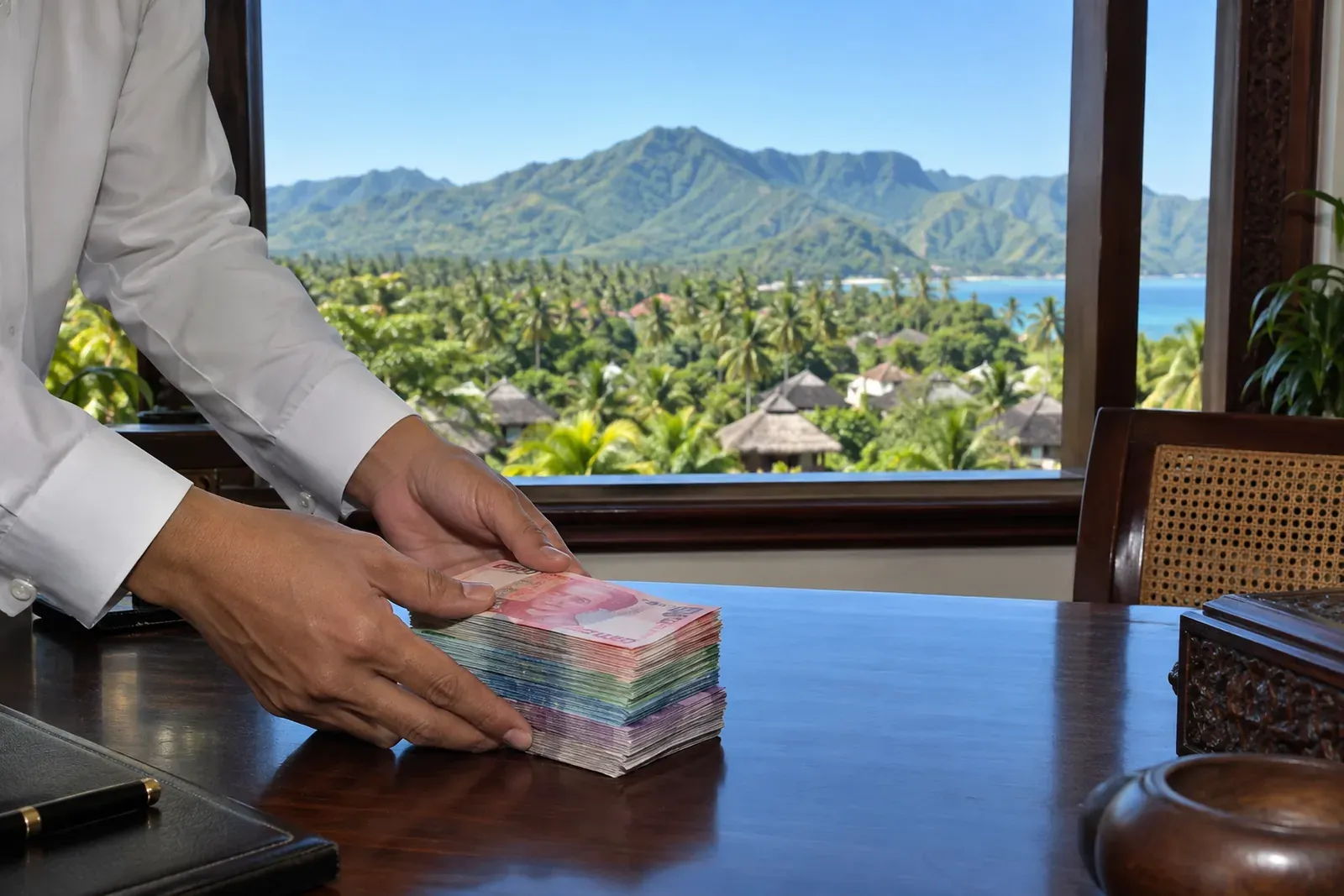
Lombok Notebook: Why Indonesia’s Finance Ministry Change Matters to Investors
Indonesia’s new finance minister inherits a pivotal budget moment. For Lombok investors, the signal is continuity, but fiscal credibility warrants close attention.
Quick answer: Indonesia’s appointment of Suahasil Nazara as finance minister matters to Lombok investors because fiscal policy, budget credibility and clear communication shape the national setting in which foreign property demand and tourism-led investment operate. His stated commitment to continuity offers reassurance, while tighter fiscal space remains an important risk to monitor.
For an investor looking at South Lombok, a cabinet reshuffle in Jakarta can appear remote from a villa site, a leasehold agreement or a coastal plot. Yet the relationship is more direct than it first seems: property investment is ultimately priced not only through local supply and visitor appeal, but also through confidence in the country’s fiscal management.
The replacement of Finance Minister Purbaya Yudhi Sadewa by Deputy Finance Minister Suahasil Nazara is therefore best read less as a standalone political drama than as a test of institutional continuity. The immediate question for internationally minded investors is whether Indonesia can sustain confidence while pursuing its national priorities within constrained fiscal room.
The Context
President Prabowo Subianto removed Purbaya on Monday and appointed Suahasil, previously deputy finance minister, as his replacement. The change arrived after the government presented its 2027 state budget bill in August and shortly before lawmakers were expected to pass it into law.
It is also Prabowo’s second finance-minister change since taking office in October 2024. Purbaya had been appointed in September 2025, following the resignation of Sri Mulyani Indrawati after unrest and protests. Such turnover naturally attracts investor attention because a finance minister is one of the principal custodians of a government’s fiscal narrative: how it funds priorities, manages deficits and communicates difficult trade-offs.
Purbaya’s tenure was marked by economic shocks, including a sharp fall in the rupiah and a widening fiscal deficit, according to the Jakarta Post Business report. His early move to inject liquidity from the budget surplus balance, known as SAL, into state-owned banks drew criticism from lawmakers and created friction with Bank Indonesia.
The most recent disagreement concerned Purbaya’s push for state asset fund Danantara to transfer Rp 120 trillion in state-owned-enterprise dividends to the budget as a fiscal buffer. He argued that the transfer should proceed under Prabowo’s instructions, despite objections from the fund.
For portfolio investors, this is a familiar emerging-market question. The issue is not merely whether a government has ambitious programmes; it is whether the financing of those programmes is credible, comprehensible and institutionally disciplined. For direct investors in Indonesian real estate, the same question matters through a longer chain: national confidence affects currency perceptions, funding conditions, policy certainty and the willingness of overseas buyers to commit capital.
“The state budget must be able to carry out the government's priority programs. Therefore, the budget must be healthy, must be credible, […] must be reliable.”
, Suahasil Nazara, after his inauguration
A Familiar Hand at a Delicate Budget Moment
Suahasil brings unusually deep experience of the finance ministry’s machinery. He joined its advisory team in 2009, led the Fiscal Policy Agency from 2015 and became deputy minister in 2019. That background does not remove the challenges facing the ministry, but it gives the transition a clear element of institutional familiarity.
His initial public position was deliberately steady. Suahasil pledged to preserve a “healthy and credible” budget, described the transition as “business as usual”, and said fiscal policy would retain continuity. He also emphasised improving spending quality and ensuring that expenditure produces outcomes aligned with national priorities.
The numerical constraint is explicit. Suahasil said the fiscal deficit would remain below the legal cap of 3 percent. The government projected a deficit of 2.85 percent of GDP by the end of this year, equivalent to Rp 734.3 trillion. These figures are not simply accounting details. They establish the boundary within which the government must reconcile priority spending, revenue needs and fiscal resilience.
For investors, the encouraging feature is not an assertion that all uncertainty has vanished. It is that the incoming minister has framed his remit in terms markets recognise: credibility, reliability, clear communication and continuity. Those are unglamorous words, but they matter more than theatrical promises when capital is considering a long-lived asset.
The less comfortable point is that credibility must be demonstrated through decisions, not simply declared after an inauguration. The final shaping of the 2027 budget is Suahasil’s immediate task. He said the remaining weeks of September would be used to organise the government priority programmes that would receive funding.
That makes the period ahead consequential. Investors should watch how priorities are funded, how fiscal constraints are explained and whether the ministry’s communication remains coherent across the government. The Jakarta Post Business report presents an administration balancing ambitious growth plans against tighter fiscal space; the new minister’s principal job is to make that balance believable.
 Lombok Notebook · Illustration: HubLombok (AI-generated)
From Jakarta’s Budget to Lombok’s Investment Case
Lombok’s property story has its own local drivers. South Lombok has experienced foreign-arrivals momentum of 40-50% year on year, linked in the verified market data to tourism recovery and the MotoGP effect. Kuta and Mandalika villa rates are about 38% year on year higher, while Are Guling’s recorded momentum is about 47% year on year.
Those figures give the island’s investment proposition texture, but they do not operate in a vacuum. A buyer comparing an Indonesian property opportunity with one elsewhere will also assess the national backdrop: fiscal governance, currency risk, the clarity of state policy and the reliability of the rules under which an investment is held and operated.
This is especially important because Lombok is often assessed through a relative-value lens. Turnkey investment-grade villas have an entry range of EUR 95,000-350,000, compared with USD 400,000-800,000 for comparable specification in Bali. Prime tourist-zone land is about Rp 150-400 million per are, with an are equal to 100 m². In this setting, the argument is not simply that Lombok is less expensive; it is that relative affordability must sit alongside a credible national operating environment.
A disciplined buyer should keep three distinctions in view:
- Local demand indicators are not substitutes for national fiscal credibility. Stronger arrivals or villa rates may support a local thesis, but they do not eliminate macroeconomic risk.
- Gross-return marketing is not the same as investable income. Developer-quoted gross yields can be 12-22%, while honest net rental yields after management fees and realistic occupancy are 7-12%; top-performing assets can reach about 15% net.
- Property economics and legal ownership deserve separate scrutiny. Foreigners cannot hold freehold, or Hak Milik. Available routes include leasehold, Hak Pakai and a foreign-owned PT PMA holding Hak Guna Bangunan.
That final distinction is particularly relevant in a period of heightened national-policy attention. An investor should not assume that a favourable macro narrative compensates for a weak transaction structure, or that a carefully drafted ownership structure neutralises country-level risk. Both layers need to stand on their own.
For legal due diligence, HubLombok’s advisory partner TerraNusa Advisory works across the process: checking SHM or HGB certificates, ownership history, zoning and encumbrances; supporting PT PMA setup; addressing BPHTB and PPh taxes; and handling deed and title transfer at BPN. Deeds are executed by a licensed PPAT notary, while an AJB is the deed of sale. Nominee arrangements, in which an Indonesian holds freehold on a foreign buyer’s behalf, are illegal and void in court.
The point is not that a finance-ministry transition changes these rules overnight. The source does not say that it does. Rather, the episode is a reminder that investment analysis should be layered: local asset quality, operating assumptions, legal structure and the wider policy environment all demand attention.
What This Means for Investors
The immediate read-through is measured rather than dramatic. Suahasil’s long tenure within the finance ministry and his stated commitment to continuity are meaningful signals for investors who value institutional experience during a budget transition. His pledge to keep the deficit below the legal cap reinforces the importance he places on fiscal discipline.
But a thoughtful Lombok investor should treat this as a monitoring item, not a reason to revise an investment thesis on its own. The source describes pressure on the government to balance growth plans with tighter fiscal space. That tension will be resolved through budget choices, implementation and communication over time, not through the symbolism of a single appointment.
A practical investor checklist would therefore include:
- Follow the final form and explanation of the 2027 state budget, particularly how priority programmes are funded within the deficit framework.
- Keep rental underwriting conservative: realistic stabilised occupancy in the first years is 55-70%, rather than assuming a mature-market outcome.
- Separate gross projections from net returns after management fees of 18-22% of gross rental revenue and OTA or booking commissions of 15-20%.
- Undertake full title, zoning, ownership-history and encumbrance checks before committing capital.
- Assess Lombok’s local advantages against national risks, rather than treating either as a complete investment case.
There is a mature way to read Indonesia’s latest reshuffle. It is neither an automatic warning signal nor an all-clear. The appointment places an experienced ministry insider in charge at a sensitive budget moment, with a public mandate to make fiscal policy credible and spending effective. For Lombok investors, that offers a useful basis for cautious confidence, provided confidence remains paired with rigorous underwriting and patient observation.
Stay informed, subscribe to the free Lombok Briefing for market intelligence like this, published twice a month.
Why does Indonesia’s finance minister matter to Lombok property investors?
The finance minister shapes fiscal policy, budget credibility and public communication around government spending. These national conditions influence the wider confidence environment in which overseas investors assess Indonesian assets, alongside Lombok’s local tourism, property and legal fundamentals.
What has Suahasil Nazara said about Indonesia’s fiscal position?
Suahasil Nazara pledged to maintain a healthy and credible state budget, preserve fiscal-policy continuity and keep the fiscal deficit below the legal cap of 3 percent. The government projected a deficit of 2.85 percent of GDP by the end of this year.
Should the cabinet change alter a Lombok investment decision now?
The appointment alone should not determine a Lombok investment decision. Investors should monitor the final 2027 budget and fiscal communication, while continuing to test local demand, realistic occupancy, net rental returns, legal ownership structure and full transaction due diligence.

The Lombok Buyer's Field Guide
Legal structures ranked by risk, the honest ROI math line by line, all six zones ranked, and the 24-point due-diligence checklist. The whole book, free in your inbox.
See what's inside