
Daily Dispatch: Destry Damayanti Puts Rupiah Stability at BI’s Centre
Incoming BI Governor Destry Damayanti has put rupiah and inflation stability at the centre of her mandate, sharpening the policy signal for investors.
Quick answer: Incoming Bank Indonesia Governor Destry Damayanti says rupiah stability and domestic inflation control will remain the central bank’s priority amid global uncertainty. For Lombok investors, the immediate message is continuity: currency conditions, inflation and fiscal-monetary coordination remain the national variables to watch before committing capital.
Jakarta’s central-bank transition has arrived with an unusually direct opening signal. Destry Damayanti, confirmed as incoming Governor of Bank Indonesia, has made stability the organising principle of her approach, placing the rupiah exchange rate and domestic inflation ahead of any temptation to present policy change as a spectacle.
For overseas buyers considering Indonesian assets, that restraint matters. A Lombok villa, land lease or operating business may be rooted in a particular coastline or tourism district, but its financing assumptions, imported costs and eventual repatriation of returns remain connected to the broader monetary setting in Jakarta.
The Context
According to Antara Business, Destry spoke at the House of Representatives building in Jakarta as global market uncertainty remained elevated. Her message was concise: stability is the priority, and it is the foundation on which sustainable, higher economic growth can be built.
The statement follows the DPR RI Plenary Meeting’s approval of a new Bank Indonesia leadership team for the 2026–2031 tenure:
- Destry Damayanti as Governor;
- Aida S. Budiman as Senior Deputy Governor; and
- Solikin M. Juhro as Deputy Governor.
The incoming board members are scheduled to take their official oaths at the Supreme Court on Wednesday, September 2. Antara reports that operational portfolios will then be assigned promptly, with the stated aim of a seamless transition.
“Stability is the priority,” Destry said, citing the continuing high level of global uncertainty.
The importance of the phrasing lies less in drama than in what it excludes. Destry did not present the incoming administration as a break with the policies of its predecessor. Instead, she said Bank Indonesia would retain successful existing policies while keeping its monetary strategy dynamic and adaptive as conditions evolve.
That is a consequential distinction for capital assessing Indonesia from abroad. Investors rarely need a central bank to promise a fixed outcome; they need a credible hierarchy of priorities. In this case, the stated hierarchy is clear: protect monetary stability first, then support the conditions for durable growth.
For a cross-border investor, the rupiah is not an abstract policy indicator. It shapes the translation between foreign capital and rupiah-denominated acquisition, construction, operating and tax costs. Inflation, meanwhile, affects the cost base beneath an investment’s headline return. Neither variable determines a property’s success alone, but both inform the quality of the underwriting.
A Stability-First Mandate
Destry’s emphasis on the exchange rate and inflation places two familiar investor concerns at the heart of the handover. The rupiah matters to foreign owners because entry capital may be held in another currency, while local revenues and many local expenses are denominated in rupiah. Domestic inflation matters because it can influence costs across the economy, including supplies and services associated with operating a real asset.
The practical reading should be measured. The source does not announce a new exchange-rate target, a change in interest rates, or a fresh package of monetary measures. It does, however, set out the incoming governor’s declared policy preference at a moment of leadership change: preserve stability while remaining responsive to changing conditions.
That is particularly relevant for investors tempted to reduce an Indonesian opportunity to a single headline yield. A property prospectus may be written in one currency, while land, labour, permits, maintenance and guest spending are experienced in another. Sensible analysis keeps those layers separate.
| Investor question | What the BI transition signals | | --- | --- | | Will monetary policy be abruptly reinvented? | Destry said successful policies would be maintained, while strategy remains adaptive. | | What is the stated priority? | Rupiah stability and domestic inflation control. | | What should overseas investors monitor? | Currency conditions, inflation and the execution of the incoming board’s stated approach. |
The message is therefore one of policy continuity with room for adjustment, rather than policy immobility. Investors should resist turning that into a prediction about future currency moves or borrowing costs. The useful conclusion is narrower: the incoming governor has explicitly identified the variables she considers essential to the country’s economic foundation.
That matters in Lombok because local opportunity is increasingly evaluated by investors with portfolios across Europe, Australia and the United States. Those investors may be attracted by tourism demand, a specific development’s design or an earlier-stage location, yet their investment committee will still ask the national questions: how stable is the operating environment, how are inflation pressures being addressed, and how coherent is the relationship between fiscal and monetary policy?
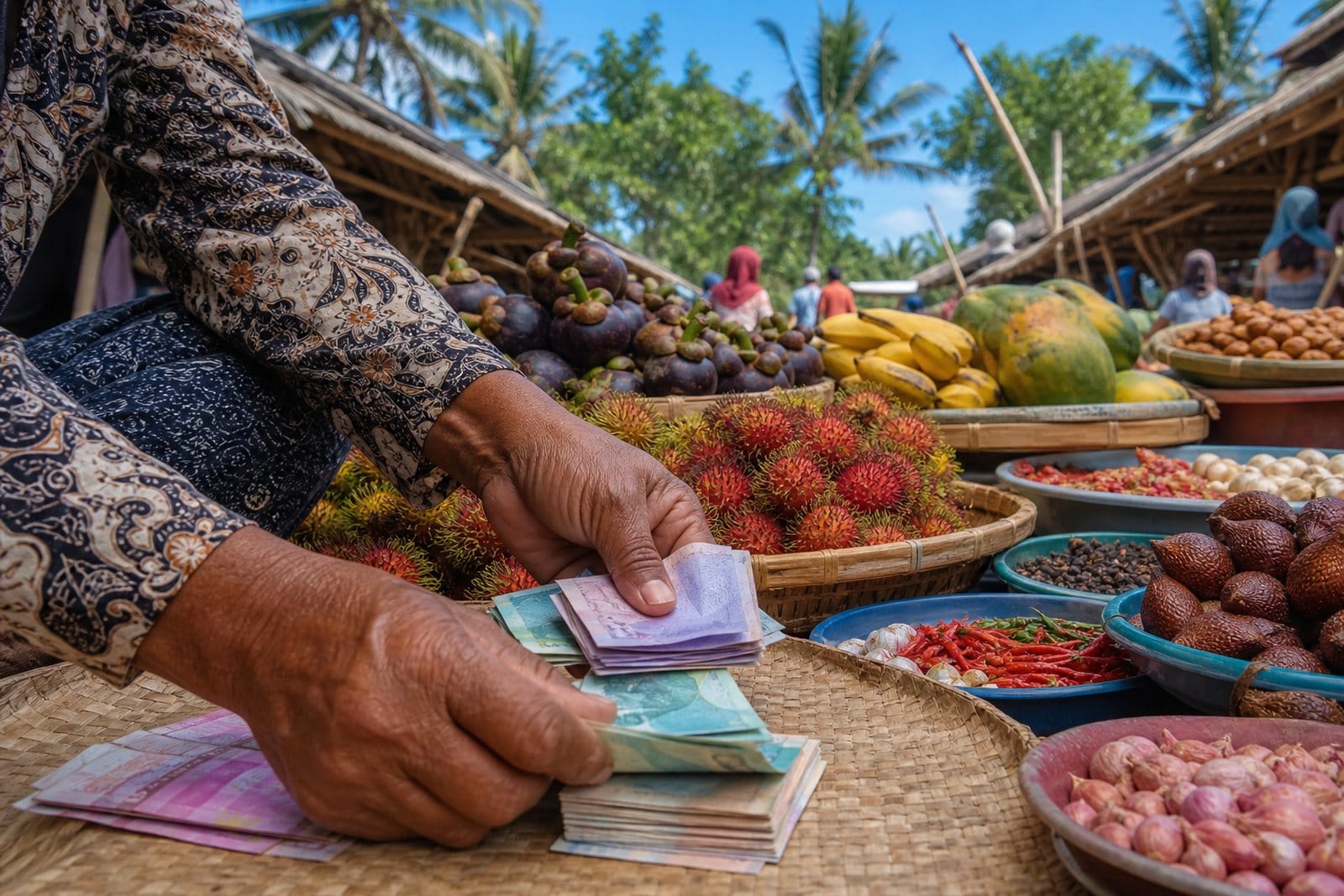 Daily Dispatch · Illustration: HubLombok (AI-generated)
Fiscal Alignment, Food Prices and Local Currency Trade
The second major theme in Destry’s remarks was coordination. She said Bank Indonesia would deepen engagement with the central government to align fiscal and monetary policy, particularly as the government pursues expansionary fiscal plans.
Her stated framework, described as “Red and White Synergy”, is intended to support public welfare while preserving the central bank’s institutional independence. For investors, that formulation deserves attention because coordination can be constructive without becoming a dilution of monetary discipline. Destry’s own emphasis remained on maintaining a harmonious fiscal-monetary balance.
The planned joint work will focus principally on inflation control through targeted interventions with the government to manage volatile food prices on the supply side. This is an important analytical point. Destry acknowledged that supply-side food-price pressures sit beyond the reach of monetary policy alone. The proposed response is therefore not presented as a central-bank-only solution, but as a coordinated effort across public institutions.
A separate priority is the expansion of local currency transactions, or LCT. Antara reports that Bank Indonesia intends to strengthen cooperation with government bodies and private-sector actors to reduce reliance on hard currencies in international trade.
For internationally minded investors, LCT is best understood as part of a broader resilience agenda rather than an immediate instruction for a Lombok asset purchase. It signals an effort to develop more local-currency pathways in trade. It does not remove the need for foreign buyers to understand their own currency exposure, nor does it eliminate the relevance of the rupiah to any investment whose costs or receipts sit inside Indonesia.
Destry also said Bank Indonesia would work closely with lawmakers and place dedicated emphasis on micro, small and medium enterprises. That focus matters to a tourism-led local economy because a destination is not only its hotels or villas. It is also the ecosystem of smaller operators, suppliers, transport providers, food businesses and service enterprises surrounding an asset.
Still, investors should keep cause and effect disciplined. The source describes policy intentions and areas of cooperation. It does not provide a timetable for outcomes, a forecast for tourism activity, or a guarantee of investment returns. A responsible reading treats the announcement as a policy signal, then tests each individual investment on its own legal, commercial and operational merits.
What This Means for Investors
The immediate implication is not that investors should rush to alter a Lombok strategy. It is that the national assumptions inside that strategy deserve a fresh review as Bank Indonesia’s new leadership takes office.
For those assessing an acquisition, development or leasehold position, the most useful questions are practical:
- Is the investment case still credible if the rupiah moves differently from the base assumption?
- Have local operating costs been considered separately from foreign-currency capital?
- Does the return analysis distinguish gross revenue from net income after realistic costs?
- Is the legal structure appropriate for a foreign buyer, rather than merely convenient in a sales presentation?
- Has the buyer allowed for a period in which global uncertainty remains a defining policy concern?
Lombok investors also have a particular reason to maintain this discipline. The island’s appeal may be local and tangible, but ownership structures and transactions are governed by Indonesian rules. Foreigners cannot hold freehold Hak Milik, or SHM; that form of ownership is reserved for citizens. Available routes include leasehold, Hak Pakai for eligible residents, and a foreign-owned PT PMA holding Hak Guna Bangunan, or HGB. Nominee arrangements, in which an Indonesian party holds freehold on a foreigner’s behalf, are illegal and void in court.
Those legal fundamentals sit alongside, rather than beneath, the monetary story. A stable-policy message cannot compensate for inadequate due diligence; equally, a well-structured title cannot make currency and inflation conditions irrelevant. The strongest investment case addresses both the asset-level detail and the national environment.
Where legal structure, title history, zoning, encumbrances or transfer steps are in scope, buyers may seek independent advice. HubLombok’s advisory partner TerraNusa Advisory supports foreign buyers with due diligence, PT PMA setup, tax matters and deed and title transfer at the land office, BPN. Its role is particularly relevant because a proper review extends beyond executing an AJB deed with a licensed PPAT notary.
For now, Destry’s arrival offers a useful, if deliberately restrained, dispatch from Jakarta: economic stability is to remain the anchor. Investors should welcome the clarity, avoid treating it as a forecast, and use the transition to pressure-test the assumptions that connect a Lombok opportunity to the wider Indonesian economy.
Stay informed, subscribe to the free Lombok Briefing for market intelligence like this, published twice a month.
What is Destry Damayanti’s stated priority as BI Governor?
Destry Damayanti said maintaining economic stability is Bank Indonesia’s primary focus, with rupiah exchange-rate stability and domestic inflation control forming the basis for sustainable, higher economic growth amid continuing global market uncertainty.
Who was approved to lead Bank Indonesia for 2026–2031?
The DPR RI Plenary Meeting approved Destry Damayanti as Bank Indonesia Governor, Aida S. Budiman as Senior Deputy Governor, and Solikin M. Juhro as Deputy Governor for the 2026–2031 tenure.
Why does the BI transition matter to Lombok property investors?
Lombok assets operate within Indonesia’s wider monetary environment. Bank Indonesia’s stated focus on rupiah stability, inflation control and fiscal-monetary coordination is relevant to foreign investors assessing currency exposure, local costs and the broader operating backdrop.

The Lombok Buyer's Field Guide
Legal structures ranked by risk, the honest ROI math line by line, all six zones ranked, and the 24-point due-diligence checklist. The whole book, free in your inbox.
See what's inside