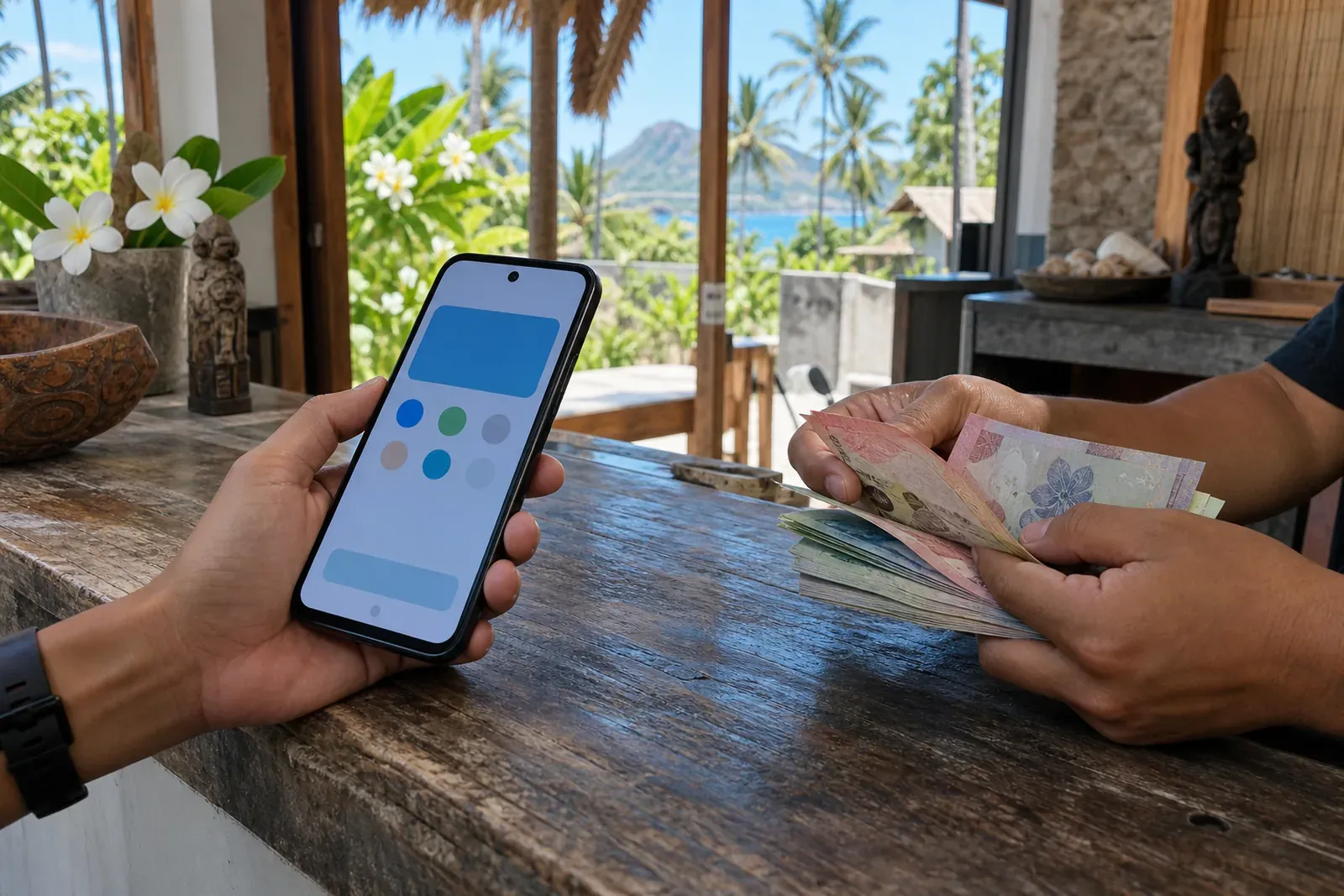
Lombok Notebook: Why BRICS Payment Links Matter to Indonesian Investors
Bank Indonesia’s BRICS agenda is not a property-market catalyst, but it sharpens the case for watching payment rails, currency use and financial resilience.
Quick answer: Bank Indonesia’s push for local-currency transactions and cross-border payment links within BRICS matters to Lombok investors because it signals a policy preference for more resilient regional financial connections. It does not change property ownership rules or asset pricing directly, but it may improve the long-term infrastructure surrounding cross-border economic activity.
For a foreign investor assessing Lombok, the most useful reading of a central-bank meeting is rarely the headline alone. It is the direction of travel: whether Indonesia is seeking more dependable ways to transact, settle payments and manage exposure in a fragmented international economy. Bank Indonesia’s intervention at the BRICS finance meeting offers precisely that kind of clue.
The Context
At the 2nd BRICS Finance Ministers and Central Bank Governors Meeting in Mumbai, Bank Indonesia called for deeper financial integration among BRICS members. Its priorities were local currency transactions, known as LCT, and stronger cross-border payment connectivity. The stated objective was to help shield regional economies from geopolitical risks and global market fragmentation.
The language matters. This was not a declaration that a new system is already operating, nor a promise of immediate benefits for international buyers of Indonesian assets. It was an argument for practical cooperation, calibrated to the differing stages of development and national priorities of participating countries.
“Indonesia sees a strategic opportunity for BRICS to transform various challenges into mutual resilience,” Bank Indonesia Governor Destry Damayanti said, highlighting local currency transactions and cross-border payment connectivity.
For investors, “mutual resilience” is an instructive phrase. International capital normally pays close attention to the visible components of an investment case: land title, development quality, rental demand, management capability and exit liquidity. Yet the operational environment also matters. The ease, cost and reliability of moving money across borders can shape investor confidence, even when it is not the principal reason for an acquisition.
Indonesia’s position is especially relevant because the country is pursuing financial integration while emphasising stability. The central bank’s message at the meeting was that new growth sources should be developed without losing sight of macroeconomic resilience. That is a more measured proposition than financial nationalism, and a more practical one than assuming global markets will become less fractured by themselves.
The meeting included central-bank governors and finance ministers from Indonesia, Brazil, Russia, India, China, South Africa, Egypt, the United Arab Emirates, Ethiopia and Iran. Delegates adopted a joint statement addressing digital transformation, artificial intelligence, cyber resilience, sustainable finance and local-currency adoption, while also advocating reforms to International Monetary Fund governance.
For Lombok investors, these subjects should be separated into two categories. The first is immediate and transactional: the legal route through which an asset is held, the diligence behind the title and the economics of the individual investment. The second is strategic: the financial architecture through which Indonesia hopes to conduct more cross-border commerce over time. The BRICS discussion belongs firmly in the second category.
From Diplomatic Ambition to Payment Infrastructure
On the margins of the Mumbai gathering, Damayanti met Sanjay Malhotra, Governor of the Reserve Bank of India. Their discussions concerned expanding the Indonesia-India Local Currency Transaction framework, establishing a Local Currency Bilateral Swap Arrangement and linking cross-border QR-code payment systems.
Each item has a different function, but together they show an interest in moving from broad diplomatic alignment towards usable financial connections.
- Local currency transactions seek to support transactions using participating countries’ currencies rather than relying exclusively on another currency.
- A bilateral swap arrangement is a financial-cooperation mechanism discussed by the two central banks in the context of Indonesia-India integration.
- Cross-border QR-code connectivity concerns the practical payment layer: the ability to link payment systems across national borders.
The important point is not to overstate their present reach. The source describes discussions and an effort to accelerate integration; it does not say that the proposed arrangements are complete, universally available or designed for property purchases. Nor does it establish that they will alter the costs of acquiring a villa, land or leasehold interest in Lombok.
Still, investors should not dismiss payment infrastructure as technical scenery. A market becomes easier to understand when its rules, settlement mechanisms and institutions are visible. The same is true of an investment decision. Buyers may begin with the asset, but their experience ultimately includes banking, payments, tax administration, legal execution and the transfer of rights.
Indonesia’s foreign-buyer property framework remains clear in its essential boundaries. Foreigners cannot hold freehold, or Hak Milik, which is reserved for Indonesian citizens. Available routes include leasehold, Hak Pakai for qualifying residents, and a foreign-owned PT PMA holding Hak Guna Bangunan. A nominee structure in which an Indonesian holds freehold on a foreigner’s behalf is illegal and void in court.
That legal reality is not altered by a BRICS payment initiative. It is, however, a useful reminder that cross-border investing involves more than a purchase decision. The most durable approach is to treat financial connectivity and legal structuring as linked but distinct disciplines: one concerns the broader operating environment; the other determines whether the buyer’s rights are sound.
For this reason, a buyer should give greater weight to verified process than to optimistic shorthand. Deeds are executed by a licensed PPAT notary; the deed of sale is the AJB; and the land agency is BPN. Buyer transfer duty, BPHTB, is about 5% of assessed value. The annual land-and-building tax, PBB, is described as modest.
TerraNusa Advisory, HubLombok’s legal and notary advisory partner, provides due diligence covering certificates, ownership history, zoning and encumbrances, as well as PT PMA setup, relevant taxes and transfer at BPN. Its role is relevant here because payment connectivity cannot substitute for diligence. A smoother way to pay is not the same as a secure legal interest.
 Lombok Notebook · Illustration: HubLombok (AI-generated)
A More Fragmented World Raises the Value of Process
The source’s central premise is geopolitical fragmentation. This is an expression that can sound abstract until it is translated into an investor’s working habits. Fragmentation means that assumptions about currency use, payment channels and international coordination may deserve more scrutiny than they once did.
Bank Indonesia’s response is to advocate diversification of financial links while maintaining stability. That stance does not require an investor to make a prediction about BRICS, global reserve currencies or the future of international finance. It instead suggests a sensible analytical posture: look for evidence that Indonesia is participating in practical regional arrangements rather than treating cross-border finance as a static backdrop.
There is a distinction here between a policy signal and an investable catalyst. A policy signal can influence the quality of long-term institutional context. An investable catalyst must have a more direct connection to cash flow, asset value or enforceable rights. The BRICS meeting provides the former, not proof of the latter.
That distinction is particularly valuable in early-cycle real-estate markets, where narratives can arrive faster than operating evidence. South Lombok offers a broad range of land pricing, from about Rp 30 million to Rp 400 million per are, depending on zone. Kuta, the demand and liquidity leader, is quoted at Rp 300 million to Rp 400 million per are. Are Guling is quoted at Rp 120 million to Rp 180 million per are and is characterised as an early-cycle frontier.
Such differences cannot be explained by a single macroeconomic announcement. They reflect location, access, product quality, demand, legal status and the ability to operate a property successfully. Nor should currency or payment rhetoric be used to disguise the normal risks of tourism-led real estate.
The verified market figures make this need for discipline plain. Developer-quoted gross yields are 12-22%, but gross returns exclude material costs. Honest net rental yields are 7-12% after management fees and realistic occupancy, while top-performing assets can reach around 15% net. Stabilised occupancy is given as 55-70% in the first 1-3 years. Management fees are 18-22% of gross rental revenue, with OTA and booking commissions at 15-20%.
A better payment network may improve the background conditions for commerce; it does not convert a gross-yield presentation into a net return.
The same restraint applies to any assertion that international financial cooperation will automatically produce stronger tourism demand or higher Lombok property values. Bank Indonesia’s statement concerned resilience, local-currency transactions and payment connectivity. It did not offer a forecast for Lombok tourism, residential demand, exchange rates or real-estate prices.
That limitation is not a weakness in the story. It is precisely why the announcement deserves a Notebook rather than a market-alert treatment. Financial architecture tends to matter gradually. Its consequences are usually felt through the accumulated reliability of systems, institutions and relationships rather than through a single dramatic transaction.
What This Means for Investors
The practical takeaway is to add financial infrastructure to the due-diligence checklist, without letting it displace the fundamentals. A Lombok buyer need not become a specialist in BRICS policy. But an investor should understand which questions belong to the property itself and which belong to the broader cross-border environment.
A useful framework is:
| Question | What to examine | |---|---| | Asset rights | The permitted foreign ownership route, certificate status and deed process | | Investment economics | Whether income projections distinguish gross from net returns | | Operating assumptions | Occupancy, management fees and booking commissions | | Financial context | How Indonesia is developing payment and local-currency connections over time |
The source also points to Indonesia’s preference for bridge-building in a fragmented global landscape. For internationally minded investors, that may be the most significant element of all. Indonesia is not presented as retreating from international cooperation; it is seeking to make that cooperation more tangible and more aligned with national priorities.
For Lombok, a destination connected to Indonesia’s wider economic and legal system, this is constructive context rather than a reason for haste. The investor’s task remains unglamorous and exacting: establish the legal structure, test the cash-flow assumptions, understand the operating model and preserve a margin for uncertainty.
HubLombok is the editorial arm of Samudra Villas, an active developer in Are Guling, South Lombok. That position makes disclosure particularly important: readers should distinguish editorial analysis of Indonesia’s financial environment from any decision to acquire a specific development or property.
Bank Indonesia’s BRICS intervention is best read as a reminder that the plumbing of international investment is becoming a strategic concern. Lombok’s appeal will still depend on the quality and legality of individual opportunities. Yet investors who watch both the asset and the systems around it will be better placed to judge what is signal, what is promotion and what remains unproven.
Stay informed, subscribe to the free Lombok Briefing for market intelligence like this, published twice a month.
Does Bank Indonesia’s BRICS initiative change Lombok property ownership rules?
No. Bank Indonesia’s BRICS agenda concerns local currency transactions and cross-border payment connectivity. Foreign buyers still cannot hold Hak Milik freehold. Available routes include leasehold, qualifying Hak Pakai arrangements and a PT PMA holding Hak Guna Bangunan.
Will Indonesia-India payment links reduce Lombok buying costs?
The source does not establish lower property-purchase costs. Bank Indonesia and the Reserve Bank of India discussed expanding local currency transactions, a bilateral swap arrangement and QR-code payment links, but these discussions are not evidence of immediate savings for Lombok property buyers.
What should a Lombok investor prioritise alongside payment developments?
Prioritise legal structure, certificate and ownership-history checks, zoning, encumbrances, deed execution and realistic operating assumptions. Developer-quoted gross yields of 12-22% exclude costs; honest net rental yields are 7-12% after management fees and realistic occupancy.
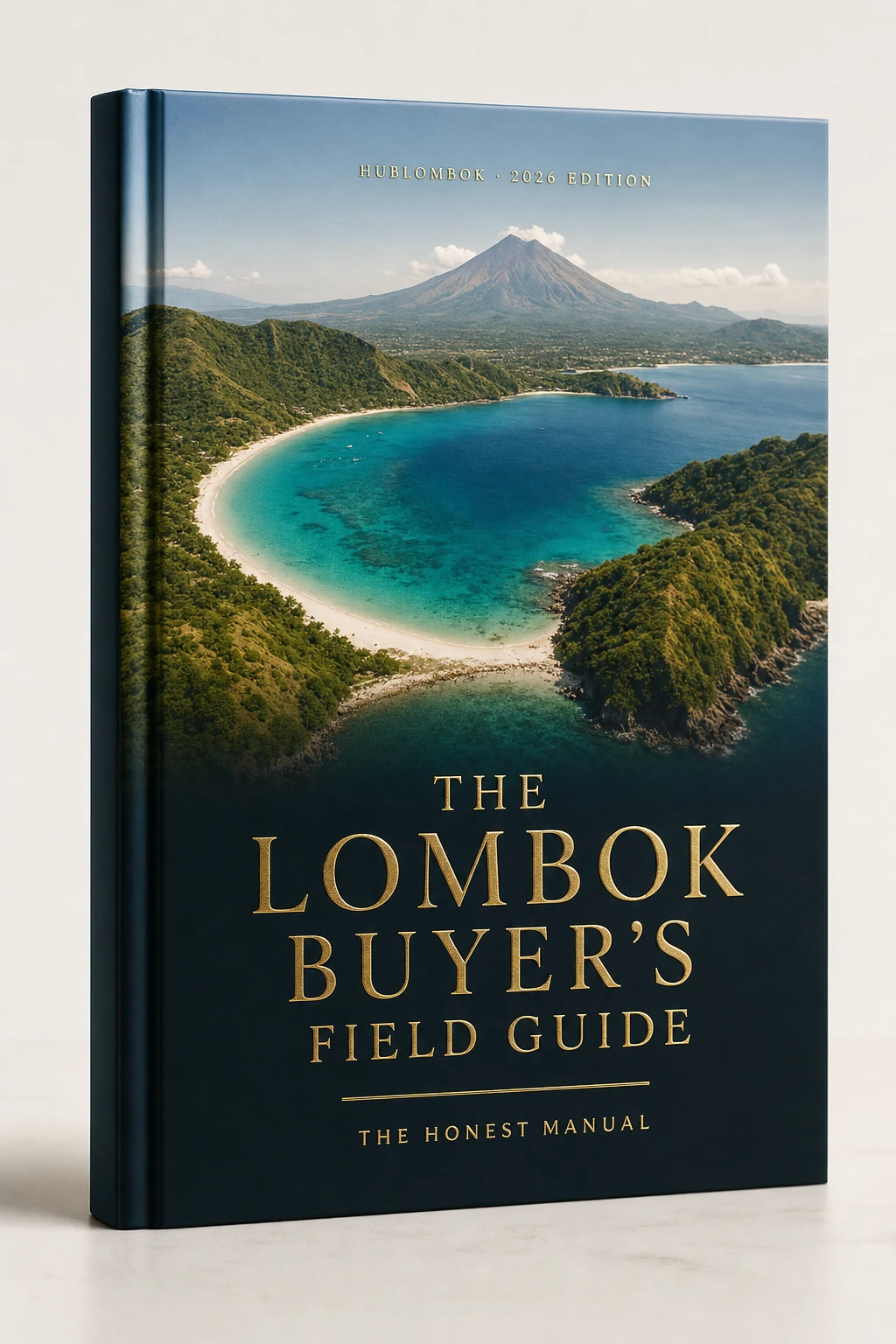
The Lombok Buyer's Field Guide
Legal structures ranked by risk, the honest ROI math line by line, all six zones ranked, and the 24-point due-diligence checklist. The whole book, free in your inbox.
See what's inside