
Bank Indonesia Puts Policy Certainty at the Centre of Investment Stability
At the G20 FMCBG meeting, Bank Indonesia outlined how stability, credible communication and policy coordination support investment resilience.
Bank Indonesia has used the G20 Finance Ministers and Central Bank Governors meeting to make a direct case for stability as an investment asset. Its message was clear: in an unsettled global economy, predictable institutions and coherent policy matter as much as headline growth ambitions.
For international investors assessing Indonesia, including those considering Lombok’s earlier-cycle property market, this is not a guarantee against risk. It is, however, a useful signal of the policy priorities being articulated by the country’s central bank at a significant international forum.
A stability-first message at the G20
Speaking on behalf of Bank Indonesia Governor, Deputy Governor Filianingsih Hendarta stressed that economic stability and policy certainty are critical foundations for attracting investment, creating jobs and strengthening business resilience. The remarks were delivered during the G20 Finance Ministers and Central Bank Governors meeting in Asheville, North Carolina, in the United States.
Hendarta attended the discussions held from August 31 to September 1, 2026, alongside Deputy Minister of Finance Juda Agung, who represented the Indonesian government. The meeting brought together G20 members, international financial institutions and guest nations including the Netherlands, Poland, Singapore, Qatar, Switzerland and the United Arab Emirates.
Bank Indonesia’s central proposition was that a clear policy framework is essential when investors and businesses are navigating continued global uncertainty.
This framing is particularly relevant to cross-border capital. Foreign investors rarely assess an opportunity only through potential returns; they also consider the reliability of the policy environment, the clarity of official communications and the ability of institutions to respond to external shocks.
Indonesia’s central bank positioned these elements as mutually reinforcing. Stability is not presented merely as an inflation objective, but as part of a wider framework intended to support confidence, investment and economic resilience.
Three strands of the central bank’s policy approach
Bank Indonesia identified three principal strategies for conducting monetary policy amid global turbulence.
First, it said it remains focused on keeping inflation expectations anchored through forward-looking and comprehensive assessments. Anchored inflation expectations refer to a situation in which expected price increases remain stable and within target ranges. For investors, the practical importance lies in what stable expectations can do for planning: they can make it easier for businesses, lenders and households to form decisions without continually recalibrating for abrupt changes in prices.
Second, the central bank said it is adapting its monetary framework to rapid digitalisation and deeper global financial integration. These shifts are changing how money moves, how payment systems operate and how financial developments travel across borders. Bank Indonesia’s stated response is a policy mix that integrates several tools rather than relying on a single instrument.
That policy mix includes:
- monetary strategy;
- exchange-rate stabilisation;
- macroprudential tools; and
- payment-system policies.
Third, Bank Indonesia said it is reinforcing policy communication that is transparent, consistent and credible. The stated aim is to anchor market expectations and improve monetary-policy transmission, in other words, to help official policy decisions carry through more effectively to the wider economy.
For overseas investors, the emphasis on communication deserves attention: clarity does not remove market risk, but it can reduce avoidable uncertainty around how policymakers see and respond to it.
The G20 discussion also reflects the growing overlap between conventional monetary questions and the infrastructure of modern finance. Digital payments, global capital flows and financial-system resilience increasingly belong in the same conversation as prices and exchange rates.
A cautious global setting
The G20 meeting did not suggest that the international outlook is uncomplicated. Delegates noted that the global economy has shown resilience, while also pointing to persistent headwinds.
These include geopolitical friction, energy and trade disruptions, stubborn inflation, heavy debt burdens and financial-market volatility. The group called for closely calibrated monetary and fiscal policies, supported by structural reforms, supply-chain diversification and targeted investment in innovation.
Artificial intelligence was a major focus. Officials identified AI as an important potential source of future productivity, but cautioned that rapid adoption needs to be balanced with cybersecurity protections and safeguards for financial-system stability.
The meeting concluded with a pledge to deepen international cooperation on systemic issues including global trade imbalances, debt relief, digital financial fraud and wider private-sector partnerships intended to support long-term, sustainable growth.
For investors, the important distinction is between resilience and immunity. The G20’s assessment acknowledged the capacity of the global economy to withstand pressures, but it also recognised that those pressures remain material. Indonesia’s message therefore sits within a broader international argument for disciplined, coordinated policymaking rather than complacency.
Why the message matters for Lombok-linked capital
Lombok investment decisions are made at several levels at once. A buyer may be focused on a specific parcel, villa project or tourism business, yet the transaction also sits within Indonesia’s wider policy, currency, payment and financial environment.
The verified South Lombok market case remains rooted in relative value and the Bali-overflow thesis: rising Bali prices and congestion are pushing some demand towards a cheaper, earlier-cycle Lombok market. Turnkey investment-grade villas in South Lombok have an entry range of EUR 95,000-350,000, compared with USD 400,000-800,000 for comparable specification in Bali.
Rental underwriting should remain conservative. Honest net rental yields in South Lombok are stated at 7-12% after management fees and realistic occupancy, while top-performing assets can reach about 15% net. Developer-quoted gross yields of 12-22% are not equivalent to net returns because they exclude relevant costs. Realistic stabilised occupancy during the first three years is 55-70%.
Those local figures do not turn Bank Indonesia’s G20 remarks into an investment recommendation. They do, however, underline why investors should examine the national framework alongside project economics. A compelling asset is more robust when it is assessed with realistic revenue assumptions, a lawful ownership route and a clear understanding of the wider operating setting.
Developments like Samudra Villas in Are Guling, South Lombok illustrate the importance of this wider lens. HubLombok is the editorial arm of Samudra Villas, an active developer in Are Guling; readers should consider that relationship when evaluating references to the local market.
What this means for investors
The immediate takeaway is not that global risks have disappeared. The G20 itself highlighted geopolitical, trade, energy, inflation, debt and market-volatility concerns. Rather, Bank Indonesia is publicly emphasising the institutional tools it sees as necessary to manage uncertainty.
For a prospective investor, that suggests a practical checklist:
- Treat macroeconomic stability and policy communication as part of due diligence, alongside location and projected income.
- Separate gross marketing claims from net-return analysis, including management fees and booking commissions.
- Use legal structures available to foreigners rather than nominee arrangements, which are illegal and void in court.
- Obtain full title, zoning, ownership-history and encumbrance checks before committing capital.
Foreigners cannot hold freehold Hak Milik, or SHM. Available routes include leasehold Hak Sewa, Hak Pakai for eligible residents, and a PT PMA holding Hak Guna Bangunan. Deeds are executed by a licensed PPAT notary, with the deed of sale known as an AJB and the land agency as BPN.
TerraNusa Advisory is HubLombok’s legal and notary advisory partner for foreign buyers in Lombok. Its stated scope includes due diligence, PT PMA setup, tax matters and deed and title transfer at BPN. This is relevant because an investment thesis, however attractive, depends on the legal pathway being properly implemented.
Bank Indonesia’s G20 intervention is ultimately a reminder that investment confidence is built through the unglamorous disciplines of stable expectations, coherent tools and credible communication. For Lombok investors, the next sensible step is to pair that national context with asset-level underwriting that remains realistic in every market condition.
Stay informed, subscribe to the free Lombok Briefing for analysis like this, published twice a month.
What did Bank Indonesia emphasise at the G20 FMCBG meeting?
Bank Indonesia said economic stability and policy certainty are critical foundations for attracting investment, creating jobs and strengthening business resilience. It highlighted anchored inflation expectations, an integrated policy mix and transparent, consistent, credible communication as its three main policy priorities.
Does Bank Indonesia’s statement remove risk for Lombok investors?
No. The G20 noted continuing geopolitical friction, energy and trade disruptions, stubborn inflation, heavy debt burdens and financial-market volatility. Bank Indonesia’s statement describes its policy priorities; Lombok investors should still assess legal structure, location, costs and realistic rental assumptions independently.
What rental assumptions are realistic for South Lombok villas?
Verified South Lombok figures indicate honest net rental yields of 7-12% after management fees and realistic occupancy, with top-performing assets reaching about 15% net. Realistic stabilised occupancy in the first three years is 55-70%; developer-quoted gross yields of 12-22% exclude relevant costs.
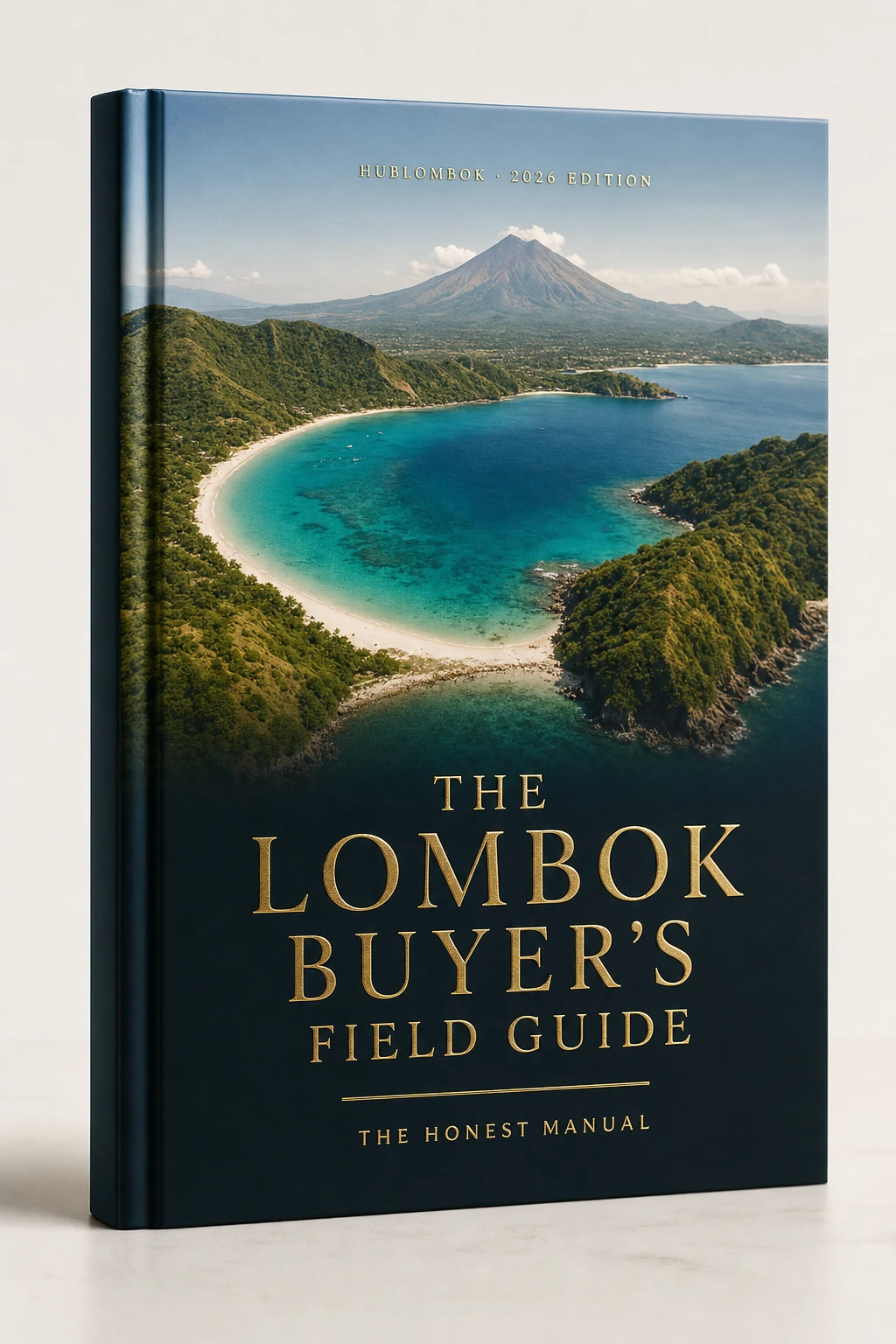
The Lombok Buyer's Field Guide
Legal structures ranked by risk, the honest ROI math line by line, all six zones ranked, and the 24-point due-diligence checklist. The whole book, free in your inbox.
See what's inside