
Lombok Notebook: Why Bank Indonesia’s Local-Currency Push Matters
Bank Indonesia’s local-currency transaction strategy offers useful context for Lombok investors assessing rupiah exposure, capital flows and market resilience.
Quick answer: Bank Indonesia’s expansion of local currency transactions is designed to reduce reliance on US-dollar trade settlement and support rupiah stability. For Lombok investors, it is not a property-market catalyst, but it is useful context: exchange-rate resilience, liquid domestic markets and institutional policy capacity shape the backdrop against which foreign capital is deployed.
Lombok property is often assessed through the intimate particulars of a plot, a view corridor, a lease term or a villa operator’s assumptions. Yet the value of an overseas asset is also mediated by a wider national system: the currency in which costs are paid, the financial markets through which capital moves, and the institutions responding when global conditions become unsettled.
Bank Indonesia’s latest explanation of its local currency transaction, or LCT, framework belongs in that wider frame. It is not a promise about property prices, tourism demand or investor returns. It is, however, a useful Lombok Notebook subject precisely because it shows how Indonesia’s central bank is seeking to make the country’s external position less dependent on one currency at a time of geopolitical tension and global uncertainty.
The Context
At a seminar organised by Indonesia’s National Development Planning Ministry and the Asian Development Bank Institute, Jardine A. Husman, head of the Macroeconomic Group at Bank Indonesia’s Department of Economic and Monetary Policy, said the central bank was continuing to expand local currency transactions with key partner countries.
The basic purpose is clear. LCT arrangements aim to diversify international trade settlement away from heavy reliance on the US dollar. Indonesia has active LCT partnerships with Malaysia, Thailand, Japan, China, South Korea, the United Arab Emirates and Singapore.
For an investor whose reference currency is the euro, Australian dollar, pound sterling or US dollar, this may sound remote from a purchase in South Lombok. The connection is not direct, and it should not be overstated. An LCT framework does not eliminate currency risk for a foreign buyer, nor does it determine the price of a villa or land parcel. What it does signal is a policy preference for broader settlement channels and deeper domestic money and foreign-exchange markets.
Bank Indonesia frames LCT as part of a broader effort to reinforce the resilience of Indonesia’s external sector.
That distinction matters. Investors can too easily turn a macroeconomic policy announcement into an investment thesis. The appropriate reading is more measured: Bank Indonesia is building tools intended to support market functioning and rupiah stability, while global forces remain capable of influencing any emerging-market currency.
The source describes a wider policy mix alongside LCT. Bank Indonesia is using foreign-exchange interventions in domestic and offshore markets, interest-rate adjustments and Bank Indonesia Rupiah Securities, known as SRBI, to attract foreign portfolio inflows. It is also maintaining liquidity in the domestic money market and banking system, while tightening oversight of large-value US-dollar purchases.
Taken together, these measures illustrate the range of levers available to a central bank. LCT is one strand rather than a solitary solution. For a foreign property investor, that is the more useful conclusion: resilience rests on a system of policies, institutions and markets, not on a single headline initiative.
Local Currency Transactions and the Investor’s Ledger
The practical relevance begins with the different currencies inside a Lombok investment. Acquisition costs, construction payments, local staffing, maintenance and many taxes are generally experienced within Indonesia’s domestic economy. An overseas investor, by contrast, may evaluate capital commitments and eventual returns in another currency.
That creates two separate questions that should not be collapsed into one:
- Is the underlying asset, including its legal structure and operating model, sound in local terms?
- How might movements between the investor’s home currency and the rupiah affect the translated value of capital outlay and income?
Bank Indonesia’s LCT strategy speaks to the national financial environment surrounding the second question. It seeks to diversify trade settlement, deepen markets and support the external sector. It does not answer the first question, which remains rooted in individual diligence: title, zoning, contract terms, construction quality, operator capability and realistic rental assumptions.
This is especially important in a market where promotional language can travel faster than operational detail. In South Lombok, developer-quoted gross yields of 12-22% exclude costs that investors must understand. Honest net rental yields are generally 7-12% after management fees and realistic occupancy, while top-performing assets can reach about 15% net. Management fees are 18-22% of gross rental revenue, and OTA or booking commissions are 15-20%.
Those figures do not arise from the LCT announcement. They are property-level realities that deserve their own underwriting. A stronger policy framework for currency and liquidity does not convert gross yield into net yield, create occupancy, or repair weak documentation.
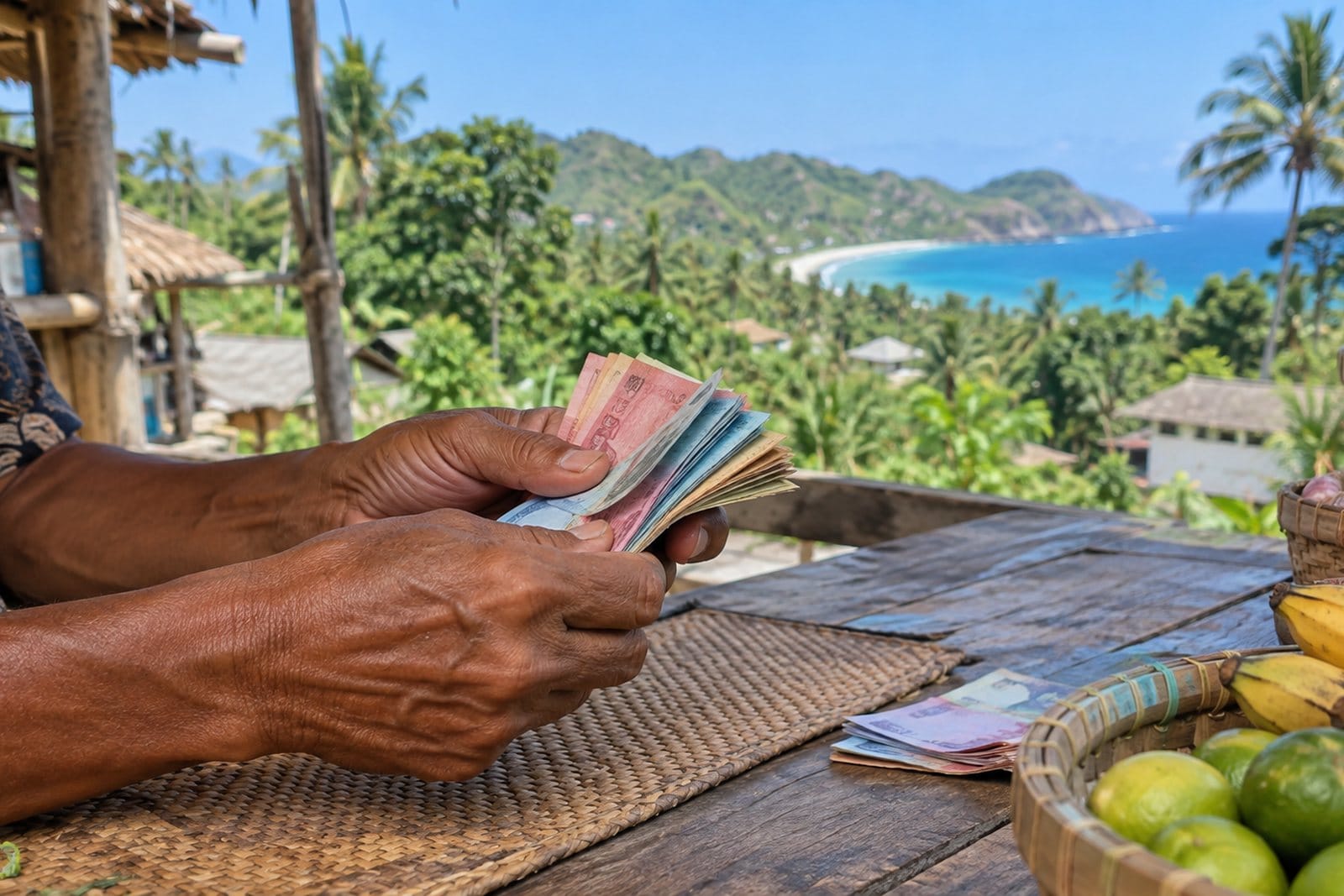 Lombok Notebook · Illustration: HubLombok (AI-generated)
There is a second, subtler point. International investors often experience Indonesia through the US dollar because it is the dominant shorthand for global real estate comparison. The central bank’s stated wish to reduce heavy reliance on dollar trade settlement is therefore notable, even if a foreign buyer will still use the currency and banking route appropriate to their own transaction.
The point is not that the dollar becomes irrelevant. The source says Bank Indonesia continues to monitor large-value US-dollar purchases and intervene in foreign-exchange markets as part of its broader mix. Rather, the LCT programme indicates an attempt to give Indonesia more options in its external commercial relationships.
For Lombok, an island investment market within a national economy, that flexibility is part of the background architecture. It may matter most when conditions are least comfortable: when global growth is sluggish, inflation remains sticky and monetary policy abroad stays tight, the pressures identified by Bank Indonesia in the source.
The Limits of a Useful Macro Signal
A serious investor should resist two symmetrical errors. The first is to dismiss central-bank policy as distant from a beachside asset. The second is to assume a well-articulated policy programme guarantees exchange-rate stability or protects an individual investment from poor execution.
The source provides grounds for neither complacency nor alarm. Husman said Indonesia’s external resilience remained strong, supported by foreign-exchange reserves of US$146.5 billion, equivalent to 5.4 months of imports. This was described as well above the international benchmark of three months. He also pointed to controlled inflation and digital transformation as supports for steady domestic growth.
These are national indicators, not a valuation model for Lombok land or villas. They should be treated as evidence of the central bank’s stated assessment of the macroeconomic setting, rather than as a forecast for a particular project.
The property investor’s task is to keep levels of analysis separate. A sensible diligence file might distinguish them as follows:
| Level | Question to test | |---|---| | National macro setting | How is Bank Indonesia describing external resilience, liquidity and currency policy? | | Transaction structure | Is the buyer using a lawful foreign-ownership route and completing the required diligence? | | Asset economics | Are price, occupancy, management costs and rental projections realistic? | | Exit and translation | How could local-market conditions and currency movements affect the investor’s eventual outcome? |
On the legal level, foreigners cannot hold freehold, or Hak Milik/SHM; it is reserved for Indonesian citizens. Available routes include leasehold, Hak Sewa, typically 25-30 years with extensions; Hak Pakai for qualifying residents; and a foreign-owned PT PMA holding Hak Guna Bangunan, with 30 years extendable. Nominee arrangements, in which an Indonesian holds freehold on a foreigner’s behalf, are illegal and void in court.
Deeds should be executed by a licensed PPAT notary, with the deed of sale known as an AJB and the land agency as BPN. Buyer transfer duty, BPHTB, is about 5% of assessed value. TerraNusa Advisory, HubLombok’s legal and notary advisory partner, supports foreign buyers with certificate, ownership-history, zoning and encumbrance checks, as well as PT PMA setup, taxes and title-transfer work at BPN.
That legal discipline is more immediately consequential to an individual buyer than an LCT announcement. Yet it is not a substitute for the macro perspective. The best investment decisions hold both truths: asset-level risk must be investigated transaction by transaction, while national monetary and external-sector policy sets an important operating environment.
What This Means for Investors
Bank Indonesia’s LCT expansion should be read as a constructive institutional signal, not as a reason to rush into Lombok real estate. The central bank is seeking more diversified trade settlement and is pairing that effort with interventions, interest-rate policy, SRBI, liquidity management and closer policy coordination with the government.
For foreign investors, the immediate discipline is straightforward. Underwrite the asset in the terms that actually govern it, then consider currency exposure separately. Do not use macro resilience as a shortcut around property diligence; equally, do not treat a local asset as detached from the policy framework that supports the rupiah, domestic liquidity and Indonesia’s external position.
Lombok’s appeal rests on its own local characteristics, and each purchase should be assessed on its specific merits. The central bank’s message adds a valuable wider lens: in a world of uncertain global conditions, Indonesia is actively developing multiple channels through which its economy can transact and its financial markets can function.
For patient investors, that is the right scale of takeaway. It is neither a headline return nor a guarantee. It is evidence of a country thinking about resilience in practical, institutional terms, an unglamorous but essential part of the landscape beneath any long-term investment.
Stay informed, subscribe to the free Lombok Briefing for market intelligence like this, published twice a month.
Does Bank Indonesia’s LCT strategy remove rupiah risk for foreign investors?
No. Bank Indonesia’s local currency transaction framework aims to diversify international trade settlement away from heavy reliance on the US dollar and support external resilience. It does not remove the exchange-rate exposure a foreign investor may face when converting capital, income or sale proceeds between the rupiah and another currency.
What is Bank Indonesia doing alongside local currency transactions?
According to Bank Indonesia, LCT expansion sits within a wider policy mix that includes foreign-exchange interventions in domestic and offshore markets, interest-rate adjustments, Bank Indonesia Rupiah Securities, domestic liquidity management and oversight of large-value US-dollar purchases.
What should a Lombok investor examine beyond currency policy?
A Lombok investor should separately test lawful ownership structure, title and zoning diligence, contractual terms, construction and operating assumptions. Foreigners cannot hold freehold Hak Milik/SHM; lawful options include leasehold, Hak Pakai for qualifying residents and a PT PMA holding Hak Guna Bangunan.

The Lombok Buyer's Field Guide
Legal structures ranked by risk, the honest ROI math line by line, all six zones ranked, and the 24-point due-diligence checklist. The whole book, free in your inbox.
See what's inside