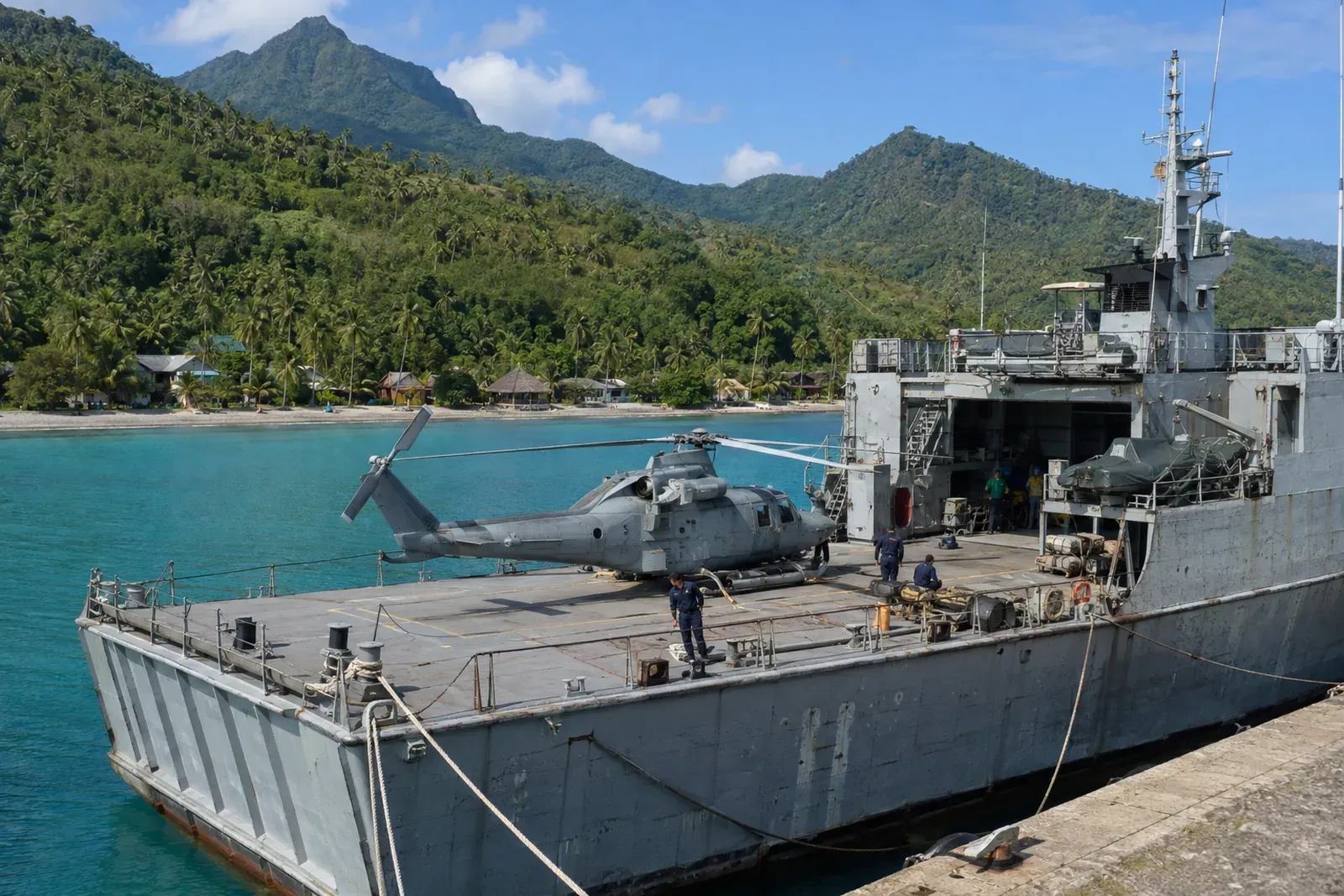
Indonesia Plans Helicopter-Base Carrier for Disaster Response
Indonesia is preparing a vessel, reportedly donated by Italy, as a helicopter base for faster disaster response.
Indonesia is preparing what Radar Lombok describes as the country’s first aircraft carrier to strengthen its response to forest fires and other natural disasters. The vessel is intended to operate as a helicopter base, potentially extending the reach of emergency operations across an archipelago where access can be difficult when crisis strikes.
According to the Radar Lombok report, President Prabowo Subianto is preparing the ship following a donation from the Italian Navy. The vessel is reportedly sailing from Italy to Indonesia and is expected to arrive between 15 and 20 September 2026.
A maritime platform for emergency response
The reported plan places disaster preparedness at the centre of the vessel’s prospective role. Rather than presenting the ship solely as a military asset, the source frames it as a platform to support the handling of forest fires and a wider range of natural disasters.
A helicopter base at sea could, in principle, give emergency services a mobile operating point closer to affected areas. That matters in an island nation, where damage to roads, weather conditions and distance can complicate the movement of personnel and supplies. The Radar Lombok report does not set out the vessel’s capacity, operational timetable or detailed disaster-response procedures, so those questions remain open.
Radar Lombok reports that the vessel will be named KRI Gajah Mada and is being prepared to support Indonesia’s response to forest fires and natural disasters.
The name carries particular symbolic weight in Indonesia. Yet for investors and observers, the practical issue is less the symbolism than execution: how the vessel is integrated into emergency planning, helicopter operations and inter-agency coordination once it reaches Indonesian waters.
What the report confirms, and what it does not
The source provides a narrow but notable set of claims. It identifies the reported donor, the intended name, the broad disaster-response purpose and the expected arrival window. It does not provide a confirmed specification, cost, deployment location or details of the helicopters that may use the ship.
That distinction is important. Large national-security and resilience projects often attract sweeping assumptions before their operating arrangements are public. At this stage, the available report supports only a measured reading:
- The vessel is reportedly a donation from the Italian Navy.
- It is expected to be called KRI Gajah Mada.
- Its stated purpose includes strengthening the response to forest fires and natural disasters.
- It is reportedly en route from Italy, with arrival expected between 15 and 20 September 2026.
No conclusion should be drawn from the report about eventual readiness, the areas it may serve, or the scale of its impact on disaster outcomes. Those would depend on operational details not contained in the source.
Why disaster logistics matter to investors
For international investors assessing Indonesia, resilience is not an abstract public-policy issue. It affects the continuity of tourism, property operations, construction activity and transport links. A disruption does not need to be permanent to be commercially meaningful: delays in access, constrained emergency services and uncertainty around local conditions can all influence a project’s operating environment.
That is particularly relevant for investors who take a long-term view of Lombok and other Indonesian destinations. A national effort to improve emergency reach may be a constructive signal of institutional attention to preparedness. But it should not be confused with a guarantee that a particular location is protected from disruption, nor with a substitute for site-specific risk assessment.
Property buyers and developers should continue to examine local access, drainage, insurance terms, building standards, operational contingency plans and the capacity of their management partners. National assets can strengthen a response architecture, while local preparation remains essential when an event affects a specific community or asset.
A development to watch after arrival
The arrival window reported by Radar Lombok gives observers a clear near-term milestone. Once the vessel reaches Indonesia, the more informative questions will concern commissioning, command arrangements, helicopter availability and how the ship fits alongside existing disaster-management systems.
Investors should also watch for official clarification on whether the vessel will have a standing disaster-response function, a broader dual-use mandate, or a different operational emphasis. The source establishes the stated intent, but it does not settle how that intent will be translated into routine capability.
What this means for investors
The immediate investment implication is one of context rather than valuation. The report points to Indonesia’s focus on improving disaster-response capability through a mobile helicopter platform. For investors with exposure to Indonesian tourism, real estate or infrastructure, this is relevant to the broader resilience landscape.
The prudent interpretation is balanced:
- Treat the reported vessel as a potential addition to national emergency capacity, not as an operating result already achieved.
- Avoid assigning a financial benefit to any region before official deployment and operational details are known.
- Keep local due diligence central to investment decisions, especially where physical access and business continuity are material considerations.
- Monitor official updates after the reported arrival period for clearer evidence of how KRI Gajah Mada will be used.
Indonesia’s reported move is therefore best viewed as an early resilience development with significance beyond defence policy. Its value for communities and investors alike will be determined by the discipline of its implementation after arrival.
Stay informed, subscribe to the free Lombok Briefing for analysis like this, published twice a month.
What is KRI Gajah Mada expected to do?
Radar Lombok reports that KRI Gajah Mada is being prepared as a helicopter base to strengthen Indonesia’s response to forest fires and other natural disasters. The source does not provide detailed operating procedures, vessel specifications or a confirmed deployment area.
When is the vessel expected to arrive in Indonesia?
According to Radar Lombok, the vessel is sailing from Italy to Indonesia and is expected to arrive between 15 and 20 September 2026. The report does not state when it will enter service or begin disaster-response operations.
Does this change the risk assessment for Lombok property investors?
The report signals a national focus on disaster-response capacity, but it does not establish protection for any particular location, including Lombok. Investors should continue to assess local access, building standards, insurance, drainage and operational contingency planning for each asset.

The Lombok Buyer's Field Guide
Legal structures ranked by risk, the honest ROI math line by line, all six zones ranked, and the 24-point due-diligence checklist. The whole book, free in your inbox.
See what's inside