Rupiah Strengthens Post-US Midterms: What It Means for Lombok Property
A strengthening rupiah and falling oil prices provide macro relief for Indonesia. Here is how foreign investors should navigate South Lombok property acquisitions.
Quick answer: The Indonesian rupiah strengthened to Rp 18,070 per US dollar following US midterm election results and falling oil prices. For foreign property investors in Lombok, this modest currency rebound creates a tactical entry window: offshore buyers retain substantial purchasing power, while stabilising domestic yields support asset fundamentals across emerging Indonesian resort markets.
Global macroeconomic sentiment shifted decisively this morning as political outcomes in Washington reverberated across international foreign exchange desks. In Jakarta, the Indonesian rupiah rebounded by 98 points against the greenback, responding swiftly to softening US Treasury yields and a sharp contraction in global crude benchmarks. For cross-border investors assessing Indonesian real estate, this currency recalibration provides valuable clarity on monetary stability, import cost trajectories, and asset valuation dynamics across South Lombok.
The Context
Trading in Jakarta opened on Thursday with immediate momentum for the domestic currency. The rupiah advanced 98 points to reach Rp 18,070 per US dollar, climbing from the previous close of Rp 18,168. Market analysts attribute this rebound directly to the results of the United States midterm elections, which saw the Democratic Party secure legislative victories.
According to Woori Saudara Bank analyst Rully Nova, the legislative outcome has fundamentally altered market expectations regarding American fiscal and trade trajectory. Rully Nova noted that the Democratic victory is widely anticipated to constrain the Trump administration's operational latitude regarding tariff policies, corporate and personal tax reductions, federal budget deficits, and Treasury bond issuance. This prospective legislative gridlock prompted global institutional funds to re-balance their capital allocations toward risk-on assets and emerging market currencies.
"With the Democratic Party's victory, there is an expectation that it will limit the Trump administration's room to maneuver on tariff policy, taxes, the government budget deficit, and government bond issuance, prompting global investors to re-balance their portfolios toward risk-on," Rully Nova explained to ANTARA in Jakarta.
The global repercussions were instantaneous across sovereign debt and foreign exchange indicators. The 10-year US Treasury yield declined by 10.1 basis points to 4.86 percent, while the broader US dollar index contracted to 101.3. Concurrently, a substantial pullback in energy commodities provided a powerful tailwind for energy-importing economies. International benchmark Brent crude dropped by more than 8 percent (specifically down USD 8.55, or 8.25 percent) to USD 95.05 per barrel, dipping below the pivotal USD 100 threshold for the first time in an entire month. The US benchmark, West Texas Intermediate (WTI), registered an equivalent retreat, falling USD 7.81, or 8.13 percent, to USD 88.28 per barrel.
Within Indonesia's domestic capital markets, this improving sentiment drove a compression in sovereign borrowing costs, with Indonesian government bond yields easing to 7.67 percent. Market confidence is further buttressed by official projections indicating that national economic expansion in the third quarter of 2026 will surpass performance recorded in the preceding quarter. In light of these converging factors, analysts project the rupiah to consolidate within a near-term trading corridor of Rp 18,000 to Rp 18,100 per US dollar.
Global Macro Shocks and Indonesian Monetary Breathing Room
The dual catalyst of softer US yields and depressed petroleum prices affords Bank Indonesia much-needed monetary leeway. For most of 2026, central banks across Southeast Asia have had to manage imported inflationary pressures alongside capital flight generated by elevated American interest rates. When the US 10-year yield pushed past 4.90 percent, defending currency parity required vigilant domestic liquidity management.
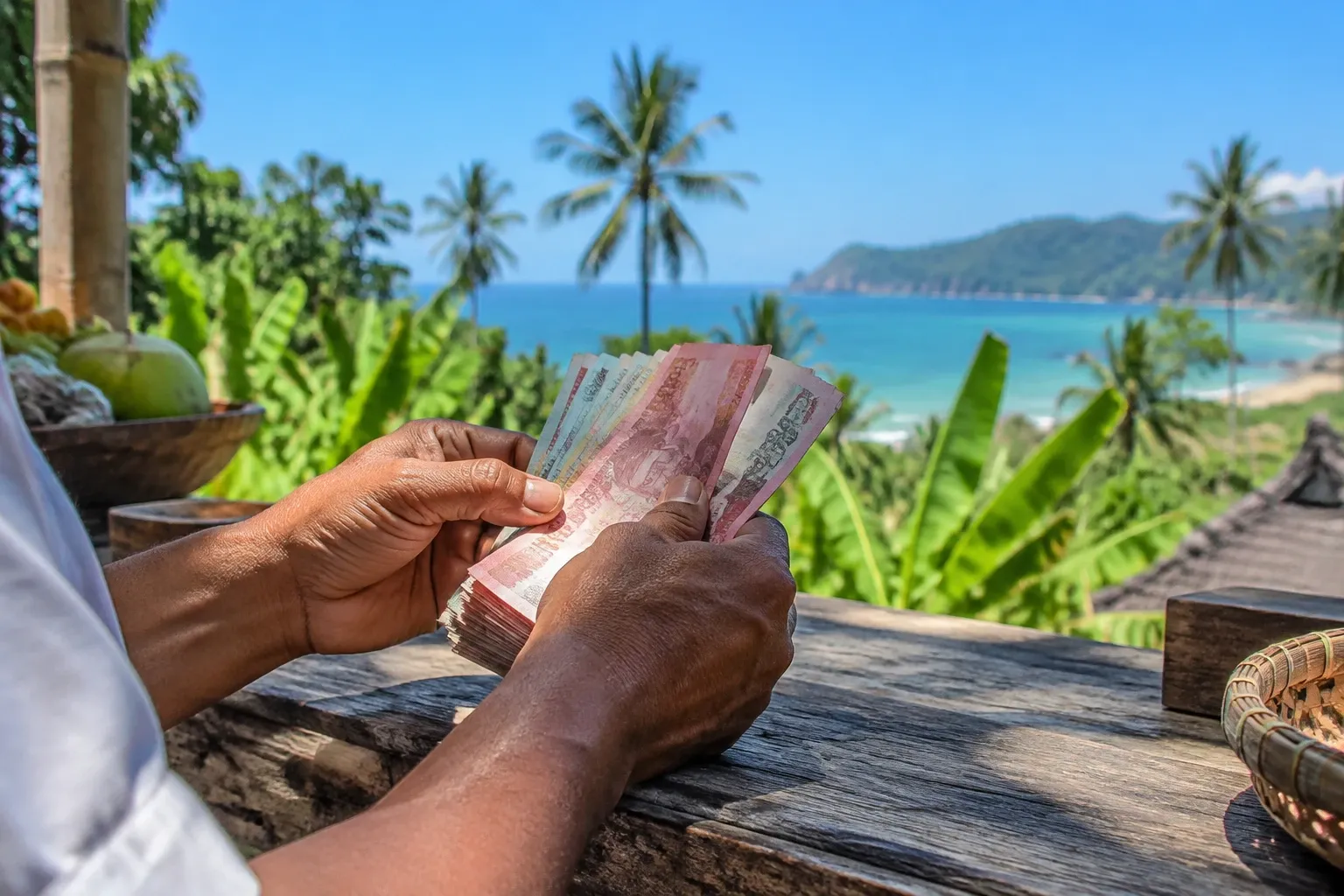
 Rupiah Strengthens Post-US Midterms · Photo by Zeca Souza on Pexels
A pullback in 10-year US Treasuries to 4.86 percent, combined with the dollar index softening to 101.3, alleviates acute pressure on local monetary authorities. More importantly, crude oil falling back below USD 95 per barrel reduces the national energy subsidy burden and limits foreign exchange outflows required for refined fuel imports. This balance of payments relief directly supports domestic stability, allowing Indonesian 10-year sovereign bond yields to settle at 7.67 percent without necessitating sudden interest rate interventions.
For foreign direct investors and private real estate allocators, macro stability is the primary determinant of long-term capital preservation. An economy demonstrating resilient gross domestic product growth alongside controlled domestic yields creates an orderly foundation for real asset underwriting. When national growth accelerates quarter-on-quarter, infrastructure investment, airport logistics, and provincial utilities continue uninterrupted, ensuring secondary tourism corridors remain on their projected growth paths.
Currency Dynamics and Real Estate Valuation in South Lombok
How does a rupiah oscillating between Rp 18,000 and Rp 18,100 per US dollar translate into physical property acquisitions? To understand the practical impact, one must evaluate both development construction costs and relative international purchasing power across South Lombok's expanding leisure market.
While imported architectural materials, structural glazing, and high-efficiency mechanical plant become marginally more accessible in local currency terms as the rupiah strengthens, offshore capital from North America, Europe, and Australia continues to enjoy an unprecedented valuation arbitrage. Even after the 98-point rally, the exchange rate affords international buyers extraordinary leverage over domestic land and construction costs compared to historical baselines.
| Indicator / Asset Class | South Lombok Benchmark | Mature Bali Comparison | | :--- | :--- | :--- | | Turnkey Villa Entry Price | EUR 95,000 to EUR 350,000 | USD 400,000 to USD 800,000 | | Prime Land Price | Rp 150M to Rp 400M per are (~USD 90 to USD 240/m²) | USD 200 to USD 500/m² | | Kuta Central Land | Rp 300M to Rp 400M per are (~USD 18,200 to USD 24,200/are) | Highly saturated / premium pricing | | Selong Belanak Land | Rp 150M to Rp 250M per are (~USD 9,100 to USD 15,200/are) | Emerging family tourism enclave | | Mandalika Circuit Zone Land | Rp 100M to Rp 150M per are (~USD 6,100 to USD 9,100/are) | Special Economic Zone fringe | | Honest Net Rental Yield | 7% to 12% net (top performers ~15% net) | 6% to 9% net stabilised | | Developer Quoted Gross Yield| 12% to 22% gross | 10% to 16% gross | | Stabilised Occupancy (Y1-3) | 55% to 70% | 70% to 85% |
In South Lombok, land transactions adhere strictly to local conventions, quoted per are (where 1 are equals 100 square metres). In primary commercial and residential nodes such as Kuta, authoritative pricing sits at Rp 300 million to Rp 400 million per are (roughly USD 18,200 to USD 24,200 per are). Further west, the scenic bay of Selong Belanak commands Rp 150 million to Rp 250 million per are, while the Mandalika Special Economic Zone adjacent to the international circuit registers land values of Rp 100 million to Rp 150 million per are. Overall, the southern coast exhibits a broad land price spread from Rp 30 million to Rp 400 million per are.
When converted at prevailing exchange rates of ~Rp 16,500 to Rp 18,000 per dollar, prime tourist-zone land equates to approximately USD 90 to USD 240 per square metre. By contrast, equivalent prime coastal plots in saturated Bali tourist hubs trade between USD 200 and USD 500 per square metre. Similarly, turnkey investment-grade villas in South Lombok require entry capital of EUR 95,000 to EUR 350,000, compared to USD 400,000 to USD 800,000 for comparable specifications in southwestern Bali.
Yield dynamics further reinforce the investment case. In South Lombok, marketing brochures often promote developer-quoted gross yields of 12 to 22 percent. However, sophisticated investors must distinguish promotional gross claims from realistic net returns. Net yields must account for professional management fees of 18 to 22 percent of gross rental revenue, alongside online travel agency (OTA) booking commissions of 15 to 20 percent. Applying realistic stabilised occupancy assumptions of 55 to 70 percent (compared to Bali's mature 70 to 85 percent), honest net rental yields settle between 7 and 12 percent. Top-performing, highly differentiated assets occasionally achieve approximately 15 percent net, though this represents an explicit outlier rather than the standard market expectation.
Underpinning these yields is sustained demand expansion: foreign tourist arrivals across Lombok continue to trend upward by 40 to 50 percent year-on-year, propelled by the ongoing post-pandemic recovery and the durable international profile generated by major sporting events at the Mandalika circuit.
What This Means for Investors
For institutional capital and private high-net-worth investors monitoring Indonesia, the current macroeconomic window offers three distinct strategic takeaways:
- Favourable Currency Timing: While the rupiah has demonstrated resilience by recovering to Rp 18,070 per dollar, it remains comfortably within an attractive foreign exchange band for buyers holding US dollars, euros, or British pounds. Locking in land acquisitions or staged construction payment contracts within the projected Rp 18,000 to Rp 18,100 corridor secures physical real estate at highly compelling dollar-denominated cost bases before potential domestic rate cuts compress foreign exchange spreads later in the cycle.
- Disciplined Underwriting of Net Cash Flows: Global disinflation, evidenced by Brent crude settling near USD 95 per barrel and domestic bond yields softening to 7.67 percent, reduces volatility in local operating expenditure. Nevertheless, buyers must maintain conservative financial modeling. Gross yield figures must always be discounted by the standard 18 to 22 percent management fee, platform booking deductions, and stabilised 55 to 70 percent occupancy ceilings to assess genuine cash-on-cash viability.
- Strict Adherence to Legal Structures: Capital inflows must align rigorously with Indonesian property law. Foreign individual investors cannot hold freehold titles (Hak Milik / SHM), which are reserved exclusively for Indonesian citizens without exception. Legitimate foreign investment proceeds either via long-term leasehold agreements (Hak Sewa, typically 25 to 30 years with formal extension mechanisms), personal Right to Use (Hak Pakai, which requires official KITAS or KITAP residency status), or through an incorporated foreign investment company (PT PMA) holding Right to Build (Hak Guna Bangunan / HGB, granted for 30 years with legal extensions). Under no circumstances should investors entertain nominee agreements, where an Indonesian citizen holds freehold title on behalf of a foreigner; these arrangements are illegal, unenforceable, and void in Indonesian courts.
All real estate transactions must be formalised through an official Land Deed Official (PPAT notary) using an authentic Deed of Sale and Purchase (AJB), with title registrations certified by the National Land Agency (BPN). Investors must also factor in the standard land acquisition duty (BPHTB), which accounts for approximately 5 percent of the assessed property value, alongside modest annual land and building taxes (PBB).
As global monetary policy digests the outcome of Washington's legislative shifts and energy prices ease macroeconomic pressures across emerging Asia, Indonesia presents a compelling picture of stability. For allocators seeking unhedged exposure to frontier growth corridors, South Lombok combines disciplined entry valuations with enduring structural tailwinds.
Stay informed: subscribe to the free Lombok Briefing, published twice a month (the 1st and 15th), for market intelligence like this.
How does a stronger rupiah affect foreign villa buyers in Lombok?
While a strengthening rupiah marginally raises foreign-currency construction budgets, it signals macroeconomic stability and lower domestic inflation. Offshore investors funding acquisitions in dollars or euros still benefit from substantial purchasing power, acquiring prime South Lombok land and turnkey villas at significant discounts relative to mature regional resort destinations.
Can foreign buyers secure freehold title during this market cycle?
No. Foreign nationals cannot hold Hak Milik freehold titles under Indonesian law. Foreign buyers must utilise legal mechanisms including leasehold (Hak Sewa for 25-30 years), Hak Pakai under resident visa status, or a foreign-owned PT PMA holding Hak Guna Bangunan (HGB). Nominee arrangements remain completely illegal and void.
What rental yield benchmarks apply to South Lombok villas in 2026?
Realistic stabilised net rental yields range between 7% and 12% across South Lombok, calculated after standard 18-22% management fees and 15-20% booking commissions. While developer marketing materials frequently cite gross yields of 12-22%, rigorous investor underwriting should reflect honest net figures based on 55-70% stabilised occupancy.

The Lombok Buyer's Field Guide
Legal structures ranked by risk, the honest ROI math line by line, all six zones ranked, and the 24-point due-diligence checklist. The whole book, free in your inbox.
See what's inside