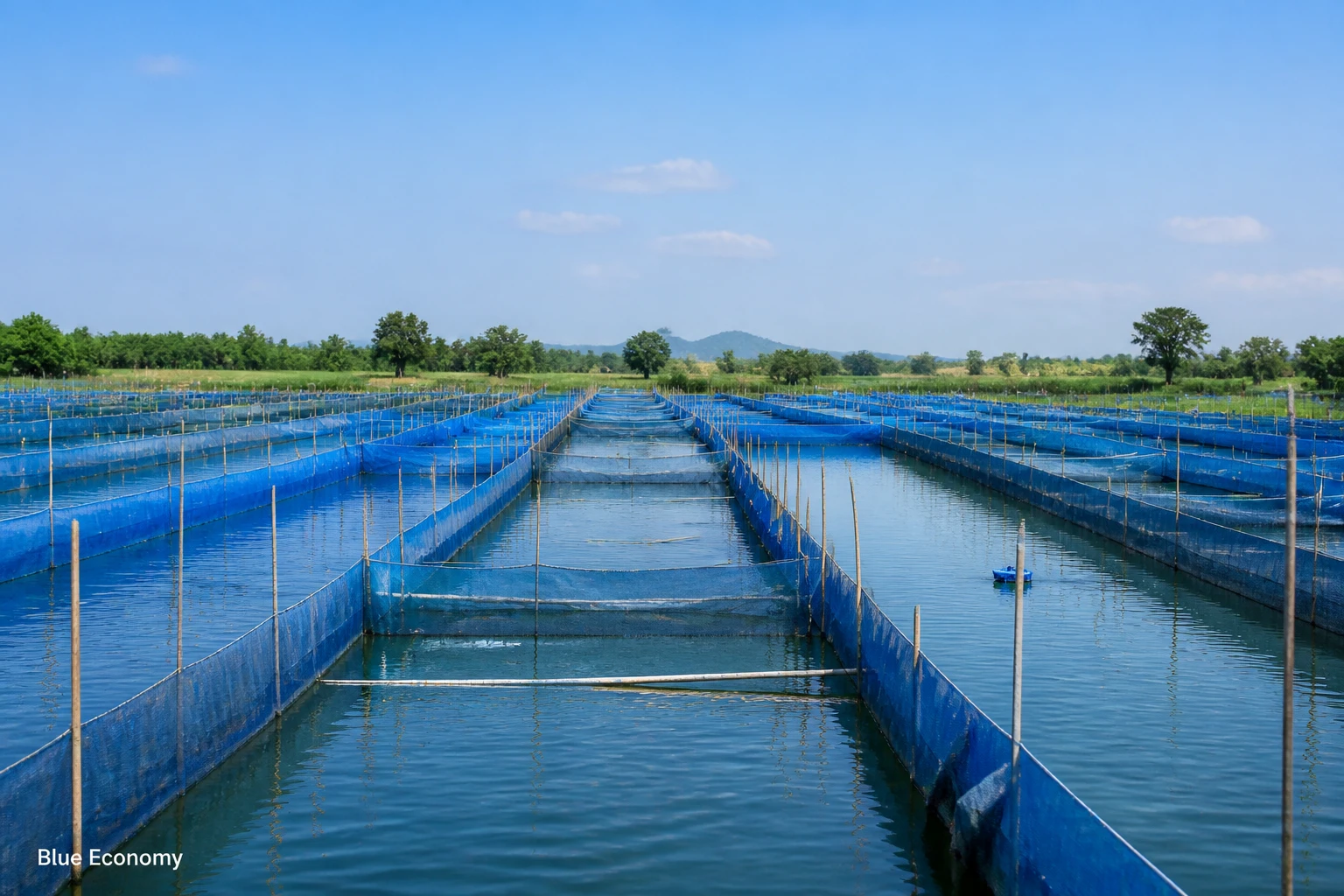
Prabowo’s shrimp-farm visit points to a bigger blue-economy play
A single hectare in Kebumen is said to generate Rp2.8 billion, offering a vivid case for how Indonesia is rethinking aquaculture as an investable growth story.
President Prabowo Subianto’s visit to the Area-Based Shrimp Farming site in Kebumen was more than a ceremonial stop on an agricultural circuit. It was a signal that Indonesia intends to treat aquaculture not as a peripheral rural activity, but as a strategic industry with export value, productivity upside and room for private capital.
What matters to investors is not the symbolism alone. The striking claim attached to the site, that a bumper harvest can produce Rp2.8 billion per hectare, suggests a business model that, if scalable and replicable, could reshape how the country thinks about coastal land, cold-chain logistics and food security.
The Context
Shrimp is one of Indonesia’s most commercially important marine commodities. It sits at the intersection of domestic food demand, export earnings and regional development policy. For years, the sector has promised more than it has consistently delivered, constrained by fragmented farm sizes, disease risk, infrastructure gaps and uneven productivity.
That is why a model such as the Area-Based Shrimp Farming system in Kebumen matters. The underlying logic is straightforward: centralise production, improve water management, standardise husbandry practices and extract higher yields from a smaller footprint. In principle, this should lower waste, increase consistency and make investment appraisal more bankable.
The headline figure from the visit is the one that will travel fastest through policy circles and investor chat: Rp2.8 billion per hectare. Even allowing for differences in methodology, crop cycle timing and operating costs, that level of gross output places shrimp farming in a different league from conventional agriculture.
“A hectare is no longer just a patch of coastal land; it can be a production unit with industrial economics.”
For context, that matters because investors in emerging markets often underestimate the value of process rather than asset class. The land itself is only part of the story. The real value lies in whether the site has reliable power, clean water intake, drainage discipline, post-harvest handling and access to markets. In other words, whether it functions like an operating system rather than a stand-alone farm.
This is precisely the sort of shift that can attract patient capital. When policy leadership visibly engages with a sector, it often reduces perceived execution risk, especially in markets where investors worry about fragmented oversight and weak coordination. A presidential visit does not guarantee returns, but it can accelerate the translation of an idea into a funded programme.
The broader macroeconomic case is also relevant. Indonesia continues to seek export sectors that can diversify growth beyond commodities and manufacturing alone. Aquaculture, particularly shrimp, has the advantage of linking rural employment, processing activity and trade receipts in a single value chain. For provincial economies, that combination can be more durable than a one-off infrastructure spend.
For investors from Europe, Australia and the United States, the opportunity set is not only in direct farm ownership. It extends to equipment, hatchery systems, feed, testing, cold storage, logistics, packaging and traceability software. Each of these layers can carry different risk profiles and return horizons, allowing exposure to the sector without taking on the full biological risk of production.
The key is to read the Kebumen example as a systems story. When productivity can be made visible and repeatable, capital becomes easier to allocate. That is the core investment proposition here.
From Policy Signal to Investable Sector
A good policy signal is not the same as a bankable asset, but it is often where the first serious capital conversations begin. In aquaculture, the path from concept to investable platform depends on a sequence of practical questions: can the farm maintain biosecurity, can output volumes remain stable across cycles, can water quality be monitored, and can the operator sell at prices that survive input volatility?
The Kebumen site is useful because it anchors those questions in a measurable outcome. A hectare that can generate Rp2.8 billion in output implies that the economics of scale may be attractive enough to justify investment in better engineering and tighter operational control. It also invites scrutiny, which is healthy. Strong numbers should be stress-tested, not repeated uncritically.
A useful way to think about the sector is to distinguish between headline production value and investable surplus. Gross output is important, but it is not cash flow. Feed, labour, energy, mortality, disease management, financing costs and logistics all shape the final return. Still, when gross output is this high, there is room for attractive economics even after a disciplined cost base is applied.
A simplified investment lens looks like this:
| Layer | What it contributes | Investor angle | |---|---|---| | Farm design | Productivity, water control, density | Capex-heavy, but central to yield | | Hatchery supply | Seed quality and consistency | Lower risk, recurring demand | | Feed and inputs | Growth rates and survival | Large addressable market | | Cold chain | Preservation and export readiness | Infrastructure-style returns | | Processing | Value capture and quality control | Margin expansion potential | | Traceability | Market access and compliance | Increasingly important for export |
The attraction is that each layer can be invested in differently. A family office may prefer equity in a processing business. A more conservative investor might look at debt financing against equipment or warehouse assets. Development capital may support the infrastructure required to make the entire chain work.
This matters particularly in an era when investors are looking for inflation-resilient real assets with an operational moat. Shrimp is not a passive yield play. It is a management-intensive business. But that is exactly why efficient operators can earn a premium.
One should also note the policy alignment. A government that highlights a successful farming model is usually signalling a desire to scale it. That can lead to more permissive permitting pathways, infrastructure support, technical assistance or clustering strategies. None of that is guaranteed, but it is often the difference between a niche success and a sectoral build-out.
For international investors, the comparison is instructive. In many frontier and emerging markets, agricultural narratives can sound promising while remaining operationally thin. Here, the emphasis on measurable hectare-level productivity gives the story a firmer base. It is easier to finance something that can be priced, tracked and audited.
At the same time, the risks should be stated plainly. Aquaculture can suffer from disease outbreaks, environmental pressure and price swings. Concentrated production may improve control, but it can also magnify systemic failures if governance is weak. Any serious investor should therefore prefer structures with strong reporting, third-party verification and contingency planning.
The best outcome is not simply larger farms. It is more resilient farms.
 Prabowo’s shrimp-farm visit points to a bigger blue-economy play · Photo by Tom Fisk on Pexels
Why This Matters Beyond Kebumen
It is tempting to see the Kebumen visit as a local story about shrimp. That would miss the larger point. Indonesia is trying to build an investment narrative around productive land use, export-oriented food systems and better rural economics. That is the sort of narrative that can pull in capital when it is backed by visible results.
For Lombok readers, the analogy is immediate. The island’s investment thesis has long relied on the idea that underdeveloped but strategically placed assets can compound rapidly when infrastructure, branding and management improve. The same logic applies here. Coastal land with strong utility access, a clear production model and export connectivity can become far more valuable than its surface appearance suggests.
The comparison across asset classes is also instructive:
- In property, value is created by access, planning and amenity.
- In aquaculture, value is created by water quality, biosecurity and throughput.
- In both cases, the market rewards disciplined operators more than speculative landholders.
That is why the shrimp sector deserves investor attention now. It is not because every farm will be profitable, or because government endorsement removes risk. It is because the combination of measurable productivity and policy visibility can unlock a more mature capital stack.
For those accustomed to tourism, hospitality or residential real estate, this is a reminder that Indonesia’s growth story is not confined to beaches and villas. Productive coastline can matter just as much as scenic coastline. In some cases, more so.
There is also a strategic trade-off at work. Countries that want to expand export earnings while creating regional employment need sectors that are capital-efficient, scalable and rooted in local geography. Shrimp farming, when done well, can satisfy all three conditions. That is why policymakers keep returning to it.
The unanswered question is execution. Will more regions adopt industrial-style aquaculture clusters? Will supporting infrastructure keep pace? Will private investors be brought in on terms that reward quality rather than volume alone? The answers will determine whether Kebumen becomes a reference point or a one-off success story.
For now, the visit suggests that the sector is moving up the policy agenda. For investors, that is enough to merit attention, even if it does not justify complacency.
What This Means for Investors
The investment lesson is not that shrimp farming is suddenly low-risk. It is that Indonesia is increasingly willing to frame agricultural production as an industrial, scalable and investable activity. That shift can be powerful when it is paired with technical discipline and credible local partners.
Investors should watch four things closely:
- Whether area-based farming models can maintain consistent output beyond one cycle.
- Whether the infrastructure around them, especially cold chain and transport, scales properly.
- Whether export quality and traceability standards improve.
- Whether capital can enter the sector through structures that match risk to return.
For those with a broader Indonesia thesis, this is a useful reminder that frontier value often appears first in the productive use of land rather than in the land title alone. The best opportunities tend to sit where policy, logistics and management intersect.
The Kebumen example does not replace due diligence. It does, however, sharpen the case for paying attention to blue-economy assets that can demonstrate real throughput. In a market where everyone looks for the next growth story, the most durable ones are usually those that can be measured hectare by hectare.
Stay informed, subscribe to the free Lombok Briefing for market intelligence like this, published twice a month.
What is the gross output potential of shrimp farming per hectare in Indonesia?
The Area-Based Shrimp Farming site in Kebumen demonstrated that a bumper harvest can produce Rp2.8 billion per hectare. This places shrimp farming in a different league from conventional agriculture, though investors should account for feed, labour, energy, disease management and logistics costs before treating that figure as net return.
Can foreign investors access Indonesia's shrimp sector without owning a farm directly?
Yes. The investment opportunity extends beyond direct farm ownership to equipment, hatchery systems, feed, testing, cold storage, logistics, packaging and traceability software. Each layer carries a different risk profile and return horizon, allowing exposure to the sector without taking on the full biological risk of production.
Why is President Prabowo's visit to the Kebumen shrimp farm significant for investors?
When policy leadership visibly engages with a sector it often reduces perceived execution risk, particularly in markets where investors worry about fragmented oversight. The visit signals that Indonesia now treats aquaculture as a strategic export industry. A gross output of Rp2.8 billion per hectare at the Kebumen site anchors that signal in a measurable outcome.

The Lombok Buyer's Field Guide
Legal structures ranked by risk, the honest ROI math line by line, all six zones ranked, and the 24-point due-diligence checklist. The whole book, free in your inbox.
See what's inside