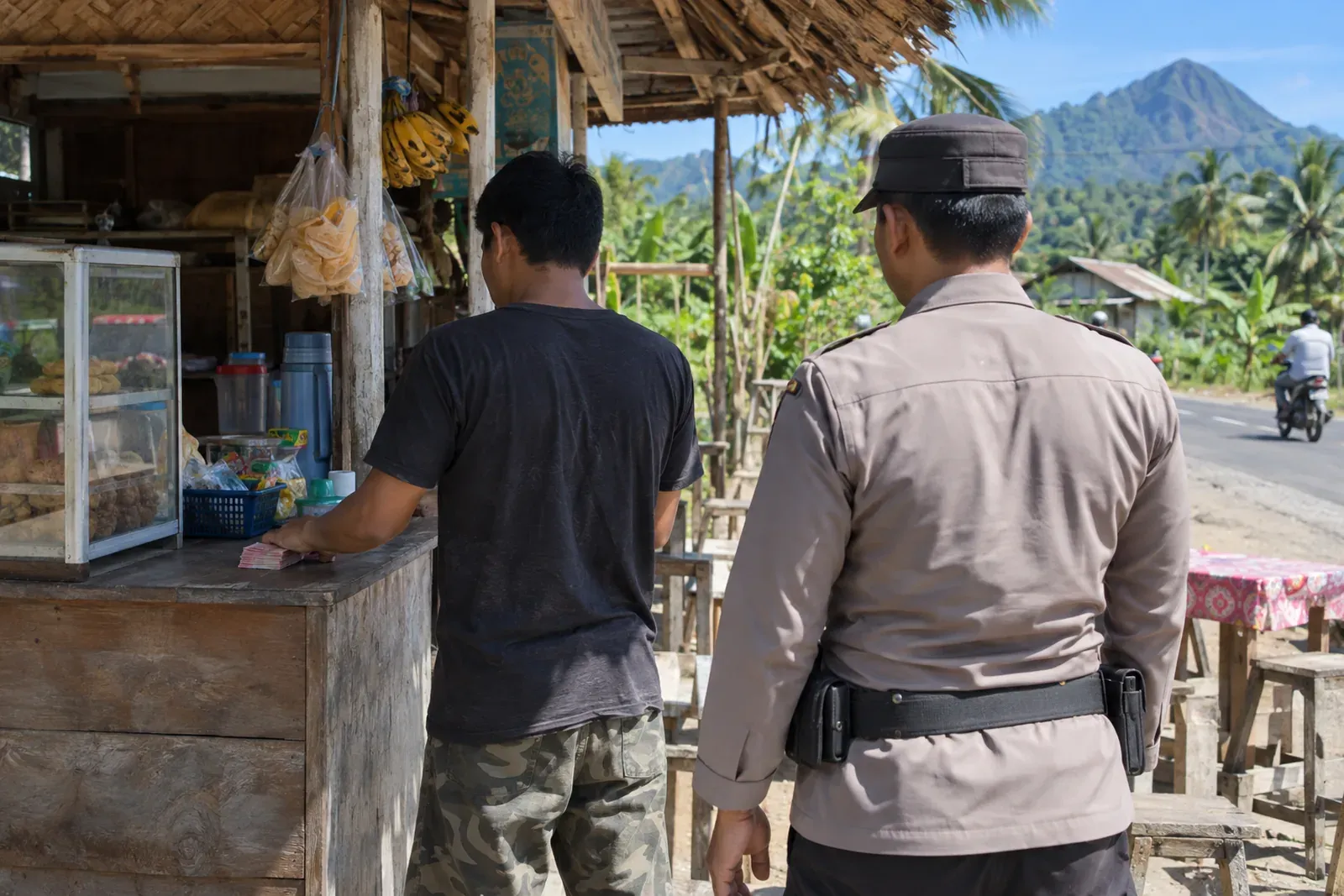
Indonesia’s police chief calls on businesses to report illegal levies
Indonesia’s police chief has urged companies to report thuggery and illegal levies, framing public security as central to investor confidence.
Indonesia’s national police chief has urged companies and business owners to report thuggery, illegal levies and other crimes that disrupt commercial activity. The message is straightforward: security, legal certainty and functioning industrial relations are being presented as core conditions for sustaining investment.
A direct appeal to businesses
Speaking during a meeting with the Federation of Indonesian Metal Workers’ Union (FSPMI) in Bekasi District, West Java, National Police Chief General Listyo Sigit Prabowo encouraged businesses facing disruption to come forward.
He said police had been instructed to follow up immediately on reports involving thuggery, illegal levies or other crimes, with the stated aim of ensuring that investors do not hesitate to invest in Indonesia. The comments were issued through a police press statement quoted by Antara.
“Business people and companies that continue to encounter acts of thuggery, illegal levies, or other crimes are encouraged to report them,” Prabowo said.
For investors, the importance of the statement lies less in its rhetoric than in the institutional expectation it sets: business disruptions should be reported, and law-enforcement authorities should respond. That is particularly relevant in a market where the practical experience of operating an asset can matter as much as the headline investment case.
Security as an investment foundation
Prabowo described public security and order as important foundations for the sustainability of the business sector. In his assessment, a well-maintained security environment can support workers’ confidence, smoother company operations and stronger investor confidence.
This framing recognises a basic commercial reality. Investment decisions depend on more than demand, pricing or physical assets. Investors also assess whether a business can operate predictably, whether disputes can be addressed through recognised channels, and whether the authorities signal an intention to protect lawful activity.
The police chief said the National Police would continue to provide protection and legal certainty so that industrial activity could operate safely and sustainably. He also sought to reassure the business sector and investors that Indonesia is a safe and conducive place to invest.
National investment realisation reached Rp1,010.6 trillion in the first half of 2026, according to Prabowo.
The figure was cited as evidence of Indonesia’s potential as an investment destination. Prabowo linked that potential to the country’s natural resources, large domestic market and downstream development across strategic sectors. These are national observations, rather than a measure of conditions in any single region or asset class.
The labour relationship matters too
The address did not focus solely on criminal disruption. Prabowo also reminded companies to comply with regulations, fulfil workers’ rights and build fair, harmonious industrial relations.
He argued that workers and employers are mutually dependent: companies need workforce support to sustain production, while workers rely on healthy and growing companies as a source of livelihood. His proposed route for resolving labour-related issues was communication and deliberation among the parties.
For a business owner or prospective investor, that is a useful reminder that operational resilience is not only a matter for security teams or legal advisers. Employment practices, regulatory compliance and dispute management are part of the broader environment in which an enterprise must function.
The police chief’s intervention therefore contains two linked messages:
- Businesses should report criminal disruption rather than absorb it silently.
- Companies should also meet their responsibilities to employees and seek constructive resolution of labour issues.
Neither principle substitutes for due diligence. But together they describe the type of operating environment policymakers say they want to uphold: one in which businesses can function safely while workers’ rights and lawful processes are respected.
What this means for investors
The immediate news concerns Indonesia’s national business climate, not a new investment rule or a sector-specific policy. Investors should therefore avoid treating the statement as a guarantee about any individual transaction, location or operating partner.
Instead, it offers a timely prompt to make risk assessment practical. Before committing capital, investors should understand the reporting channels available to a business, the allocation of security and compliance responsibilities, and the documentation supporting the investment structure.
For foreign buyers considering Lombok property, legal structure remains a distinct issue. Foreigners cannot hold freehold, known as Hak Milik or SHM; that title is reserved for Indonesian citizens. Available routes include leasehold, Hak Pakai for eligible residents, and a foreign-owned PT PMA holding Hak Guna Bangunan or HGB.
Nominee arrangements, in which an Indonesian citizen holds freehold on a foreigner’s behalf, are illegal and void in court. A licensed PPAT notary executes deeds, while the BPN is the land agency. Investors should commission proper due diligence over certificates, ownership history, zoning and encumbrances before proceeding.
TerraNusa Advisory, HubLombok’s legal and notary advisory partner, provides due diligence, PT PMA setup, tax support and deed-and-title-transfer assistance for foreign buyers in Lombok. Its role is advisory; the investor remains responsible for obtaining appropriate independent advice for the transaction at hand.
The broader lesson from Prabowo’s remarks is measured rather than dramatic. A favourable market narrative must be matched by credible execution: lawful structures, documented checks, fair employment practice and a willingness to report misconduct where it arises.
Stay informed, subscribe to the free Lombok Briefing for analysis like this, published twice a month.
What did Indonesia’s police chief ask businesses to do?
National Police Chief General Listyo Sigit Prabowo urged businesses and company owners to report thuggery, illegal levies and other crimes that disrupt commercial activity. He said police had been instructed to follow up on such reports promptly to support investor confidence.
Does this announcement create a new rule for Lombok property investors?
No. The statement concerns Indonesia’s national business climate and does not establish a new Lombok property rule. Foreign buyers should still use a lawful ownership route, conduct certificate and zoning due diligence, and obtain transaction-specific independent legal advice.
Can a foreign investor hold Indonesian freehold land after this announcement?
No. Foreigners cannot hold Hak Milik, or SHM, freehold title, which is reserved for Indonesian citizens. Lawful foreign-buyer routes include leasehold, eligible Hak Pakai arrangements, or a PT PMA holding HGB; nominee structures are illegal and void in court.

The Lombok Buyer's Field Guide
Legal structures ranked by risk, the honest ROI math line by line, all six zones ranked, and the 24-point due-diligence checklist. The whole book, free in your inbox.
See what's inside