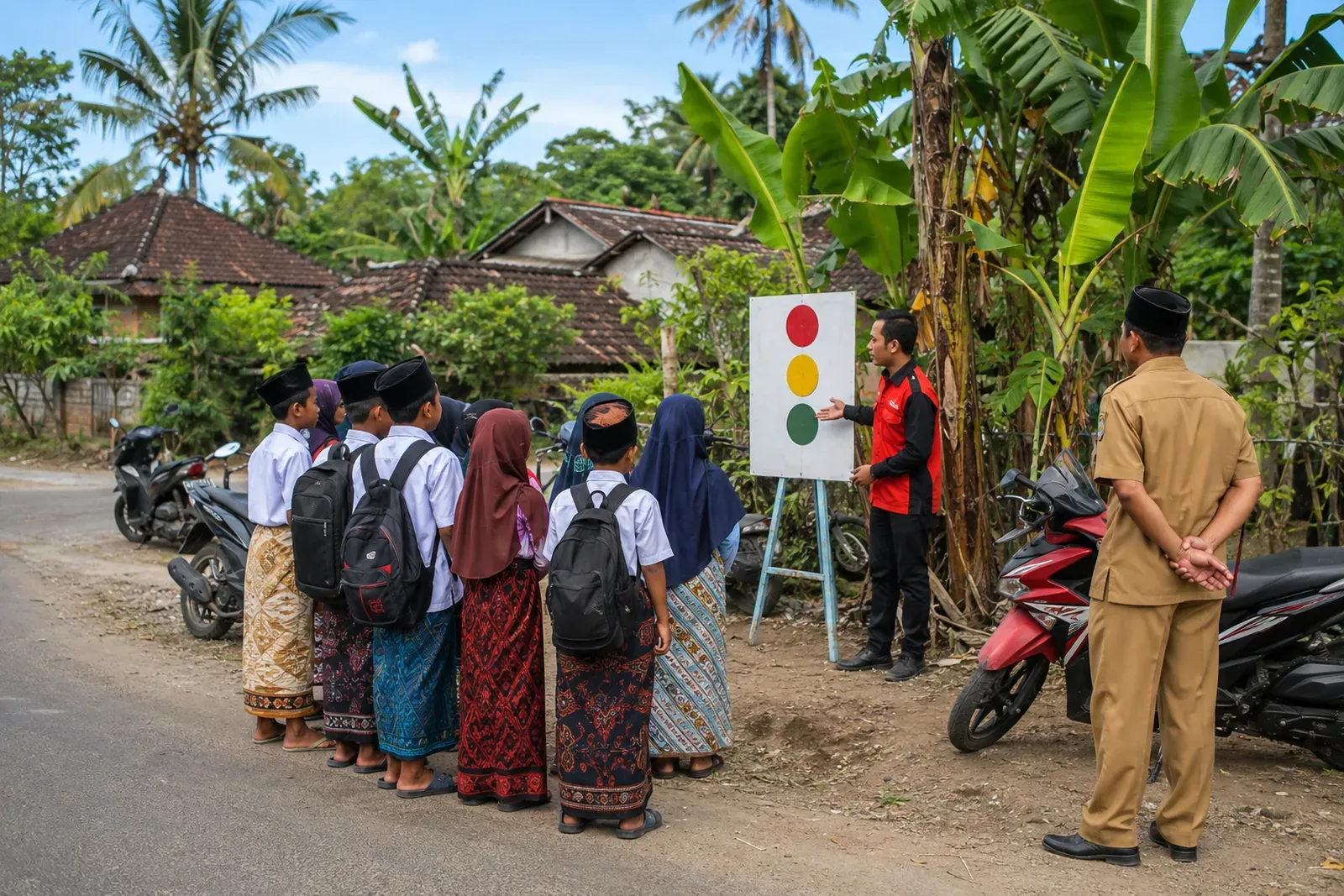
Road-Safety Education Brings NTB Institutions Together
Astra Motor NTB joined public-sector partners for a road-safety education initiative in NTB, Radar Lombok reports.
Astra Motor NTB has joined Jasa Raharja Provinsi NTB, Detasemen Polisi Militer (Denpom) and Ditlantas Polda NTB in a road-safety education activity, according to Radar Lombok. The initiative placed driver discipline and individual awareness alongside vehicle and road conditions in the discussion of safer travel.
A shared focus on road users
The message reported by Radar Lombok is straightforward: road safety does not rest solely on the state of a vehicle or the condition of a road. It also depends on the conduct, discipline and awareness of each person using it.
That framing matters because it makes road safety a shared responsibility. A vehicle may be maintained and a route may be familiar, yet the choices made by drivers and other road users remain central to the experience of travel. The education activity brought several institutions into the same conversation, linking a commercial motor-industry participant with public bodies involved in traffic, protection and enforcement.
Radar Lombok reported that participants received information on the rights and benefits of available protection.
The source does not provide further detail on the format of the education activity, the specific material presented or the protection arrangements discussed. It does, however, make clear that the programme combined safety awareness with information intended to help participants understand their rights and benefits.
The institutions involved
The initiative involved four named parties:
- Jasa Raharja Provinsi NTB
- Detasemen Polisi Militer (Denpom)
- Ditlantas Polda NTB
- Astra Motor NTB
Such collaboration is notable in its own right. Road safety touches regulation, behaviour, public awareness and the everyday use of motor vehicles. Bringing together bodies with different roles can help present a more joined-up message to participants, particularly when that message concerns both responsible conduct and an understanding of available protection.
The report does not attribute a quote to any of the participating organisations, nor does it set out future commitments arising from the activity. Investors and readers should therefore treat the event as a reported education initiative, rather than as evidence of a newly announced policy, infrastructure programme or regulatory change.
Why the message is broader than a single event
For Lombok’s visitors, residents, workers and businesses, travel conditions form part of the wider operating environment. Yet the source offers no figures on traffic, incidents, visitor movements, transport demand or the scale of the programme. It would be inappropriate to infer a trend from this single report.
Still, the emphasis on discipline is useful. It recognises that safer mobility is not merely an engineering question. Behaviour on the road is part of the practical fabric of a destination: it shapes how individuals approach daily journeys and how organisations communicate responsibility to their communities.
The involvement of Astra Motor NTB also gives the initiative a business dimension without changing its public-interest focus. The source presents the company as working with its partners on road-safety education, rather than promoting a product, a development project or an investment proposition.
What this means for investors
For investors assessing Lombok, this report is best read as a modest but relevant signal of local attention to road-user education. It is not, on the available evidence, a basis for making conclusions about transport performance, public policy outcomes or property values.
A disciplined approach to interpretation is especially important in emerging markets. The useful question is not whether one education activity can prove a wider change; it cannot. The more constructive question is whether public institutions and private-sector participants are engaging with practical issues that affect everyday mobility. In this case, Radar Lombok reports that they are.
Investors should keep the distinction clear:
- The reported activity concerns road-safety education.
- It involved Astra Motor NTB, Jasa Raharja Provinsi NTB, Denpom and Ditlantas Polda NTB.
- Participants were given information regarding rights and benefits of available protection.
- The source does not provide quantified outcomes, investment implications or details of a future programme.
That restraint is worth preserving. Property, hospitality and business decisions should rest on verified due diligence relevant to the particular asset or operation under consideration. A local news report can provide context, but it should not be made to carry more analytical weight than its evidence supports.
A practical public-interest signal
The value of road-safety education lies in the clarity of its central proposition: each road user has a role. By placing discipline and awareness beside vehicle and road conditions, the participating organisations have highlighted a practical view of safety that does not depend on a single actor.
For the Lombok investment audience, the immediate takeaway is measured rather than dramatic. This was a locally reported collaboration around safer road use and awareness of protection-related rights and benefits. Its longer-term significance will depend on what follows, which the available source does not specify.
Stay informed, subscribe to the free Lombok Briefing for analysis like this, published twice a month.
Which organisations took part in the NTB road-safety education activity?
Radar Lombok reported that the road-safety education activity involved Astra Motor NTB, Jasa Raharja Provinsi NTB, Detasemen Polisi Militer (Denpom) and Ditlantas Polda NTB. The report presents the initiative as a collaborative education activity focused on safer road use.
What was the main road-safety message of the reported initiative?
The reported message was that road safety depends not only on vehicle condition and road condition, but also on the discipline and awareness of every road user. Participants also received information about the rights and benefits of available protection.
Does the report announce a new transport policy or infrastructure project?
No. The supplied Radar Lombok report describes a road-safety education activity involving several organisations. It does not provide details of a new transport policy, infrastructure project, quantified safety outcome or future programme commitment.

The Lombok Buyer's Field Guide
Legal structures ranked by risk, the honest ROI math line by line, all six zones ranked, and the 24-point due-diligence checklist. The whole book, free in your inbox.
See what's inside