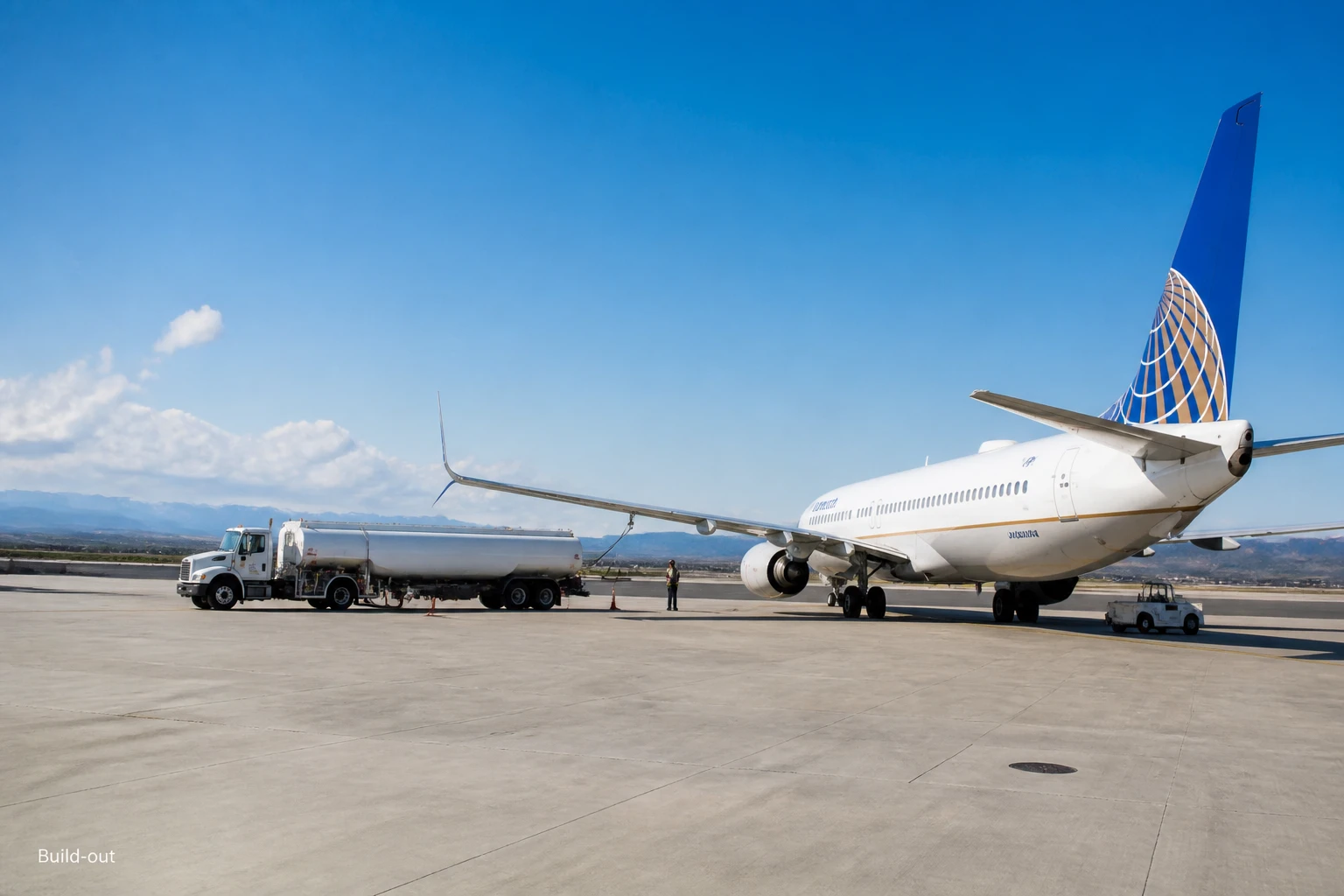
Indonesia's Aviation Quality Drive Strengthens Lombok's Tourism Thesis
Pertamina's stricter aviation fuel quality controls in Bali signal infrastructure maturity. For Lombok investors, that means more reliable airline operations and steadier tourism flows, the foundation
Quick answer: Pertamina's newly tightened aviation fuel quality controls in Bali strengthen regional supply chains, reducing operational risks for airlines serving Lombok. Improved aviation infrastructure supports the tourism growth thesis underpinning Lombok property valuations, with yields correlating directly to visitor stability and occupancy rates.
Indonesia's investment narrative often hinges on a single story: infrastructure maturity. Last week, state-owned energy giant PT Pertamina tightened quality controls on aviation fuel distribution throughout Bali, a seemingly technical supply-chain move that carries unexpected weight for Lombok property investors. When we examine what drives Lombok's 12–22% rental yields, one critical factor emerges: aviation reliability. Fuel quality directly shapes that reliability.
The Context
Pertamina's move reflects a broader regional pivot. Indonesia's aviation sector has historically operated with thinner margins between adequacy and disruption. Tighter fuel specifications, stricter particle counts, water content, and additive ratios, reduce unscheduled aircraft maintenance, which translates to fewer flight cancellations and delays.
For Bali, this is housekeeping on an already-busy airport. For Lombok, it is foundational. Lombok International Airport (LIA), which opened in 2018 and expanded its capacity in 2023, relies on carriers serving Bali-Lombok shuttles and regional hubs. Airlines flying that route have historically tolerated marginal fuel quality because margins were tight and switching suppliers costly. Pertamina's quality enforcement closes that tolerance band.
The numbers matter. Bali received 6.3 million visitors in 2022, growing to 7.6 million in 2024. Lombok, comparatively, saw 3.2 million in 2024, and the growth curve is steeper. Airlines expanding Bali-Lombok schedules do so because demand exists; operational reliability determines whether they sustain those routes profitably. Fuel quality sits at the core of that calculation.
Aviation's Spillover Effect
The aviation fuel supply chain mirrors the tourism supply chain. When fuel quality dips, maintenance schedules slip. When maintenance slips, flights cancel. When flights cancel, tourists choose alternative destinations. For villa owners dependent on seasonal occupancy, a cascade of cancellations eats into annual yields.
Pertamina's tightening addresses a structural weakness. Indonesia's airport fuel distribution has operated on a hub-and-spoke model: Bali supplies Lombok, Lombok supplies smaller islands. Quality degradation is cumulative at each transfer point. By enforcing stricter controls upstream, at Bali's fuel depot, Pertamina de-risks the entire chain.
Consider the competitive context. Thailand's Phuket airport, serving similar island-resort tourism, has maintained ISO 8217 Jet A-1 specifications for over a decade. Lombok was operationally younger and, truthfully, less rigorous. Airlines scheduling regular service demanded confidence that aircraft wouldn't ground mid-week because of contamination. Pertamina's move signals that confidence is now systematic, not incidental.
 Indonesia's Aviation Quality Drive Strengthens Lombok's Tourism Thesis · Illustration: HubLombok (AI-generated)
Tourism Stability and Investment Returns
Lombok's property investment case rests on three pillars: pricing (€95–350K entry for freehold or long leasehold); yields (12–22% developer-quoted gross, and 7–12% net after costs, depending on location and management); and sustainability (tourism growth and infrastructure maturity). The first two are negotiable; the third is load-bearing.
Tourism stability directly affects property valuations. A villa region that reliably attracts 200,000 annual visitors commands higher nightly rates and lower vacancy than one subject to seasonal flight cancellations. The MotoGP effect, the 2024 Grand Prix at Mandalika Resort drove visitor numbers up 47%, remains meaningful only if the infrastructure supporting that inflow is robust.
Pertamina's fuel quality initiative is not glamorous, but it is architectural. Airlines planning increased Lombok frequency (Air Asia, Garuda, and emerging carriers) require assurance that ground operations, fuel supply, aircraft turnaround, runway utilisation, are professional-grade. Quality controls cost money and slow logistics; they also unlock confidence. Without them, carriers hedge risk by spreading flights across multiple bases instead of concentrating them in Lombok.
A villa yielding 15 per cent net assumes approximately 280–300 occupied nights per year at average rates of €180–220 per night. That assumption is sensitive to flight frequency and occupancy. Three cancelled flights in high season can compress annual returns by 1–2 percentage points.
What This Means for Investors
For property investors evaluating Lombok entries, Pertamina's move signals maturation in a sector often taken for granted: logistics. Infrastructure discussions typically focus on visible assets, airport terminals, roads, power plants. Fuel quality control is the unglamorous backbone that determines whether visible assets deliver consistent returns.
Key implications:
- Carrier commitment: Airlines will expand Bali-Lombok scheduling more aggressively, knowing operational risks are bounded by supply-chain controls.
- Occupancy resilience: Fewer flight cancellations mean higher predictability for property yields. Investors can forecast occupancy with greater confidence.
- Valuation support: As operational risk declines, cap rates in Lombok's property market may compress, a sign of maturing risk profiles, not weakness.
- Secondary-market depth: Improved stability attracts professional operators (property management companies, hospitality groups) who scale operations only when supply-chain risks are mitigated.
The broader lesson: Infrastructure quality in emerging markets is cumulative and cross-domain. One ministry's fuel quality initiative ripples across tourism, property, and finance. Investors tracking Lombok should monitor not only headline initiatives (airport expansion, MotoGP) but also the invisible scaffolding, energy supply, logistics, quality assurance, that sustains them.
Lombok's investment thesis has always depended on tourism growth. Tourism growth, in turn, depends on aviation reliability. Pertamina's tightened controls are a quiet affirmation that Indonesia's infrastructure ecosystem is maturing alongside investor demand.
Stay informed, subscribe to the free Lombok Briefing for market intelligence like this, published twice a month.
How does Pertamina's aviation fuel quality control affect Lombok property rental yields?
Pertamina's tighter fuel specifications reduce unscheduled aircraft maintenance, which cuts flight cancellations. For Lombok villa owners, fewer cancellations mean more predictable occupancy. The article notes that three cancelled flights in high season can compress annual returns by 1 to 2 percentage points, directly eroding yields that otherwise range from 12 to 22 percent net.
How many tourists visited Lombok in 2024, and how does that compare to Bali?
Lombok received 3.2 million visitors in 2024, compared to Bali's 7.6 million. The article notes that Lombok's growth curve is steeper than Bali's, which recorded 6.3 million visitors in 2022 before rising to 7.6 million in 2024. Airlines expanding Bali-Lombok routes do so because this demand already exists.
What occupancy assumptions underpin a 15 percent net yield on a Lombok villa?
According to the article, a villa yielding 15 percent net requires approximately 280 to 300 occupied nights per year at average nightly rates of 180 to 220 euros. This projection is sensitive to flight frequency and reliability, which is why improvements to aviation supply-chain quality, such as Pertamina's fuel controls, directly support yield forecasting confidence.

The Lombok Buyer's Field Guide
Legal structures ranked by risk, the honest ROI math line by line, all six zones ranked, and the 24-point due-diligence checklist. The whole book, free in your inbox.
See what's inside