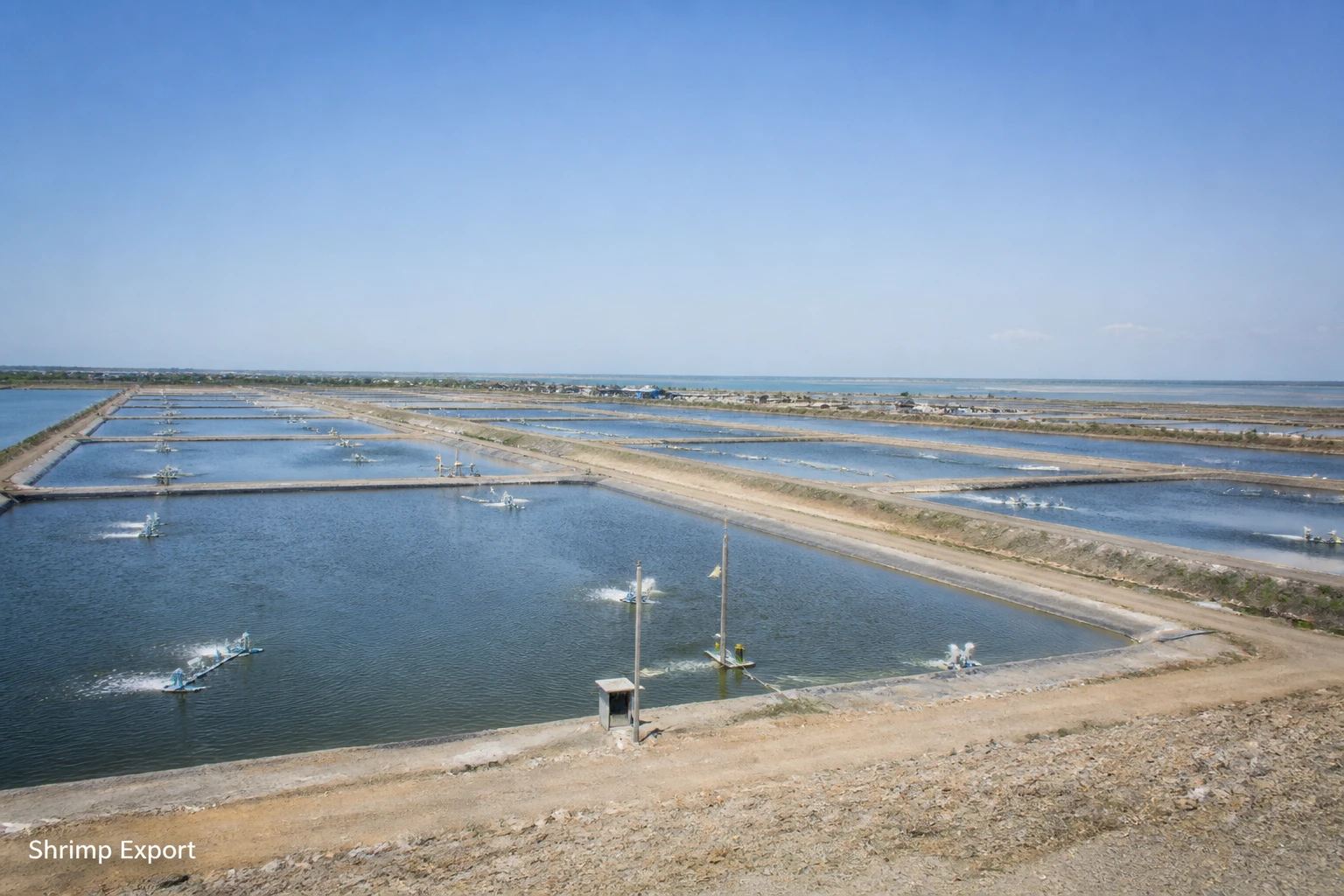
Indonesia’s shrimp expansion signals a new food-export push under Prabowo
Jakarta is scaling up shrimp farms nationwide, with Kebumen as the template. Investors should watch export earnings, cold-chain demand and coastal land plays.
Indonesia’s latest move into industrial shrimp farming is more than an agricultural story. It is a live signal that President Prabowo Subianto’s administration wants the seafood economy to become a faster, more measurable engine of exports, jobs and regional development.
The immediate catalyst is the government’s push to replicate the Area-Based Shrimp Farming model in Kebumen, Central Java, after Prabowo inspected the facility and framed it as a national template. For investors, the message is clear: Indonesia is trying to turn aquaculture into investable infrastructure, not just a rural livelihood.
The Context
The scale matters. According to ANTARA, the Kebumen site has 206 ponds and can generate around Rp67.2 billion in production value per cycle, with annual output potentially reaching Rp134.4 billion under optimal management. That translates to roughly Rp2.8 billion per hectare in harvest value, a striking figure for a sector often treated as fragmented and seasonal.
206 ponds, Rp67.2 billion per cycle, and Rp2.8 billion per hectare: this is not a pilot in name only, but a state-backed production model being readied for replication.
Prabowo’s broader framing is equally important. The administration is presenting productive pond farms as a tool to:
- create jobs in coastal regions
- generate added value through processing and logistics
- increase foreign exchange through food exports
- strengthen Indonesia’s position in global seafood supply chains
That language matters to capital allocators because it shifts shrimp from an isolated commodity story into a policy-led growth theme. When governments talk in export multipliers, the investable opportunity usually extends beyond farm gates to include hatcheries, feed, freezing capacity, port handling, certification, and transport.
The government is already pointing to further expansion beyond Kebumen, with projects cited in Waingapu, Gorontalo, and Pantura, West Java. That suggests the model is not being tested for publicity value; it is being prepared for geographic scale.
| Location | Project scale | Status / note | |---|---:|---| | Kebumen, Central Java | 206 ponds | Current reference model | | Waingapu, East Sumba | 2,000 hectares | Large-scale project under development | | Gorontalo | 200 hectares | Expansion project under way | | Pantura, West Java | 14 hectares | New build cited by the President |
The production economics are compelling, but they also reveal the real investment story: the state is trying to build a repeatable coastal industrial platform. That has implications for land use, water management, cold storage, hatchery supply, disease control, and export compliance.
The Expansion Model
What stands out in this announcement is not simply the size of the ponds, but the shift in development logic. Indonesia is not discussing isolated farm output. It is discussing a chain of assets that can be standardised and scaled across provinces.
That is a familiar playbook in emerging-market food systems. First comes a flagship site. Then comes the regulatory narrative. Then come the replicated assets and the private capital that follows them.
In this case, the investment logic could unfold across four layers:
- Primary production: pond construction, water systems, aeration, breeding and feed.
- Midstream processing: sorting, freezing, packaging and quality control.
- Logistics and trade: roads, cold-chain transport, export handling and customs readiness.
- Enabling services: certification, insurance, equipment maintenance and environmental monitoring.
For the government, this structure is attractive because it ties food security to export earnings. For investors, it can create multiple ways to participate without taking direct farming risk.
The policy tone also suggests that the state wants to pull investment into regions outside the usual urban and tourism corridors. That matters because Indonesia’s coastal periphery often lacks the infrastructure depth that makes private capital comfortable. If Jakarta is prepared to underwrite early-stage pond systems, the secondary opportunities become more credible.
A useful comparison is with other Indonesian growth narratives that have moved from policy rhetoric to bankable projects. The difference now is that shrimp offers shorter production cycles and a clearer path from farm output to export receipts than many longer-dated industrial schemes. That can make the economics easier to model, especially if disease risk is contained and throughput stays stable.
 Indonesia’s shrimp expansion signals a new food-export push under Prabowo · Photo by Tom Fisk on Pexels
There is also a timing angle. The administration is trying to show visible economic delivery while global food markets remain sensitive to supply disruptions and price volatility. If the shrimp programme improves Indonesia’s reliability as a supplier, it could lift its bargaining power with buyers in Asia, the Middle East and Europe.
For domestic stakeholders, that would be a win across the board: local employment, more formal coastal land use, and stronger foreign exchange inflows. For investors, the key question is whether the government can convert a strong headline into a disciplined operating model.
That means watching for:
- whether expansion sites are selected for water quality and logistics, not just political balance
- whether feed and breeding inputs are localised or imported
- whether export-grade processing is built alongside production
- whether environmental standards are enforced tightly enough to avoid long-term degradation
The high-level thesis is straightforward. Indonesia wants shrimp to become a strategic export pillar. The execution question is whether the system can be expanded without sacrificing margins to disease, infrastructure gaps or weak site selection.
What This Means for Investors
For investors looking at Indonesia’s coastal economy, this is a constructive signal. The state is effectively telling the market that aquaculture will be treated as a national development priority, not a peripheral subsector.
That could support several themes:
- Agribusiness and seafood supply chains: feed, hatcheries, processing and packaging
- Cold-chain logistics: warehouses, reefers, inland distribution and port handling
- Regional infrastructure: roads, water systems, power and drainage near production zones
- Land and development plays: serviced coastal land near designated aquaculture corridors
The immediate relevance to Lombok and the wider eastern Indonesian story is indirect but real. When Jakarta prioritises scalable coastal production, it tends to pull capital eastward into regions with available land and lower entry costs. That is the same structural logic investors already use when assessing South Lombok’s entry range of €95,000-350,000, the Bali-overflow thesis, and tourism-led coastal appreciation. Here, the asset class is different, but the development pattern is similar: infrastructure first, then pricing power.
The caution is that aquaculture is operationally unforgiving. Returns can look compelling on paper, yet biosecurity failures, feed cost inflation and weak processing capacity can compress margins quickly. In other words, this is not a passive land-banking story. It is an operating-system story.
The strongest takeaway from today’s announcement is that Prabowo’s government appears ready to use shrimp as a proof point for a wider food-export strategy. If the rollout proceeds at scale, investors should expect a broader repricing of Indonesia’s coastal production economy, especially where public infrastructure and private processing capital can meet.
For now, the dispatch from Kebumen is simple: Indonesia is not merely talking about food resilience. It is building an export platform.
Stay informed, subscribe to the free Lombok Briefing for market intelligence like this, published twice a month.
What is the production value of Indonesia's Area-Based Shrimp Farming model in Kebumen?
The Kebumen reference site operates 206 ponds and generates around Rp67.2 billion in production value per cycle, with annual output potentially reaching Rp134.4 billion under optimal management. The harvest value works out to roughly Rp2.8 billion per hectare, making it a state-backed model the government plans to replicate at scale across multiple provinces.
Where is Indonesia planning to expand its industrial shrimp farming beyond Kebumen?
The Indonesian government has cited expansion projects in Waingapu, East Sumba (2,000 hectares), Gorontalo (200 hectares), and Pantura, West Java (14 hectares). These sites suggest the Area-Based Shrimp Farming model is being prepared for geographic replication rather than remaining a single flagship demonstration.
What investment opportunities does Indonesia's shrimp expansion create beyond direct farming?
The government's model creates four layers of investable activity: primary production covering ponds and breeding; midstream processing including freezing and packaging; logistics covering cold-chain transport and export handling; and enabling services such as certification, equipment maintenance, and environmental monitoring. This structure allows investors to participate without taking direct farming risk.

The Lombok Buyer's Field Guide
Legal structures ranked by risk, the honest ROI math line by line, all six zones ranked, and the 24-point due-diligence checklist. The whole book, free in your inbox.
See what's inside