Indonesia’s Push Beyond Bali Could Reprice Lombok’s Tourism Corridor
Jakarta wants tourism capital beyond Bali. For Lombok, that policy shift could strengthen the island’s investment case from airport-led access to villa-led cash flow.
Tourism capital has a habit of chasing the familiar until policy, price and infrastructure make the next market unavoidable. Indonesia’s renewed effort to direct investors beyond Bali is therefore more than a regional talking point: it is a signal that Lombok is moving from “alternative destination” to a more investable node in the archipelago’s tourism map.
For investors, the important question is not whether Bali remains dominant, but whether the spillover economics are now strong enough for Lombok to stand on its own. The answer is increasingly yes, provided one looks at the island through the lens of access, scarcity and operating yield rather than headline brand recognition alone.
The Context
The government’s message is straightforward: tourism development should not be confined to Bali. In practice, that means encouraging capital into other destinations that can absorb visitors, create employment and broaden Indonesia’s foreign exchange base without overloading one island’s infrastructure. Lombok sits near the centre of that argument because it combines international appeal with a lower entry point and a materially different supply profile.
Bali is still the benchmark, but it is also the constraint. High land prices, congestion, environmental pressure and policy sensitivity have made the island increasingly expensive to build on and harder to underwrite with comfortable margins. That has created a structural opening for nearby destinations that can capture overflow demand. Lombok is one of the clearest beneficiaries of that dynamic.
The case is not merely geographic. Lombok has been absorbing a growing share of attention from travellers and developers who want Bali-adjacent exposure without Bali pricing. That matters because the island’s demand story is not dependent on one segment alone. It draws from surf travellers, luxury leisure buyers, long-stay digital workers, domestic weekend traffic and a smaller but steadily improving base of international tourism.
A useful way to frame the market is through the supply-demand mismatch. The best known parts of South Lombok still offer entry points around €95,000 to €350,000, which is a very different proposition from much of Bali’s prime south-western corridor. At the same time, well-structured villas in strong locations can still target gross yields of 12% to 22%, depending on occupancy, management quality and seasonality. Those are not guaranteed returns, but they are high enough to reward disciplined underwriting.
The practical implication of Jakarta’s policy stance is that Lombok no longer needs to argue only on beauty. It can argue on economics.
For context, several travel and infrastructure indicators are reinforcing the same conclusion:
- Tourist arrivals tied to major event traffic have shown strong momentum, with MotoGP-related arrivals reported up 47% in recent periods.
- Broader tourism activity has been running about 40% to 50% year on year in some local measures, though investors should distinguish between surge periods and sustained baseline demand.
- The airport expansion window for 2025-26 remains a meaningful medium-term catalyst, particularly if it improves capacity, convenience and route confidence.
Taken together, these are not isolated headlines. They point to a destination gradually moving from opportunistic interest to institutionalised tourism development.
Why Lombok Is Different
Lombok is often described as a Bali overflow thesis, but that shorthand only captures part of the story. The island is not simply a spillover valve for excess demand; it is increasingly shaping up as a distinct product with a different buyer profile and a different development economics.
The first difference is land cost. Even after recent appreciation, South Lombok still compares favourably with many established resort belts in the region. That lower cost base matters because tourism property economics are highly sensitive to acquisition price. A villa that might struggle to produce acceptable yields at an inflated land basis can become attractive when the entry price allows room for both construction margin and operating flexibility.
The second difference is inventory quality. Lombok remains relatively underbuilt in comparison with Bali’s mature markets. That can be a disadvantage where service ecosystems are thin, but it is an advantage where investors are seeking scarcity. In real estate, scarcity is rarely just about fewer units; it is about fewer credible units in locations where access, views and operational support align.
The third difference is the island’s evolving infrastructure story. The airport expansion expected across 2025-26 is not only a transport upgrade. It is a demand-shaping event. Improved capacity can shorten bottlenecks, encourage route planning and make higher-value stays more practical. For premium guests, convenience is not a luxury add-on; it is part of the product.
| Factor | Bali | Lombok | |---|---:|---:| | Typical entry price for prime tourism stock | Higher and more compressed | €95,000 to €350,000 in South Lombok entry bands | | Supply maturity | Highly mature | Earlier-stage, with more room for differentiation | | Brand recognition | Global | Rising, but still forming | | Yield potential | Often lower in prime locations | 12% to 22% possible in stronger assets | | Infrastructure pressure | High | Improving, with runway for growth |
There is, however, an important distinction between market potential and investment execution. Lombok’s relative affordability can tempt buyers into assuming that any villa in a scenic location will perform. That is not the case. The island rewards specificity. Proximity to the right beach, road access, rental management, legal structure and guest-facing quality all matter more here than in a more commoditised destination.
Developers and buyers should also understand that tourism growth does not automatically translate into uniform asset appreciation. Markets with early-stage momentum often move in waves: first the land bank, then the branded stay, then the service layer, then the premiumisation cycle. Lombok is somewhere in that progression, which is precisely why it remains interesting. The upside is still being priced with some caution.
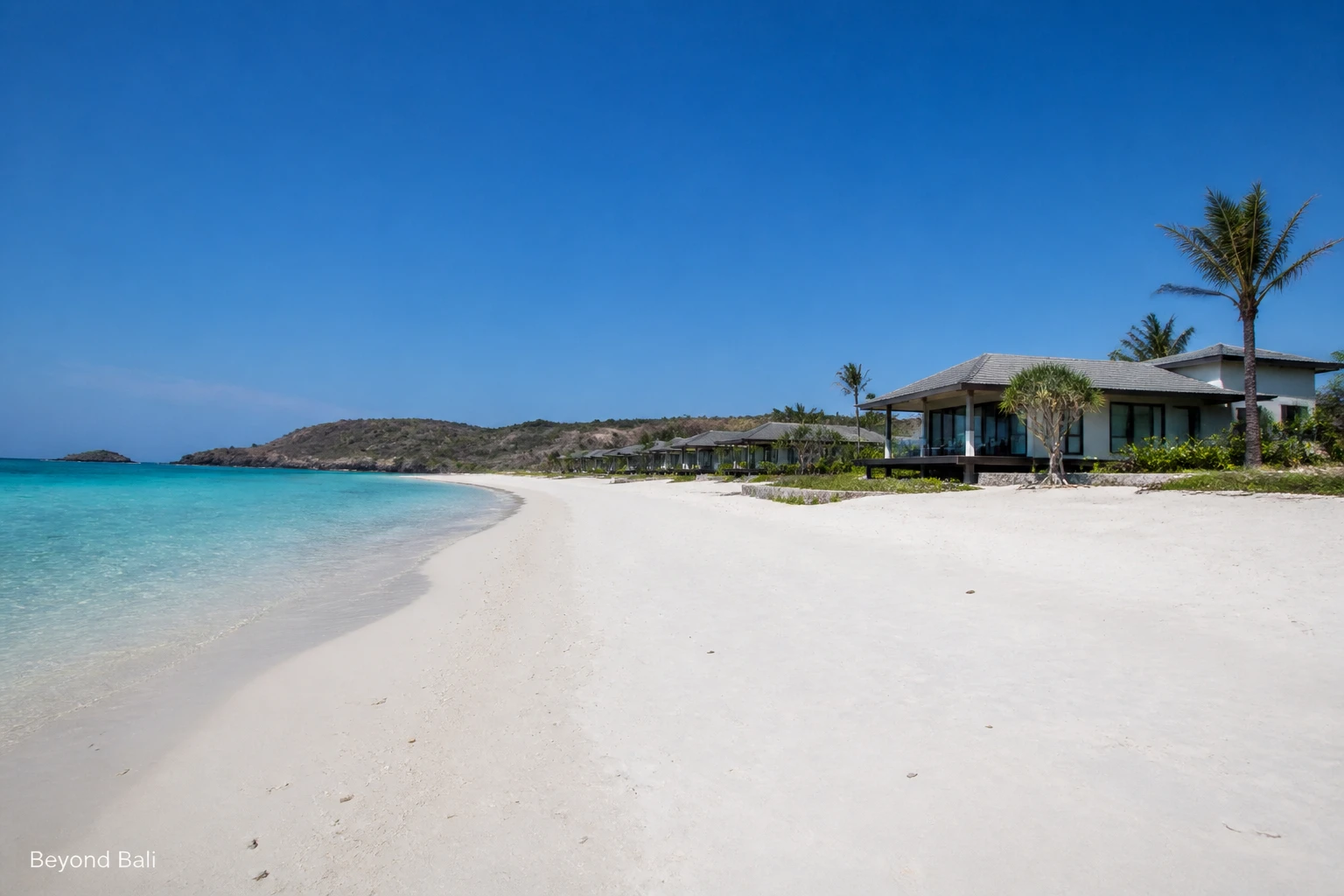
 Indonesia’s Push Beyond Bali Could Reprice Lombok’s Tourism Corridor · Photo by Pok Rie on Pexels
The Investment Logic
For investors based in Europe, Australia or the United States, Lombok’s appeal is not only the possibility of capital gain. It is the shape of the income profile. In a world where many leisure assets have been repriced downwards by higher interest rates and more selective travel behaviour, a market that can still support double-digit gross returns deserves attention.
The strongest investment logic in Lombok rests on four pillars:
- Relative affordability: entry levels remain approachable for a market with international tourism ambition.
- Policy tailwind: Indonesia is actively trying to shift tourism capital beyond Bali.
- Infrastructure catalyst: airport expansion and route development can improve accessibility over time.
- Demand diversification: the island is less dependent on a single luxury segment than some mature resort markets.
That said, investors should resist the temptation to extrapolate recent momentum linearly. A 47% jump in event-linked arrivals is impressive, but event traffic is not the same as year-round base demand. Similarly, 40% to 50% year-on-year tourism growth may reflect a recovery phase or a low base effect as much as it reflects durable market depth. The proper question is not whether the numbers are strong. It is whether they are repeatable once the novelty premium fades.
The most persuasive answer comes from underwriting the asset, not the narrative. In practice, that means asking:
- What is the realistic occupancy base outside peak season?
- How defensible is the nightly rate against comparable stock?
- Is management locally competent enough to maintain ratings and guest repeatability?
- Does the title structure align with the buyer’s nationality and intended exit horizon?
- Can the asset remain competitive once more supply arrives?
Lombok’s current pricing range suggests that the market still offers a margin of error, which is often absent in overheated destinations. That margin matters. It gives investors room to professionalise operations, absorb slippage and still preserve a strong return profile.
For many buyers, the real insight is that Lombok is not trying to replace Bali. It is becoming something more useful: a complementary market with a different risk-reward curve. That makes it valuable in a portfolio sense. A disciplined investor does not need every destination to be a global superstar. Sometimes the smarter play is the market that sits in the shadow of the superstar, yet has more room to grow.
Stay informed, subscribe to the free Lombok Briefing for market intelligence like this, published twice a month.
The broader lesson from Jakarta’s diversification push is that policy can still matter in property markets when it aligns with geography and scarcity. Lombok already has the fundamentals of a credible tourism destination. What is changing now is the institutional backing, the infrastructure outlook and the degree to which investors can underwrite the island as a serious regional play rather than an emerging alternative. For those willing to look beyond Bali, that is a meaningful shift.
What is the typical price range for tourism villas in South Lombok?
South Lombok entry points range from €95,000 to €350,000 for well-known areas. This lower cost base compared to Bali is significant because tourism property economics are highly sensitive to acquisition price. A villa that struggles at inflated prices becomes attractive when entry price allows room for construction margin and operating flexibility.
What rental yields should I expect from a Lombok villa investment?
Well-structured villas in strong locations can target gross yields of 12% to 22%, depending on occupancy, management quality and seasonality. These are not guaranteed returns, but they are high enough to reward disciplined underwriting when properly structured and located.
Is tourism demand in Lombok strong enough to support property investment?
Yes. Tourist arrivals tied to major events showed 47% growth in recent periods. Broader tourism activity has been running 40% to 50% year on year in some local measures. Airport expansion planned for 2025-26 is expected to improve capacity and convenience, potentially accelerating growth further.

The Lombok Buyer's Field Guide
Legal structures ranked by risk, the honest ROI math line by line, all six zones ranked, and the 24-point due-diligence checklist. The whole book, free in your inbox.
See what's inside