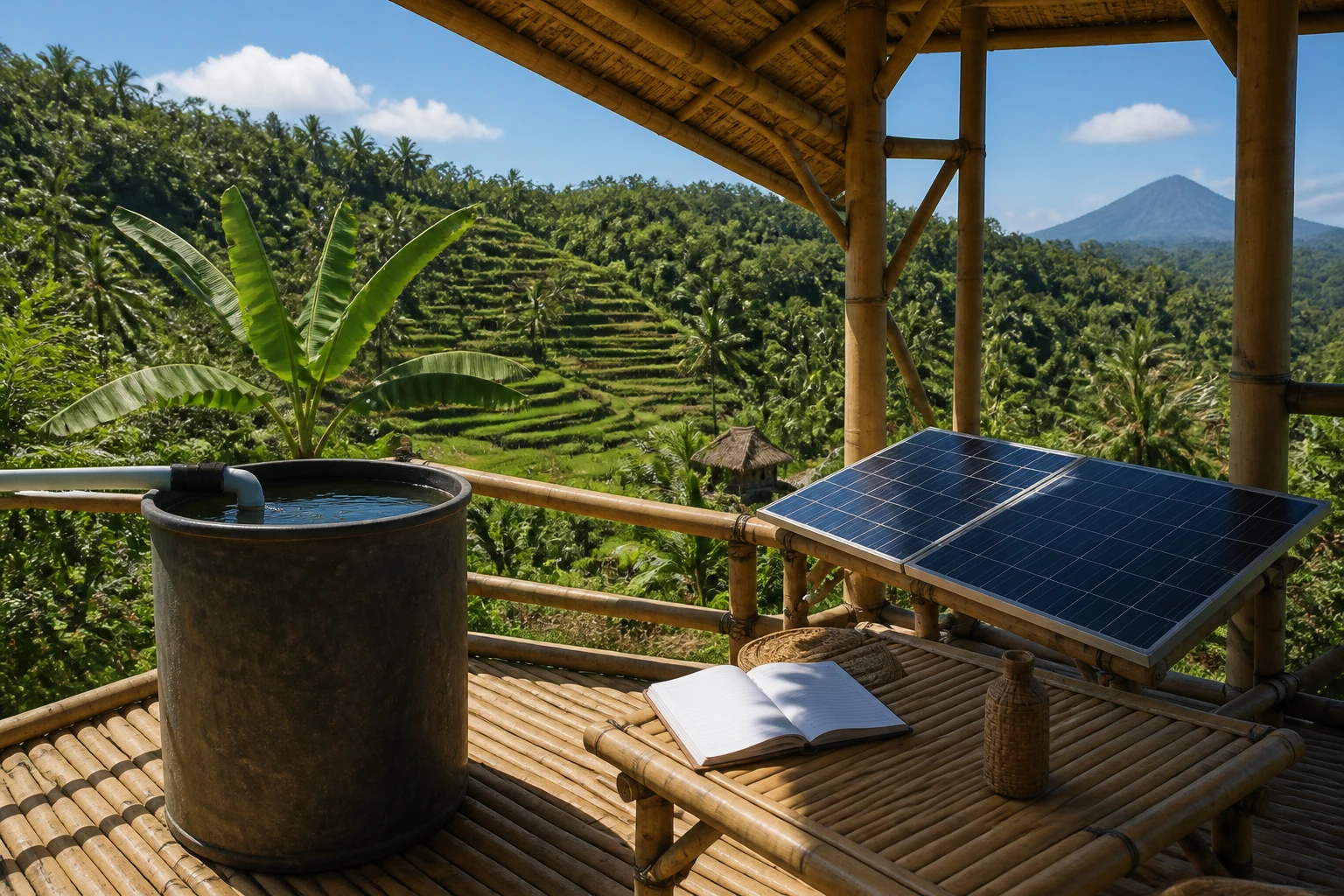
Eco and sustainable villas in Lombok: a real premium or greenwash?
Eco labelling in Lombok runs from genuine rainwater harvesting and solar arrays to a fresh coat of bamboo paint. Buyers who dig into the specifics, solar capacity, grey-water cycling, local-materials ratios, find real energy savings and measurably higher occupancy. Those who skip the detail risk pay
Quick answer: Eco labelling in Lombok runs from genuine rainwater harvesting and solar arrays to a fresh coat of bamboo paint. Buyers who dig into the specifics, solar capacity, grey-water cycling, local-materials ratios, find real energy savings and measurably higher occupancy. Those who skip the detail risk paying a premium for marketing copy.
What counts as "eco" in Lombok
"Sustainable villa" is not a regulated term in Indonesia. No government certification scheme equivalent to BREEAM or LEED exists that a developer must satisfy before using the label. That gap matters, because it means the distance between genuine environmental practice and aspirational marketing copy is wide and poorly policed.
Eco features in Lombok villas fall, in practice, into three tiers. The first covers structural decisions made at the design stage and impossible to reverse later: building orientation for passive solar cooling, natural cross-ventilation design, roofing materials chosen for heat rejection, and the use of locally quarried stone or reclaimed timber. The second covers installed systems: rooftop solar with battery storage, rainwater harvesting with filtration, grey-water recycling for irrigation, and low-flow water fittings. The third tier, the one most susceptible to greenwash, is aesthetic: bamboo partitions, linen signage about towel reuse, potted plants in the lobby. Tier three costs almost nothing and delivers almost no measurable environmental benefit.
Buyers should establish, in writing, which tier is actually present before signing any purchase agreement.
The guest demand signal
Booking-platform data and operator reports consistently point in the same direction: guests in the upper-mid and luxury short-let segment actively filter for sustainability features, particularly solar power and plastic-reduction policies. In South Lombok, where grid outages still occur outside the main Mandalika corridor, solar-plus-battery is not only a green credential but a practical guest-experience improvement. A property that keeps the lights and pool pump running through a grid interruption earns a review; one that does not earns a refund request.
For a detailed look at how solar and backup systems affect day-to-day villa operations in this region, see Solar power and backup options for Lombok villas.
The effect on occupancy is harder to isolate, because eco-conscious guests also tend to prefer boutique properties over resort complexes. What operators consistently report is that properties with credible, verifiable green credentials attract longer stays and stronger repeat-booking rates. In a market where realistic stabilised occupancy in the first three years runs at 55-70%, any structural driver of repeat bookings has direct financial value.
Build and operating choices that actually move the numbers
At the construction stage, the decisions with the greatest financial weight are also the ones most aligned with genuine sustainability.
Passive cooling. Roof pitch, ceiling height, window placement and wall thermal mass determine base cooling load. A well-oriented villa with a high-pitch roof and adequate ceiling height can materially reduce air-conditioning runtime compared with a poorly oriented concrete box of equivalent floor area. Lower runtime means lower electricity bills and slower equipment wear.
Solar and battery sizing. A system sized correctly for villa demand can reduce grid electricity draw to near zero for most of the year in Lombok's solar conditions. Under-sized systems installed as a visual feature, a single panel on an otherwise grid-dependent property, provide neither the guest-experience benefit nor the bill reduction. For guidance on sizing and specification considerations during construction, the villa building guide covers this in practical detail.
Water independence. Lombok's dry season runs roughly May to October. Rainwater harvesting paired with adequate holding capacity gives a property resilience against trucked water costs and supply uncertainty. Water supply disruption is a genuine operational risk in emerging zones such as Are Guling and Mawun, not a hypothetical one.
Local materials. Locally quarried stone, bamboo and reclaimed timber reduce embodied carbon, lower import costs, and produce buildings that perform better in the local climate. They also tend to attract builders who understand humidity and seismic movement, rather than those replicating designs from cooler, drier climates.
Does the green premium pay back?
The honest answer depends on which features are being assessed.
Genuine tier-one and tier-two investments typically reduce operating costs, increase occupancy, or both. Solar reduces electricity bills. Passive cooling reduces air-conditioning demand. Rainwater harvesting reduces water costs. These are not marginal effects. Villa operating costs in Lombok are materially affected by energy and water spend, and reductions compound across the ownership or lease period.
Management fees run at 18-22% of gross rental revenue, and OTA and booking commissions add a further 15-20% on top. Against those baseline outgoings, any structural reduction in energy and water spend is meaningful. With honest net yields sitting at 7-12% across South Lombok, and top-performing assets reaching around 15% net, cost control at the operating level is where margin is actually managed, not in headline gross-yield numbers.
Tier-three eco features carry build costs but no measurable return. The risk for buyers is paying a premium acquisition price for a property styled to look sustainable while delivering no operational advantage. For a current view of how pricing and yield ranges sit across South Lombok zones, see the market data page.
It is worth noting that HubLombok is the editorial arm of Samudra Villas, an active developer in Are Guling. The project incorporates solar and passive cooling design as standard, which is why we can speak to this topic from direct operational experience as well as from market observation.
What to ask before you buy
If a developer or agent uses "eco" or "sustainable" in their materials, these are the specific questions worth requesting answers to in writing.
- What is the solar system capacity in kilowatt-peak, and what is the usable battery storage in kilowatt-hours?
- Is rainwater harvesting installed, and what is the holding capacity relative to dry-season demand?
- What percentage of structural materials are locally sourced, and from where?
- What is the design air-conditioning load, and has a thermal performance model been produced?
- Are any eco claims covered by third-party certification or independent inspection?
If the answer to the last question is no, the earlier questions become more important, not less. Lombok's property market is early-cycle and lightly regulated. That creates real opportunity, but it also means due diligence cannot be outsourced to a certification badge that does not yet exist here. The buyers who will benefit from the sustainability premium are those who verify the substance themselves, before they commit capital.
Do eco villas in Lombok earn higher rental yields than standard villas?
Not automatically. Properties with credible solar systems and passive cooling benefit from lower operating costs and often attract longer stays, both of which support net yield. Villas with only superficial green styling, bamboo aesthetics without functional systems, typically see no measurable yield premium and may carry unnecessary build cost on top of their acquisition price.
Is there an official eco-certification standard for villas in Lombok?
No. Indonesia has no residential certification scheme equivalent to BREEAM or LEED that applies in Lombok. The label 'sustainable villa' is unregulated. Buyers should request written specifications of installed systems, solar capacity, water harvesting, local-materials ratios, and verify these independently rather than relying on marketing language.
Which eco features matter most for reducing villa operating costs in South Lombok?
Solar with battery storage has the most direct impact on electricity bills, which are a significant line item given air-conditioning and pool pump loads. Rainwater harvesting reduces water costs and supply risk, particularly during the dry season from roughly May to October. Passive cooling design reduces air-conditioning runtime. Purely aesthetic features such as bamboo decor have no measurable effect on operating costs.
The Lombok Buyer's Field Guide
Legal structures ranked by risk, the honest ROI math line by line, all six zones ranked, and the 24-point due-diligence checklist. The whole book, free in your inbox.
See what's inside