Bank Indonesia Local Currency Trade Surges Past US$52 Billion
Bank Indonesia logs US$52.6 billion in local currency settlements through September 2026, lowering transaction frictions and currency risk for cross-border regional investors.
Quick answer: Bank Indonesia recorded US$52.6 billion in bilateral local currency transactions through September 2026, doubling 2025 volumes. For foreign investors, expanding direct settlement across seven Asian partners, combined with central bank hedging discounts of up to 45 percent, cuts foreign exchange conversion frictions, stabilises the rupiah, and anchors cross-border capital entering Indonesian real assets.
Macroeconomic plumbing rarely commands headlines in lifestyle property circles, yet institutional capital and seasoned private investors understand that currency mechanics dictate ultimate net returns. When cross-border transactions require multiple banking intermediaries and mandatory US dollar conversions, foreign capital pays a quiet friction tax at every stage of deployment. Bank Indonesia has spent the past three years systematically dismantling those barriers across key Asian trading corridors.
The Context
Speaking at a Financial System Stability Committee (KSSK) briefing in Jakarta, Bank Indonesia Governor Destry Damayanti confirmed that bilateral trade settlements conducted through local currency transaction (LCT) frameworks reached an equivalent of US$52.6 billion between January and September 2026. This volume is more than double the US$25.7 billion recorded across the entire 2025 fiscal year, marking an inflection point in regional financial integration.
"The implementation of LCT continues to show positive progress," Bank Indonesia Governor Destry Damayanti stated, noting that the central bank remains committed to expanding international cooperation under the framework toward an annual target of US$55 billion for 2026.
The framework bypasses the conventional US dollar intermediary route, allowing direct settlement between the Indonesian rupiah and partner currencies. Indonesia has established operational LCT mechanisms with seven primary trading partners:
- China (RMB-IDR direct settlement)
- Japan (JPY-IDR clearing)
- Singapore (SGD-IDR corridor)
- Malaysia (MYR-IDR bilateral framework)
- Thailand (THB-IDR mechanism)
- South Korea (KRW-IDR direct channel)
- United Arab Emirates (AED-IDR corridor)
This architecture alters the risk profile for inbound Asian capital. An investor domiciled in Singapore, Tokyo, or Kuala Lumpur deploying funds into Indonesian assets no longer absorbs double foreign exchange spreads: converting home currency into US dollars, and subsequently converting US dollars into Indonesian rupiah upon entry.
Currency Diversification and Hedging Mechanics
To accelerate institutional participation, Bank Indonesia paired currency diversification with structured balance-sheet incentives. The central bank introduced premium discounts across standard hedging facilities:
| Instrument | Tenor | Central Bank Premium Reduction | | :--- | :--- | :--- | | Domestic Non-Deliverable Forward (DNDF) | Trade & Investment | 10% | | Domestic Non-Deliverable Forward (DNDF) | 6-month tenor | 40% | | Domestic Non-Deliverable Forward (DNDF) | 12-month tenor | 45% | | Conventional Buy-Swap | Standard trade | 10% | | Conventional Buy-Swap | 3-month tenor | 15% | | Conventional Buy-Swap | 6-month tenor | 20% | | Conventional Buy-Swap | 12-month tenor | 25% |
These adjustments represent deliberate balance-sheet protection. By lowering the cost of hedging swaps by up to 25 percent and slashing DNDF premiums by up to 45 percent on 12-month commitments, the central bank cushions inbound capital against currency volatility while preserving domestic liquidity.
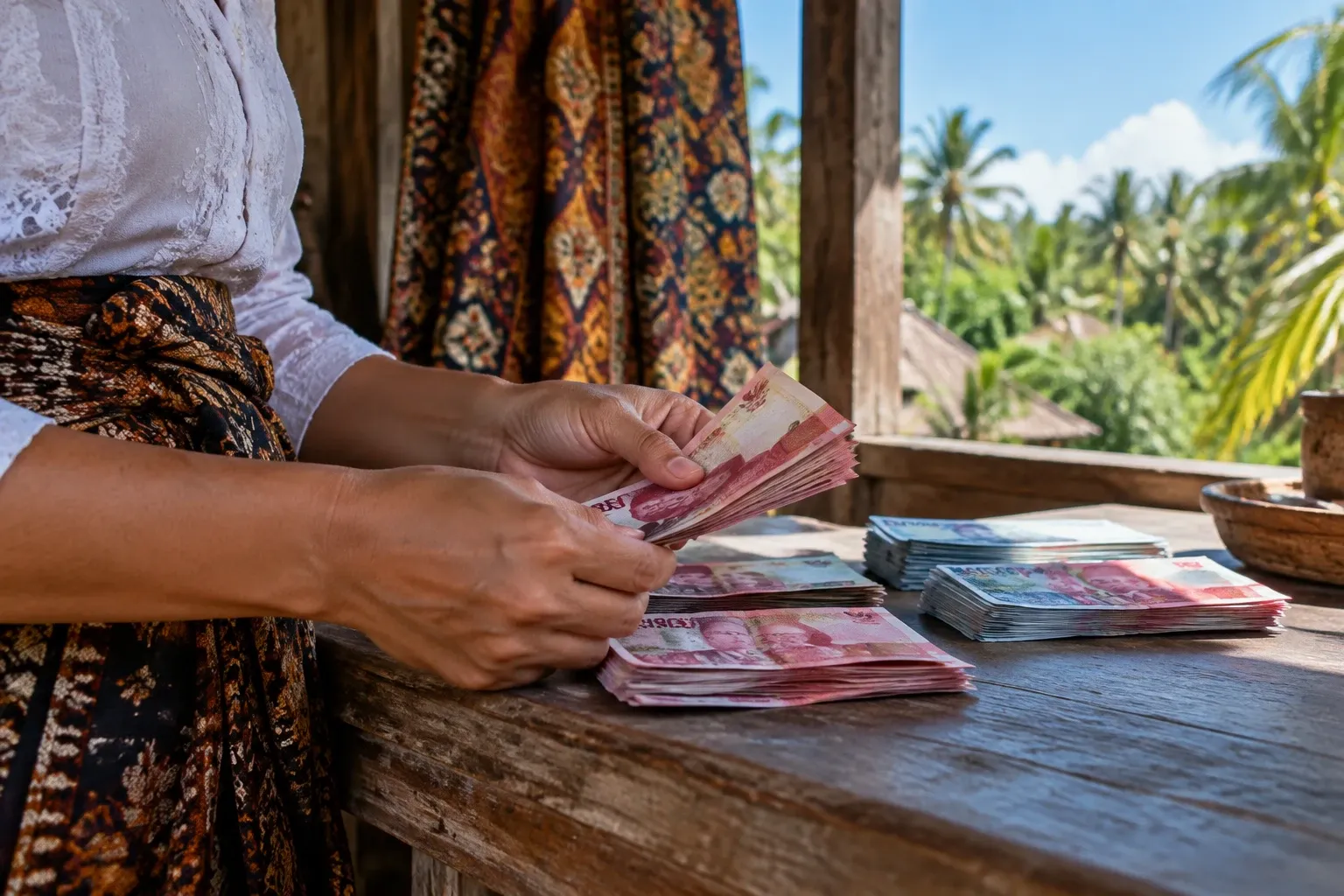
 Bank Indonesia Local Currency Trade Surges Past US$52 Billion · Photo by Gustavo Fring on Pexels
Foreign Direct Investment and the Real Asset Transmission
While LCT frameworks were initially designed for cross-border trade invoices, their maturity directly benefits foreign direct investment into Indonesian real estate and hospitality infrastructure. A stable foreign exchange regime directly impacts land and property fundamentals.
Consider the operational reality for a foreign corporate entity establishing a PT PMA (foreign-owned company holding Hak Guna Bangunan / HGB title for 30 years extendable). When establishing operational accounts, funding land acquisitions, and paying statutory duties such as the 5 percent BPHTB buyer transfer tax, currency slippage has historically eroded early-stage project capital.
In South Lombok, where prime tourist-zone land trades between Rp 150 million and Rp 400 million per are (roughly USD 90 to 240 per square metre at approximately Rp 16,500 per USD), foreign acquisition capital is increasingly originating from regional hubs like Singapore, Hong Kong, and Kuala Lumpur. For comparison, comparable land specs in southern Bali trade between USD 200 and USD 500 per square metre. Direct bilateral settlement corridors allow regional family offices and syndicates to fund development tranches without exposure to sudden dollar liquidity bottlenecks.
Furthermore, the macro stability fostered by these bilateral channels underpins foreign arrivals. International tourist arrivals across Indonesia have trended upward by 40 to 50 percent year-on-year, driven by broader tourism recovery and major regional sporting events like the Mandalika MotoGP. Stabilising the domestic currency protects operational margins for hospitality operators balancing foreign booking revenues against domestic wage and supply costs.
What This Means for Investors
For private wealth and institutional buyers assessing Indonesian assets, the record LCT volume signals three concrete strategic takeaways:
- Diminishing Currency Frictions: Direct clearing mechanisms between regional currencies and the rupiah mean Singaporean, Malaysian, Japanese, and Emirati investors face significantly lower conversion leakages when funding accounts or repatriating capital.
- Accessible Downside Hedging: Bank Indonesia's targeted premium reductions, offering up to 45 percent savings on 12-month DNDF contracts, make portfolio currency hedging economically viable for mid-market private equity and private development syndicates.
- Macroeconomic Buffer Against Global Volatility: A diversified bilateral trade settlement structure insulates the domestic economy from Federal Reserve rate cycles, protecting the purchasing power of assets held in Indonesian jurisdiction.
When evaluating real estate investments, yield calculations must reflect net operational reality. Turnkey investment-grade villas in South Lombok command entry prices between EUR 95,000 and EUR 350,000, delivering honest net rental yields of 7 to 12 percent after accounting for 18 to 22 percent management fees, 15 to 20 percent booking commissions, and realistic stabilised occupancy rates of 55 to 70 percent. While promotional developer brochures frequently market gross yields of 12 to 22 percent, prudent investors model strictly on net numbers.
Reduced currency volatility enhances the security of those yields. When legal titles are properly structured through licensed PPAT notaries, registered with the land agency (BPN), and executed via transparent legal conduits such as PT PMA or long-term Hak Sewa leases, macroeconomic stability reinforces asset-level fundamentals.
As Bank Indonesia approaches its US$55 billion full-year LCT target, the archipelagic economy demonstrates clear monetary autonomy. For the international investor looking past short-term noise, systemic monetary stability is the strongest foundation for long-term real estate outperformance.
Stay informed: subscribe to the free Lombok Briefing, published twice a month (the 1st and 15th), for market intelligence like this.
What is Bank Indonesia's Local Currency Transaction framework?
It is a bilateral settlement mechanism allowing Indonesia and partner nations to settle trade and direct investment transactions in their own local currencies, bypassing US dollar conversion intermediaries.
How does bilateral currency settlement benefit foreign property investors?
Investors from partner countries avoid double foreign exchange conversion fees, access central bank hedging discounts of up to 45 percent, and face reduced exposure to broader currency volatility.
Which countries currently participate in Indonesia's LCT network?
Indonesia has operationalised LCT agreements with seven key partner economies: Malaysia, Thailand, Japan, China, South Korea, Singapore, and the United Arab Emirates.

The Lombok Buyer's Field Guide
Legal structures ranked by risk, the honest ROI math line by line, all six zones ranked, and the 24-point due-diligence checklist. The whole book, free in your inbox.
See what's inside