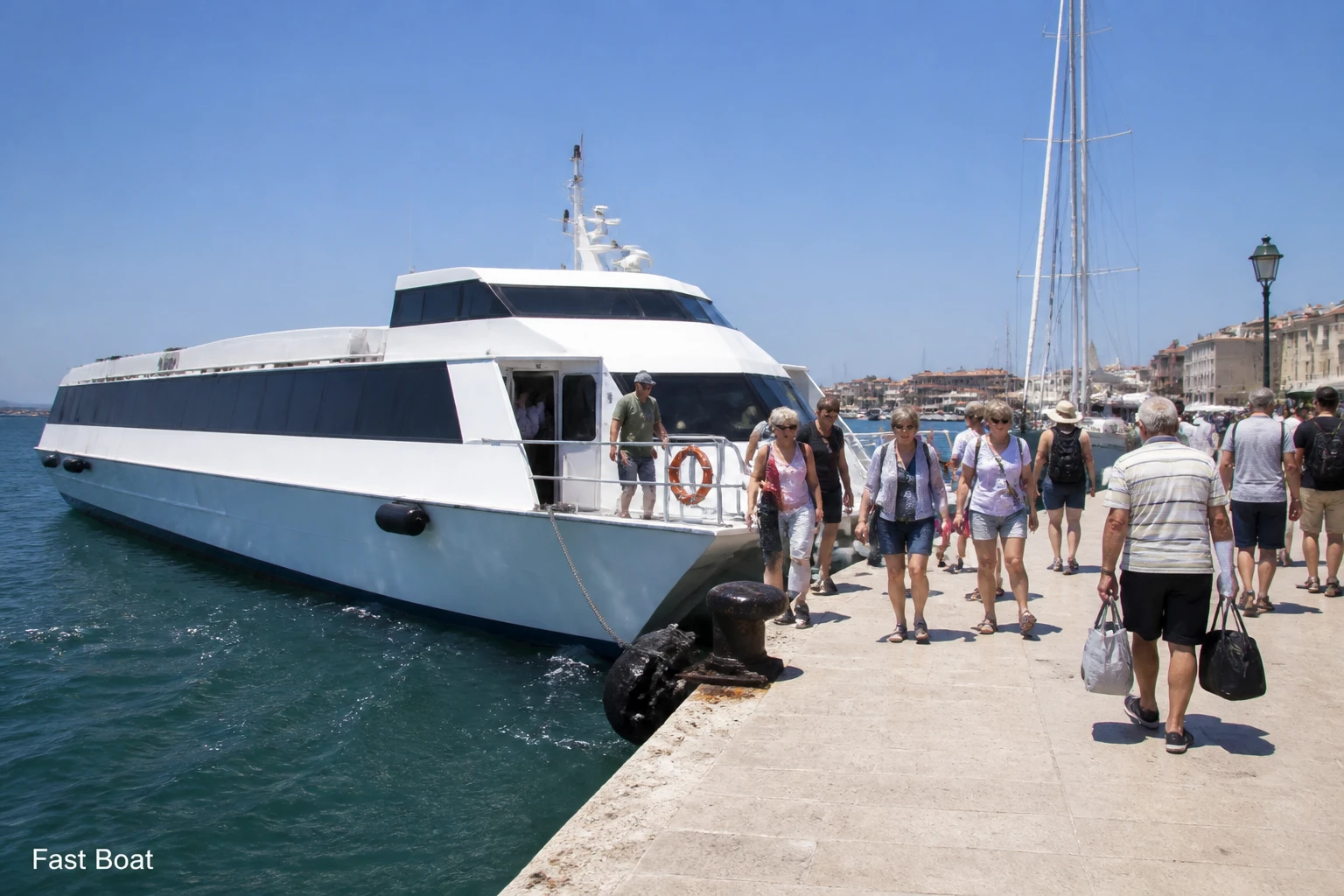
New Bali-Lombok Fast Boat Route Accelerates Tourism Boom and Property Investment
A new fast boat service from Sanur to Mandalika promises to unlock Lombok's tourism and real estate potential. Here's what property investors need to know.
New Bali-Lombok Fast Boat Route Accelerates Tourism Boom and Property Investment
The West Nusa Tenggara (NTB) Provincial Government has just announced a game-changing connectivity milestone: a dedicated fast boat service linking Sanur, Bali, directly to Mandalika, Lombok. For property investors tracking the island's trajectory, this is far more than a transport story, it is a concrete expression of Lombok's emergence as a Super Priority Destination and a significant tailwind for the residential and hospitality real estate market.
Lombock is soaring in demand among travellers in 2026. The new route will formalise a connection that has long existed informally, but with a critical difference: year-round, scheduled, government-backed infrastructure. This is the kind of friction reduction that turns casual overflow tourism into sustained visitation, and sustained visitation into sustained property demand.
Lombok's Tourism Momentum: The Market Context
Lombock has experienced extraordinary tourism growth, with visitor arrivals rising 40–50% year-on-year. The island's designation as one of Indonesia's five Super Priority Destinations, the so-called 'new Balis', reflects a national strategy to distribute tourism flows across multiple world-class hubs rather than concentrating all demand on Bali's increasingly saturated infrastructure.
What makes this significant for property investors is the Bali-overflow thesis. Bali's accommodation and restaurant sectors are operating at near-capacity during peak season. Travellers seeking authentic, less-crowded alternatives, combined with couples and families seeking more space at better value, increasingly add a few days or a week in Lombok to their Balinese itinerary. A decade ago, this was rare; today it is routine. The new fast boat service will accelerate this pattern by removing one friction point: the need to arrange ad-hoc transport or book indirect routes.
Tourism context: Lombok's visitor base is expanding rapidly, with absorption rates now sustaining higher-end accommodation and mid-market holiday rental markets. Entry-level property investment in Lombok remains accessible at €95,000–€350,000, with gross rental yields of 12–22% and occupancy rates between 55–75% across well-managed portfolios.
The New Sanur-Mandalika Fast Boat Route: Infrastructure Detail
The NTB Provincial Government, through Ervan Anwar, Head of the Transportation Agency, confirmed that the new route will operate from Mandalika Pier, located within the Mandalika Special Economic Zone (KEK), to Sanur Pier in Bali's special economic zone. The service is currently in the final permitting stages, with the team 'completing necessary documentation' for formal operation.
This is not the island's first fast boat connection. Existing routes operate between Padang Bai and Gili Trawangan, Padang Bai and Senggigi, Padang Bai and Bangsal, and from Sanur to both Gili Trawangan and Senggigi. What distinguishes the new Sanur-Mandalika route is its convenience for tourists arriving at Sanur (Bali's eastern beach hub and a major departure point) and its direct link to Mandalika, Lombok's premier resort and event destination.
The route will offer more choice, better affordability, and improved availability, a functional improvement that, in network effects terms, can shift tourism flows. A tourist landing in Denpasar who can now reach Mandalika in a single, government-scheduled boat journey is more likely to extend their stay in West Nusa Tenggara than one who must arrange complex multi-leg transport.
Infrastructure as a Catalyst for Property Investment
For residential and holiday rental property investors, transport connectivity is a first-order determinant of value. A villa or apartment that is 20 minutes from reliable, scheduled boat transport to Bali's airport and central tourist areas is worth materially more than one that requires ad-hoc arrangement or a 90-minute overland commute.
The fast boat service solves a perennial challenge: tourists and expatriates have often hesitated to base themselves on Lombok for extended periods due to transport friction. With a year-round, officially-backed, predictable connection to Bali, that friction dissolves. Investors can now credibly market Lombok properties with the line: 'You are 45 minutes from Bali's restaurants, spas, and nightlife, and hours from the airport, yet in a quieter, more spacious location with better value.'
This is already happening organically. Lombok's property market has begun attracting portfolio investors seeking higher yields and lower entry costs than Bali. The fast boat formalises that transition from 'local secret' to 'mainstream alternative hub.'
The MotoGP Factor and Broader Catalyst Events
Mandalika will host the Moto GP World Championship race weekend from 9–11 October 2026. The event is both a one-off spike in visitation and a symbolic moment: international motorsports audiences will witness Lombok as a host destination, with extensive media coverage and global exposure.
The NTB Provincial Government is coordinating transport upgrades, including the fast boat service, specifically to handle the October influx. Once the infrastructure is built for 150,000 visiting motorsports fans, it remains available for the 40-week remainder of the year. Every upgraded airport terminal, every new boat dock, every road widening becomes a permanent capacity expansion.
Investors with forward-booked properties in Mandalika and the surrounding areas will benefit from both the event itself (occupancy and rates spike) and the lasting infrastructure legacy.
What This Means for Investors
The fast boat service is a tangible signal that Lombok's infrastructure and tourism positioning are not static. The island is being actively developed as a tier-one destination by national and provincial government, with capital allocation and strategic focus.
For property investors, the implications include:
- Improved tenant acquisition: Holiday rental managers can attract international guests with confidence in transport reliability.
- Higher night rates: Improved connectivity supports premium positioning; a tourist willing to stay longer across multiple islands will budget accordingly.
- Longer investment hold value: As Lombok matures from a 'special occasion' destination to a 'regular circuit' stop alongside Bali, property valuations will normalize upward over 5–10 years.
- Reduced vacancy risk: Better accessibility means steadier, less seasonal demand.
None of this eliminates due diligence: property selection, management quality, and local market knowledge remain critical. But the macro environment is decisively favourable.
Stay informed, subscribe to the free Lombok Briefing for analysis like this, published twice a month.
What property prices and rental yields can foreign investors expect in Lombok?
Entry-level property investment in Lombok is accessible at approximately €95,000 to €350,000. Gross rental yields across well-managed portfolios run between 12 and 22 percent, with occupancy rates of 55 to 75 percent. Visitor arrivals have risen 40 to 50 percent year on year, supporting demand for both mid-market and higher-end holiday rental accommodation.
What is the new Sanur to Mandalika fast boat route and when will it operate?
The NTB Provincial Government has announced a year-round, government-scheduled fast boat service linking Sanur Pier in Bali to Mandalika Pier, located within Lombok's Mandalika Special Economic Zone. The service is currently completing final permitting documentation. It adds a direct, officially backed connection between Bali's eastern beach hub and Lombok's premier resort destination.
How will the 2026 MotoGP event in Mandalika affect Lombok's property market?
The MotoGP World Championship race weekend runs from 9 to 11 October 2026 in Mandalika and is expected to attract 150,000 visiting motorsports fans. The NTB Provincial Government is coordinating transport upgrades, including the new fast boat service, specifically for the event. Infrastructure built for the influx, including upgraded boat docks and terminals, becomes permanent year-round capacity.
The Lombok Buyer's Field Guide
Legal structures ranked by risk, the honest ROI math line by line, all six zones ranked, and the 24-point due-diligence checklist. The whole book, free in your inbox.
See what's inside