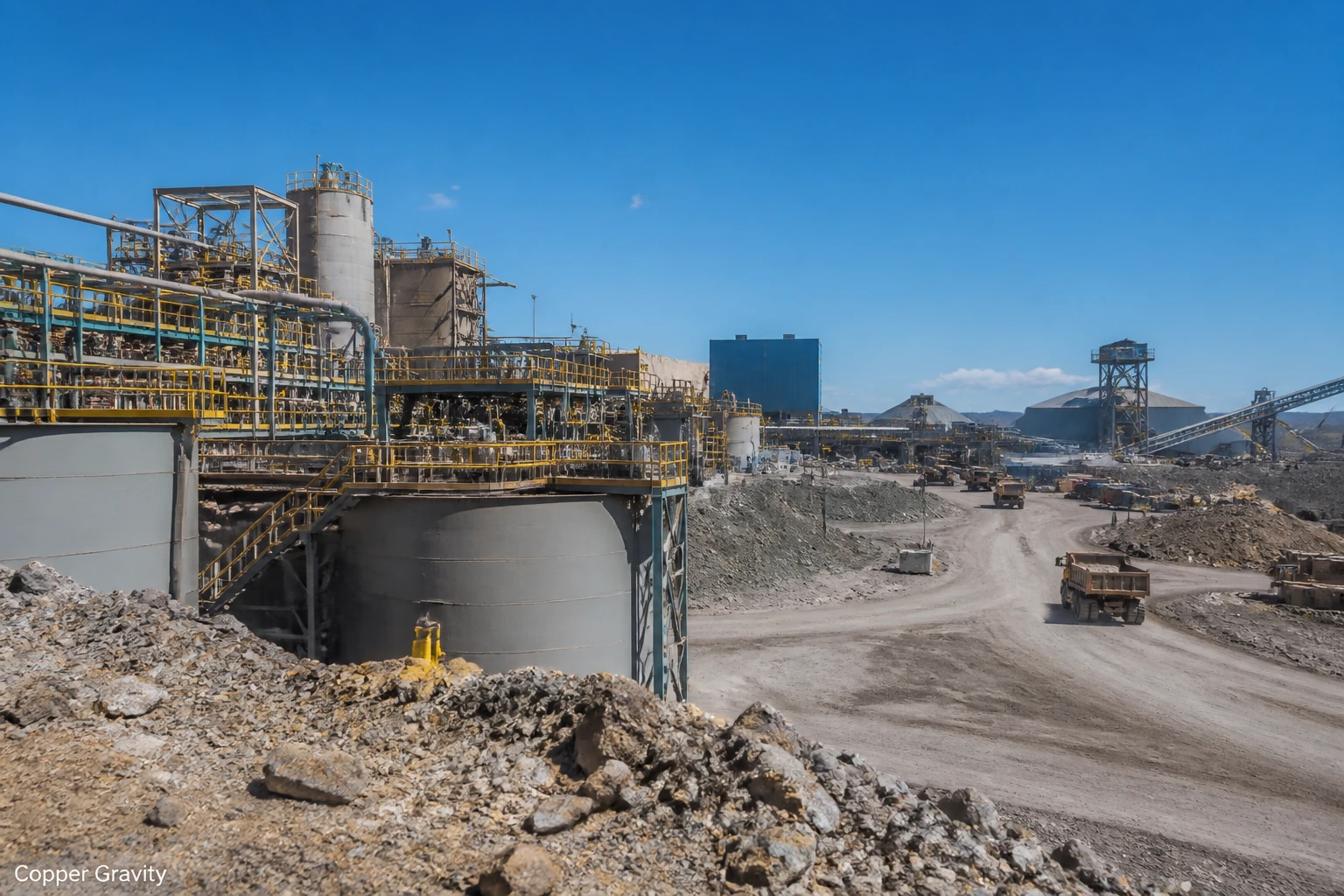
When Copper Goes Global: Amman Mineral's Rise and Lombok's Economic Gravity
PT Amman Mineral's entry into the International Copper Association signals infrastructure investment and macro currency support for Lombok property valuations. Here's why extractive integration matter
Most property investors in Lombok watch the resort sector, tourism arrivals, and MotoGP-driven visitor flows. Few notice when mining companies join international trade bodies. But PT Amman Mineral's recent admission to the International Copper Association, as the first ASEAN-based member, signals something that subtly reshapes Lombok's investment backdrop: extractive capital is going global, and that changes everything from infrastructure priorities to currency stability.
The Context
PT Amman Mineral Nusa Tenggara operates one of Indonesia's largest copper operations in the Nusa Tenggara region. Copper, unlike resort occupancy, is priced globally. A mining company joining an international commodity body isn't ceremonial, it signals integration into global supply chains, compliance with international standards, and access to premium markets willing to pay for certified, audited production.
The International Copper Association represents nearly 85% of global refined copper supply. For a regional ASEAN operator to join means:
- Export certainty: Amman's copper now qualifies for ICA-member supply agreements, locking in buyers and premium pricing power
- Operational scrutiny: ICA membership requires adherence to environmental, labor, and governance standards that exceed Indonesian baseline law
- Capital credibility: International copper buyers (automotive, renewable energy, power infrastructure) now view Amman as institutionally vetted and compliant
For Lombok investors, this matters because Amman's operations sit in East Nusa Tenggara, the same province, the same capital flows, the same infrastructure priorities.
The global copper market trades 20+ million tonnes annually. A single ASEAN producer capturing even 0.5% of supply represents hundreds of millions in annual revenue flowing into Nusa Tenggara's development ecosystem.
Amman isn't on Lombok proper (operations are primarily North Lombok and central highlands). But Nusa Tenggara is an integrated economy. Profits, tax revenue, and infrastructure investment leak across provincial boundaries. When Amman invests in port facilities, roads, and power capacity, Lombok benefits from spillover effects.
Infrastructure as the Real Asset
Extractive industries drive infrastructure in ways tourism doesn't. A resort needs water, power, and local roads. A mining operation needs ports, highways to ports, rail connections, and dedicated power plants.
Amman's global integration reshapes this calculus. The ICA membership implies:
- Port upgrades: Higher-volume copper exports require deep-water port capacity. Indonesian ports serving Nusa Tenggara (primarily Lombok and Sumbawa) are scheduled for 2025–26 expansion as part of the broader NTT development corridor.
- Road networks: Mineral logistics demand quality infrastructure from mines to ports. Recent Indonesian government planning allocates significant capital to NTT road corridors, investment that benefits general commerce, tourism, and property development alike.
- Power reliability: Copper smelting requires stable, large-scale power. Amman's demand for grid reliability creates incentive for government to expand Lombok's power generation (currently a constraint for resort expansion and property occupancy ceilings).
These aren't theoretical. Lombok's property yields (12–22% on South Lombok holdings at €95–350K entry points) are partially constrained by infrastructure gaps. When mining capital drives government investment in ports and power, the constraint loosens. Development accelerates. Yields compress or stabilize at higher volumes.
 When Copper Goes Global · Photo by Wolfgang Weiser on Pexels
The Regulatory Tailwind and Currency Effects
Here's the subtle part: global copper markets affect the Indonesian rupiah. When Amman's copper sells into global markets, those USD revenues flow into Indonesia's export earnings. Stronger exports → stronger rupiah → lower import costs for development materials → lower construction costs for Lombok properties → better margins for developers.
Conversely, when Indonesian exports weaken, the rupiah falls, construction costs rise (most materials are partially import-priced), and developer margins compress. Property yields feel pressure.
Amman's ICA membership locks in higher export volumes and premium pricing. That's macro tailwind for the rupiah, which translates into macro tailwind for Lombok property development economics.
There's also a regulatory angle often overlooked. ICA membership requires adherence to environmental and social standards that exceed Indonesian baseline. This is often framed as constraint ("higher compliance costs reduce profitability"). In reality, it's an advantage:
- Reduced environmental litigation risk: Higher environmental standards reduce chance of costly disputes with communities or NGOs
- Land tenure certainty: When extractive operations prove certified compliance, adjacent land disputes diminish (communities see legitimate regulation, not exploitation)
- Institutional investor confidence: International property capital (European, Australian, Singapore-based) increasingly screens for ESG governance in source regions. ICA-certified mining signals regional governance quality that lifts entire jurisdictions
Lombok properties positioned in regions with high-standard extractive industry compliance have lower ESG risk premiums and access to larger institutional buyer pools, a hidden yield advantage.
What This Means for Investors
Three immediate takeaways:
1. Infrastructure upside is real but gradual. Amman's global integration will drive port, road, and power investment in Nusa Tenggara over the next 3–5 years. Lombok, as the most developed island in NTT with existing tourism infrastructure, captures disproportionate spillover. Properties near secondary roads connecting Lombok to future port upgrades (particularly North Lombok and East Lombok, historically secondary to South Lombok's resort corridor) may see accelerated appreciation as connectivity improves.
2. Macro currency stability supports yields. Export growth from higher-margin copper sales strengthens the rupiah, reducing cost inflation for Lombok's development sector. For investors holding euro-denominated property (most South Lombok holdings), this means rupiah depreciation risk is slightly mitigated by improved trade fundamentals, a structural hedge within your geographic asset.
3. ESG governance becomes a competitive advantage. Lombok's property market has long positioned itself as "Bali alternative for conscious travelers." But actual ESG governance was vague. High-standard extractive industry compliance in NTT raises the baseline governance signal for the entire region. Properties marketed with "certified ESG governance at source" now have credible institutional backing, not greenwashing.
For South Lombok's €95–350K market segment, these shifts aren't dramatic. But they're structural. They support the 12–22% yield thesis by:
- Reducing infrastructure constraints (improving occupancy ceilings)
- Strengthening currency fundamentals (protecting rupiah, supporting margins)
- Raising governance signals (opening larger institutional investor pools)
The best opportunities often aren't in headlines. They're in the background, where mining companies join international bodies and infrastructure quietly upgrades.
Stay informed, subscribe to the free Lombok Briefing for market intelligence like this, published twice a month.
What is PT Amman Mineral's significance for Lombok property investors?
PT Amman Mineral became the first ASEAN-based member of the International Copper Association, which represents nearly 85% of global refined copper supply. While operations are not on Lombok proper, Nusa Tenggara is an integrated economy. Profits, tax revenue, and infrastructure investment from Amman's operations spill across provincial boundaries, benefiting Lombok's development ecosystem.
How does Amman Mineral's global integration affect Lombok's infrastructure?
Copper export volumes require deep-water port capacity. Lombok and Sumbawa ports are scheduled for 2025 to 2026 expansion as part of the NTT development corridor. Mining logistics also drive road and power investment that benefits tourism and property development. South Lombok property yields of 12 to 22% are partially constrained by infrastructure gaps, which mining capital helps address.
Does copper mining revenue strengthen the Indonesian rupiah and reduce Lombok property construction costs?
According to the article, stronger copper exports increase Indonesia's export earnings, which supports the rupiah. A stronger rupiah lowers import costs for development materials, reducing construction costs for Lombok properties and improving developer margins. Amman's ICA membership locks in higher export volumes and premium pricing, creating a macro tailwind for Lombok property development economics.
The Lombok Buyer's Field Guide
Legal structures ranked by risk, the honest ROI math line by line, all six zones ranked, and the 24-point due-diligence checklist. The whole book, free in your inbox.
See what's inside