Harvest Cycles and Property: How Agricultural Policy Reshapes Lombok's Land Values
Prabowo's agricultural push signals sustained rural investment. Here's how corn harvest festivals and productivity targets reshape Lombok's agricultural property opportunity.
Lombok Notebook: When Harvest Cycles Matter to Property Investors
President Prabowo Subianto's launch of the second-quarter 2026 corn harvest festival on government-fostered plantations might appear as routine agricultural pageantry. But for Lombok property investors, it's a visible signal of something more consequential: sustained federal commitment to rural productivity, farm incomes, and agricultural infrastructure. These elements reshape how agricultural land is valued across the archipelago, and Lombok sits at the intersection of tourism and farming economies.
The Context
The corn harvest festival isn't isolated. It's part of a broader administration strategy to boost domestic agricultural productivity, reduce import dependency, and strengthen rural income foundations. Visible festivals and harvest celebrations serve dual purposes: they celebrate farmer success and reinforce political commitment to rural constituencies.
For Q2 2026, the focus on corn is strategic. Corn is a staple crop across Indonesia's agricultural regions, including Nusa Tenggara. Production targets suggest federal funding and support for improved seed varieties, fertilizer subsidies, and mechanization, investments that increase per-hectare yields and farmer incomes.
When federal agricultural support intensifies, it typically signals a multi-year policy window. Investors see this as a 3–5 year period of sustained rural investment, improving yields, and rising farm household incomes across agricultural zones.
How Agricultural Productivity Reshapes Land Value
Agricultural land valuation is straightforward: it's capitalized farm income. When corn yields rise, farmer net income rises, and land values rise in lockstep. But the mechanics extend beyond commodity prices.
Direct Income Effects Government support for corn production typically includes:
- Improved seed varieties (20–30% yield improvements)
- Subsidized fertilizer and inputs
- Extension services and best-practice training
- Mechanization support (shared equipment access)
- Guaranteed purchase prices or government offtake agreements
When these tools are deployed, corn yields in targeted zones can rise from 4–5 tons/hectare to 6–7 tons/hectare within 2–3 seasons. At current commodity prices, this translates to $200–400 USD additional annual income per hectare for smallholder farmers.
For a typical 0.5-hectare farm (common in Lombok), this means an additional $100–200 USD annually, modest in absolute terms, but a 30–50% income lift for subsistence farming households. In capitalization terms (assuming a 5–8% agricultural land cap rate), this translates to $1,250–4,000 USD additional land value per hectare.
Multiplier Effects: Property and Services Higher farm incomes drive secondary demand:
- Rural construction (home improvements, expansions)
- Vehicle purchases (motorcycles, small trucks)
- School fees and education spending
- Healthcare and services
- Small business expansion (shops, repair services)
This demand creates local employment and business activity, raising property values in adjacent rural service centers and semi-rural property zones.
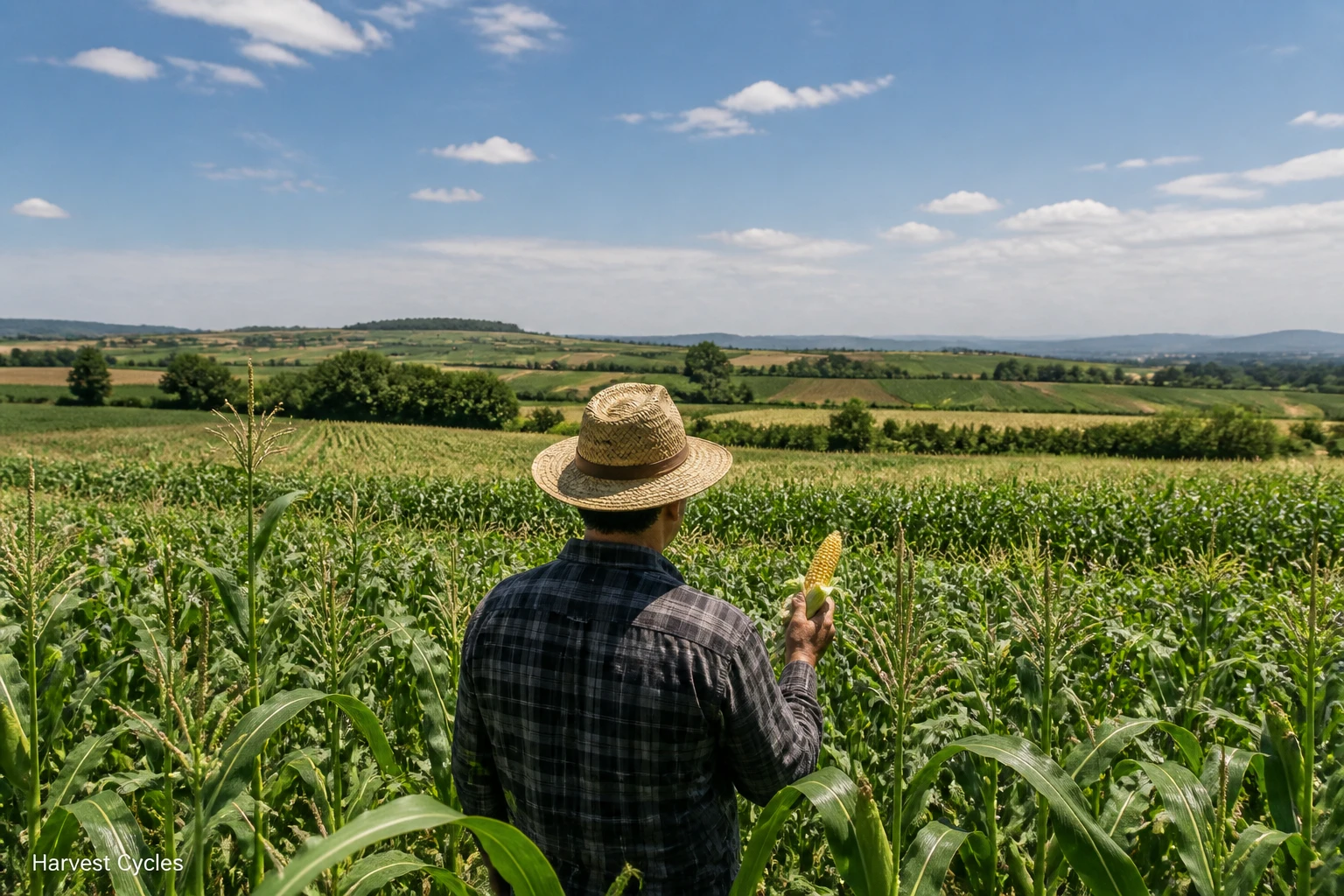
 Harvest Cycles and Property · Photo by Mikhail Nilov on Pexels
Infrastructure Investment Federal agricultural support often includes rural infrastructure:
- Irrigation system upgrades
- Agricultural roads and access improvements
- Storage and processing facilities
- Market infrastructure
These investments increase the investability of surrounding land and property. A rural village with improved irrigation and market access commands a premium over one without.
Lombok's Agricultural Property Opportunity
Lombok has a dual economy: tourism (concentrated in South Lombok and coastal areas) and agriculture (distributed across North, Central, and East Lombok). While international investors focus on villa and resort development in high-profile South Lombok zones (€95–350K entry prices, 12–22% yields), agricultural property remains underdeveloped in investor consciousness.
But the agricultural opportunity is real.
The Agricultural Geography Lombok's productive zones include:
- North Lombok: Tobacco, corn, rice; hilly terrain with cooler microclimates
- Central Lombok: Mixed agriculture; proximity to Mataram market
- East Lombok: Corn, cassava, coconut; developing infrastructure
These areas have seen modest property appreciation (2–5% annually) compared to South Lombok's tourism-driven 8–12%, but baseline valuations are lower, and federal agricultural support is beginning to trickle into the region.
Agritourism Hybrid Model For investors, the opportunity isn't purely agricultural commodity land. It's agritourism property: estates or small holdings that combine:
- Productive agricultural land (corn, vegetables, coconut)
- Farm-stay accommodations or cottage rentals
- Farm-to-table restaurants or processing facilities
- Training and workshop spaces
These hybrid properties capture both agricultural productivity benefits and tourism demand. Entry prices remain modest ($50–150K USD for 0.5–2 hectare parcels in developing zones), and yields can reach 15–20% when combining agricultural income with tourism rentals.
What This Means for Investors
Agricultural Land Appreciation Play Investors with 3–5 year horizons can acquire productive agricultural land in federal-support zones (districts with active corn or other priority crop programs) and benefit from yield-driven appreciation without managing daily farming operations. Expected appreciation: 4–8% annually if productivity initiatives succeed.
Agritourism Development Developers can acquire rural land parcels (1–3 hectares) in secondary Lombok locations, install farm-stay infrastructure, and operate as hybrid agricultural-tourism properties. These properties benefit from both agricultural productivity and tourism demand, offering more stable cash flows than pure agriculture or pure tourism.
Leverage Agricultural Infrastructure Projects Monitor federal announcements for irrigation upgrades, agricultural roads, and market facilities in your target zones. Land acquisition near these projects captures the infrastructure premium without competing directly with South Lombok's saturated villa market.
Risk Factors:
- Agricultural policy dependency. If federal support shifts or funding dries up, productivity gains stall.
- Commodity price volatility. Strong harvests only matter if corn prices remain stable or rise.
- Land titling risks. Agricultural land in remote areas can have disputed ownership or unclear certificates. Due diligence on land title is non-negotiable.
- Tourism seasonality doesn't disappear in agritourism models. Hybrid properties still see demand fluctuation.
Why Now? Prabowo's visible agricultural push, harvest festivals, and productivity targets signal a multi-year policy window. Lombok's agricultural zones are early in the cycle, infrastructure and productivity improvements are beginning, but investor awareness hasn't caught up. This creates a first-mover advantage for investors who understand the connection between agricultural policy and rural property valuations.
The corn harvest festival isn't just a celebration. It's a market signal: rural productivity is improving, farm incomes are rising, and land values in agricultural zones are poised to appreciate. Investors who position before this shift becomes widely visible will benefit from both capitalization-driven appreciation and the tourism-agriculture hybrid opportunities that Lombok's geography uniquely offers.
Stay informed, subscribe to the free Lombok Briefing for market intelligence like this, published twice a month.
How does Indonesia's agricultural support policy affect land values in Lombok?
Federal corn production support, including improved seed varieties, subsidized inputs, and mechanization, can lift yields from 4 to 5 tons per hectare to 6 to 7 tons within 2 to 3 seasons. The additional income of $200 to $400 per hectare annually translates, at a 5 to 8 percent agricultural cap rate, to $1,250 to $4,000 in additional land value per hectare.
What returns can investors expect from agritourism properties in Lombok?
Agritourism parcels combining productive farmland with farm-stay accommodation or farm-to-table facilities are available for $50 to $150K USD for 0.5 to 2 hectare sites in developing Lombok zones. Combining agricultural income with tourism rentals can push yields to 15 to 20 percent, above the 12 to 22 percent range seen in South Lombok villa developments.
How does agricultural land appreciation in Lombok compare to tourism property appreciation?
North, Central, and East Lombok agricultural zones have seen 2 to 5 percent annual price appreciation, well below South Lombok's tourism-driven 8 to 12 percent. However, baseline valuations are lower, and investors with a 3 to 5 year horizon targeting federal agricultural support zones can expect 4 to 8 percent annual appreciation if productivity initiatives succeed.

The Lombok Buyer's Field Guide
Legal structures ranked by risk, the honest ROI math line by line, all six zones ranked, and the 24-point due-diligence checklist. The whole book, free in your inbox.
See what's inside